
Filed under: 2026, A Bit Of Inspiration, Advertising, Agency Culture, Apathy, Aspiration, Attitude & Aptitude, Authenticity, Cliches, Clients, Collaboration, Communication Strategy, Complicity, Conformity, Consultants, Creative Development, Creativity, Culture, Distinction, Diversity, Effectiveness, Efficiency, Egovertising, Emotion, Empathy, Entertainment, Experience, Fake Attitude, Focus Groups, Food For Thought, Fulfillment, Independence, Influencers, Integrity, Leadership, Loyalty, Management, Marketing, Marketing Fail, Marketing Practice, Marketing Science, Mediocrity, Perspective, Planners, Planning, Point Of View, Popularity, Professionalism, Provocative, Purpose, Relevance, Reputation, Research, Resonance, Respect, Strategy, Technology, Toxic Positivity, Work

I know, that’s quite the title isn’t it.
Some would even say it’s ‘clickbait’.
Well, while I readily admit it’s slightly exaggerated, hang in there …
So years ago, Jill rang me to tell me she’d discovered Otis – who was about 4 years old back then – had made a shopping list of things he wanted to order on Amazon through Alexa.
Loads of stuff.
Fortunately for us, this included a range of items even Amazon can’t source.
Stuff such as: Eyeballs … Polar Bears … “Poo Poos” … and countless other weird shit his mind decided would be fun to own.
Putting aside the fact this proved he was most definitely my son, hearing his little voice recite all the things that were on his ‘ownership bucket list’ was wonderful, which is why we have never deleted it.
Not just so we can forever relive his childhood curiosity, but because it will be brilliant to play it when he has his 21st birthday – hahaha.
I say this because I recently read another evil genius use – or should I say, abuse – of Alexa.
This.

Why the hell had I never thought of doing this before?
On the positive, it has shown how mature I have become over the years. On the negative, it has highlighted how I am a groupie for mischief because you can be sure-as-hell I will be finding ways to do this to people from here on in. No wonder the guys at Q-Prime called me ‘immune to maturity’.
And while you may shake your head and call me a ‘sad bastard’ for wanting to do this, think of it as an act of revenge against the tech-bro boys.
Because as much as Alexa may have many uses and benefits … it has also fucked humanity. Teaching us to expect instant gratification for whatever we want, whenever we want it.
No moment for pause.
No time for consideration.
No appreciation of nuance.
Where the only thing that matters – and you are judged on – is the speed of the response.
It’s probably why so many brands love influencers.
Not simply because of their audience.
Not simply because of their popularity.
But because they will say EXACTLY what they want … without challenge, opinion or rearticulation.
I don’t blame the influencer for this, because not only are they making bank out of it, why should they give a shit … for them, the relationship is purely transactional and what they’re selling is access, not authenticity.
But I tell you who should care …
Clients.
But in these days where the main topic of conversation seems to be about ‘shouting at scale’ – read: believing media is way more important than working with people who know what to say and how to say it – is it any surprise that despite spending over US$1 TRILLION dollars on advertising last year, the industry feels like one homogenous, barren contrived-as-fuck blob?
Or as a client of mine recently said, “we’re past the brand building age and now in the brand shrinking era”.
I get instant answers are convenient.
I appreciate having people push back on you can be a pain.
But we need to get back to normalizing the value of objectivity.
Because the point of it is not to frustrate, but to stop you shouting into an echo chamber and building something that people helps people become something.
__________________________________________________________________
Finally – as if it being Friday wasn’t good enough – I am away again for 11 days.
ELEVEN!!!
However it’s not all good news because if you’re in Perth, Western Australia … then Paris, France … then Beijing, China … I’m going to be in your hood so watch out.
Actually, it’s even worse for the people in Perth because I’m going to be shouting swearwords at the brilliant State Of Social conference.
That’s right, the wonderful, generous, kind idiots have invited me again … which means some people just never learn from their mistakes.
So have a good weekend/week. Unless you’re in Perth, Paris or Beijing.
See you around the 3rd Sept.
Filed under: 2026, A Bit Of Inspiration, Ambition, Apple, Aspiration, Attitude & Aptitude, Comment, Delusion, Empathy, Finance, Generosity, Money, Privilege, Reputation, Technology
On Tuesday I wrote about how we have our priorities messed up …
If you haven’t read it, you can see it here.
The underlying point being we seem to accept the shitty behaviour of the super rich, but are hyper-critical of the humble – even though we know the former are making choices to become even richer whereas the latter are simply trying to survive.
In the post, I highlighted a valuable lesson I learned when I was starting out in my career from my then client – and now mentor – the wonderful Lee Hill.
He told me:
“There’s nothing wrong making lots of money, it’s how you do it and what you do with it that counts”.
It would be easy to think that in this Trumpian, authoritarian World, the ability to be ‘decent and rich’ is a pipe dream.
But I remember many years ago, George interviewed a bunch of wealthy people for a project we were doing at Cynic and came back saying he had discovered a group he called ‘the reluctantly rich’.
Basically, these were people who had made a lot of money but never felt they deserved it.
Maybe they inherited it, maybe they were in the right place at the right time … maybe they were just lucky … but they didn’t connect to it so did all they could to be generous to others with it.
Some to that was because it helped offset their guilt a little bit.
Some was their way to let others experience what they were going through.
But most of it was simply because they wanted to help others who hadn’t been blessed with the good fortune they’d received.
Often this was done quietly and privately because the goal was never about recieving gratitude, they just wanted to do some good with it, helped by the fact they never felt connected to the cash, so giving it away was easy … even though they were perfectly aware of what it offered and could do.
Admittedly there weren’t masses of people who felt this way, but there were more than a few.
Still are.
I say this because recently I saw a video of Steve Wozniak – Woz – the co-founder of Apple.
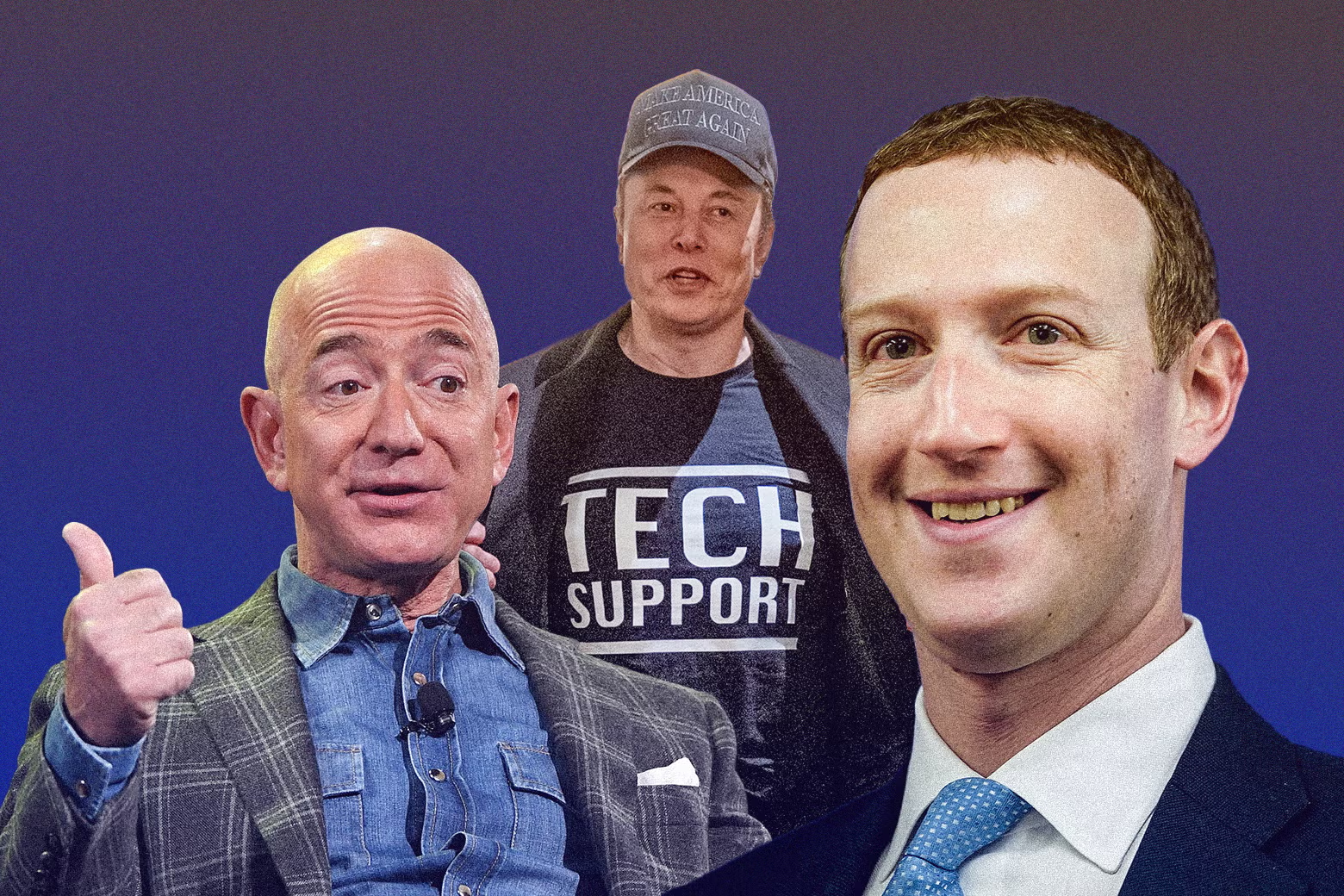
At a time where Musk, Bezos, Zuck and countless other ultra-wealthy tech and finance bros revel in their elitist, vulgar, arrogant lifestyles, he is a reminder of when the tech industry consisted of a few people trying stuff they hoped could help millions grow, express and explore their lives … which is a world away from where we are today, where the tech industry seems to be a few people designing products that enable them to control, contain and restrain millions for their own, fucked-up benefit.
So thank you Mr Woz, you’ve just proved you don’t have to be a prick to be rich.
It just feels that way.
Filed under: 2026, A Bit Of Inspiration, Advertising, Agency Culture, Attitude & Aptitude, Colenso, Collegues, Creative Brief, Creative Development, Creativity, Perspective, Planners, Planning, Point Of View, Process, Provocative, Relationships, Resonance, Respect, Strategy, Technology

A few months ago, the lovely James Welch [stupidly] invited me to have a chat about my perspectives on creativity, technology and process.
Why? I have no idea … maybe he was being charitable.
Whatever the reason it ended up – surprise, surprise – being a ramble about why I’m a nightmare to work with, an ‘acquired’ taste and absolutely not an idea megalomaniac.
The good news is only one of these character evaluations came from James … which, on second thoughts, may not be such good news after all.
Anyway, I thought I’d post it …
Not because I have a career death wish, but because if someone out there is finding it hard to sleep, listening to it will help them drift off in no time … albeit having to endure some horrific nightmares along the way.
Not because of what I say – even if some of the perspectives are pretty bleak – but because you’ll hear my dulcet tones saying it.
You can watch it here.
Don’t say I didn’t warn you …
Filed under: 2026, A Bit Of Inspiration, Agency Culture, Apathy, Aspiration, Attitude & Aptitude, Comment, Confidence, Content, Context, Corporate Evil, Corporate Gaslighting, Curiosity, Effectiveness, Efficiency, Egovertising, EvilGenius, Experience, Facebook, Influencers, Leadership, Management, Marketing, Marketing Fail, Marketing Science, Perspective, Planning, Point Of View, Popularity, Relationships, Relevance, Reputation, Research, Resonance, Respect, Ridiculous, Strategy, Stubborness, Technology, Toxic Positivity, Trust, Truth

When I was growing up there was a newspaper cartoon called ‘Andy Capp’.
Andy was a cliche of the working-class – albeit he never actually works – and lives in Hartlepool in the North East of England.
Andy is married to his long suffering wife, Flo – and despite her working – they are almost on the verge of poverty because apart from Andy being unemployed, he lacks any motivation and thinks he can ‘beat the system’ because of his smarts.
By that, think early stage manosphere but replacing the sexualization of women with more pure sexism.
Anyway, the reason I say this is because I remember one cartoon where Flo told Andy that they were in debt to the tune of £1000.
To which Andy replied something like:
“I told you Flo, if you owe £100 you’re a failure. If you owe £1000 you’re an entrepreneur. If you owe a £10,000 you’re a businessman and if you owe £1,000,000 you’re a government. So what this means Flo, is we’re on the way up!”
I don’t know why I remember that cartoon among the millions of things I’ve seen over the years – but it has always left a lasting impression on me, which may explain why I’ve tended to only seek – or listen to – the advice I’ve got from people who either failed trying or succeeded by doing. Sounds obvious doesn’t it? Yet everyday I read/hear/watch people spouting unsolicited advice about subjects they have almost zero right or credibility to do – mistaking opinion as fact, interest as knowledge, knowledge as expertise or ego as cleverness.No wonder a famous football manager once told me to always learn from winners, not players.
Look, I get we all do this to some degree, but there’s a big difference between spouting an opinion or perspective and acting like you’re the indisputable, all-knowing, God-of-all.

The point is, regardless what Andy Capp says, we would not take his proclamations as fact.
We might accept it’s what he thinks is fact, but not what is true for all.
And yet, more and more, I’m witnessing business blindly follow the statements and proclamations of people who are the real-life, modern version of Andy Capp.
Kinda.
Because while they DO have jobs … and while they have even been successful in them … they are now telling people how to succeed in areas they have absolutely no right to talk about.
Not just because many have never worked in those areas, but they have a track record of making terrible choices when developing ideas outside of their core area of knowledge.
Enter Mark Zuckerberg.
I’m not doubting he’s smart.
I’m not doubting he loves technology.
I’m not even doubting his successes.
However, why are so many people listening [and investing] in his version of the future when not only is it designed around his ego and need for power and control – not to mention his desperation to be talked about in the same breath as Steve Jobs – this is a person who spent/blew/lost US$80 BILLION on the Metaverse??
EIGHTY. FUCKING. BILLION. DOLLARS.
I get innovation is expensive.
I appreciate all technology needs time to evolve.
I acknowledge that I have two of their Quest headsets.
But 80 billion?
To put it in context, the iPhone is said to have cost anywhere between $150 million and $3.2 billion. The creation of Google Maps is said to have cost around $1 billion to initially develop. Even the A380 aircraft – the biggest passenger aircraft in the history of aviation – ‘only’ cost around $25-35 billion to build.
And to add even more context …
80 billion dollars is the equivalent of being the 90th placed country in the World by GDP.
OK, so Zuck’s 80 billion was spent over a long period of time compared to how GFP figures are calculated, but still …
In fact, this suggests Zuck is someone who stubbornly believes he is always right.
Or at the very least, refuses to acknowledge where things aren’t working or where things need improving.
Sadly, we see this same sort of arrogance in our industry …
Where someone is successful in a particular disciple or with a particular agency or with a particular piece of work or with a particular promotion… and then suddenly, they believe they are more knowledgable, more successful and more authoritative than every other person in every other industry regardless of their actual level of experience and expertise.
And what is worse is they get away with it …
Because like Zuck, too many people hang onto their words like gospel, even though in many ways they’re speaking the same delusional clap-trap as Andy Capp, which suggests 2 uncomfortable truths.
1. The real problem with ego is not the person spouting the nonsense, but the people who choose to believe loud confidence over real experience.
2. Andy Capp may have been right because it does seem in business. ‘the more you lose, the more people believe you’re a success’.

Filed under: 2026, A Bit Of Inspiration, Apathy, Attitude & Aptitude, Banks, Brand, Brand Suicide, Clients, Comment, Communication Strategy, Consultants, Corporate Evil, Corporate Gaslighting, Embarrassing Moments, Management, Marketing, Marketing Fail, Mediocrity, Microsoft, Money, Perspective, Process, Relationships, Reputation, Standards, Stupid, Technology
Over the 20 years of writing this blog, I’ve written a bunch of posts about corporate stupidity.
But of all the things I’ve seen or been exposed to, one act stands above all: when they try to gaslight their customers into believing the removal of a product and/or service, is a demonstration of how much they value and care about their customers.
We’ve seen it with ANZ Bank … when they tried to say reducing bank account interest to basically nothing, was their way of aiding financial responsibility.
We’ve seen it with NIKE … when they claimed the best way to serve their customers was to stop customers being able to order NIKE products from overseas and closing down their app.
And now this …

Yep … Microsoft are saying that to prove they’re always IMPROVING their Microsoft 365 service – a service millions pay a monthly subscription for – they are going to remove a feature that many people use.
That’s right, contrary to popular interpretation, they have decided improvement means deletion, which begs the question – whose ‘improvement’ are they talking about? Something tells me it’s their bank account.
OK, so they say that many – but not all – of the features are available in other products that you get as part of your subscription, but this is just bullshit.
They don’t tell people what those products are.
They don’t tell people how to use them in a way that will give them what they were using Microsoft Publisher for.
They don’t even fucking help you transfer all your existing Microsoft Publisher documents and files into something you can use – or turn to – later.
Nope … all they do is say, “we’re going to stop putting money into this product, you better save them as pdf’s or you’ll lose them and – while we’re at it – you better learn how to educate yourself and adapt your products so they fit with what we’ve decided you need, even though we never asked you and keep charging you an increased subscription fee.
Surely they know this is the opposite of good service?
Surely they realise this is not ‘improving’ their product?
Surely they understand customers can see through this bullshit?
In some ways I hope they don’t, because while it would mean they’re thick-as-shit, it would also mean they’re at least not trying to gaslight us.
But I am afraid it might be both …
Because Microsoft’s ability to fuck themselves – and their customers – thanks to terrible decisions is legendary.
Windows Phones.
Bing Search.
The killing of Office.
The shit that is Teams.
Skype.
Nokia.
Co-Pilot.
And basically 99% of the UI of 99% of their products.
This is a company that wants us to believe their vision of AI is one that is good for humanity and yet their behavior is more Dictatorship than democracy.
But as I pointed out at the top of this post, they’re not alone. We’re constantly seeing companies attempting to gaslight their customers with claims that by deleting a service, they’re offering a better service … even though they don’t offer an alternative and if they do, it’s either not as good or costs even more.
Which demonstrates 4 things:
Many companies care more about maxing money than doing good things that earn them money.
Many companies are gaslighting themselves more than customers because we sure-as-shit aren’t falling for this rubbish.
Most companies demonstrate the corporate culture is all about managing up rather than doing what is actually right for their customers.
Most companies hire consultancies because they validate their bad behaviour rather than hold them to standards and expectations of customers.
Which is why when a company goes on about how good their NPS score is, remember – it’s coming from a faceless data point, based on an average of other players in their category – rather than the voice of customers and how they evaluate the service in terms of anything and everything they experience and endure in their day.
More proof that there’s lies, damn lies and not just statistics but customer data.