
Filed under: A Bit Of Inspiration, Advertising, Agency Culture, America, Attitude & Aptitude, Authenticity, Brand Suicide, Comment, Communication Strategy, Confidence, Consultants, Creative Brief, Creative Development, Creativity, Culture, Devious Strategy, Diversity, Education, Egovertising, Emotion, Empathy, Equality, Fake Attitude, Focus Groups, Fulfillment, Honesty, Innocence, Innovation, Insight, LaLaLand, Management, Marketing, Marketing Fail, Planners, Planning, Point Of View, Professionalism, Relationships, Relevance, Resonance, Respect
Toxicity.
It’s a great word to describe a terrible thing.
It perfectly captures the strategy so many companies, people, governments have adopted to get ahead regardless of the cost.
But what a cost it is.
As the stories of Corporate Gaslighting highlight, it is destructive, debilitating and harmful and its rightfully being called out more and more.
However one of the byproducts of this rightful shift has been the increasing number of companies and agencies who will only accept ‘the positive’.
I’m not talking about them wanting to offer optimism in a challenging world, I mean they are actively dismissing or ignoring anything that they deem as bringing negativity into the conversation.
Questions about decisions.
Realities about their audiences.
Considerations about the categories.
No … no … no … no … no!!!
It’s the ultimate sign of privilege. Not to mention arrogance. An ability to simply close eyes and ears to the realities millions face every single day, just so they can continue living in their own Disneyland of the mind.
Actually Disneyland isn’t right, because their stories involve struggles and challenges … so we’re talking about organisations who make Disney look negative.
Jesus Christ!!!
And yet in the same breath, they will wax lyrical about wanting to have ‘deeper connections with their customers’ as well as ‘living their brand purpose’.
Of course it’s complete bollocks.
Deeper understanding equates to ‘how can we sell more stuff to them’.
And brand purpose is …. well, you know my view.
Can brand purpose have value?
Absolutely.
But brand purpose isn’t something you can ‘invent’ on a whim.
Nor is it a marketing tool to drive sales.
And it absolutely isn’t about saving the world.
It can be.
For some.
But it probably isn’t for most.

Which is why pharmaceutical companies saying stuff life, ‘We exist to rid the world of pain’ … makes me laugh so much I get a headache.
The reality is pain makes these companies oodles of money. The last thing they will ever want to do is rid the world of it.
And you know what … I’m cool with that.
Pain happens and they help it stop.
Cool.
But to say they want to get rid of it all?
Forever?
Are they forgetting how pain can actually be useful to people.
How it can help us understand our limits?
Can guide us to better decisions?
Without pain, can you imagine the trouble we would be in?
Which all explains why I – and shitloads of the planet – don’t believe a word they say when they, and countless other companies in countless other categories, go on about ‘their purpose’, especially when it’s obviously the total opposite of what funds their business?
And yet this delusional positivity of purpose is everywhere.
And what’s worse is we’re seeing more and more companies and agencies actively celebrate it, encourage it and demand it.
I cannot tell you how many planners I’ve spoken to about not being allowed to bring truth to their meetings and conversations.
I talked a lot about this – and the reasons behind it – in my rant at WARC, but it still blows my mind that companies and agencies expect planners to adopt this approach when it’s literally the opposite of what our jobs are about.
Planners are not blind cheerleaders.
We liberate through filter-free truth.
That means we’re supposed to question, challenge, have a hint of cynicism, push buttons.
Not to be dicks, but to help you be better.
It you want a planner to just accept whatever alternative reality you live in, go hire a bunch of Alexa’s.
You can say as much as you like that …
“We don’t really have competition”.
Or
“We don’t like negative insights”
Or
“We don’t want to talk about negative comments about us”
… but that doesn’t mean we should just accept it.
I don’t get why some people have this belief questioning is wrong.
At its most basic level, questioning is about wanting to understand more and surely that’s a good thing.
And even if we challenge what we’re hearing … it’s not to cause upset, it’s to get to truth.
Real truth, not corporate.
The truth that helps create great work. Not just in terms of creativity and cultural resonance … but commercial value.
If you don’t want to hear that, then frankly, you don’t want to grow. Or evolve. Or do something that can genuinely mean something.
Anyway, the reason for this post is because I was recently talking to a couple of creative mates of mine and they introduced me to the most perfect expression for this new attitude of only wanting and accepting ‘the positive’.
It’s this …

Oh my god, how good is that!!!
I cannot tell you how much I love it.
Not just the expression of Toxic Positivity, but the definition.
“The belief no matter how dire or difficult a situation is, people should maintain a positive mindset. It’s a “good vibes only” approach to life.”
Both are utterly, undeniably, absolutely bloody perfect.
Because both are utterly, undeniably, absolutely bloody true.
When I heard it, it immediately helped explain why I found so many things in LA, so annoying.
Don’t get me wrong, there were amazing people there. And the country is amazing in many ways.
I absolutely feel a deep sense of gratitude for the experience my family and I got to have there.
However quite a lot of people I met had this ability to blatantly ignore reality in favour of repetitively repeating some superficial and delusional positivity while trying to look like they weren’t annoyed when I asked what the hell they were talking about.
Even the mere suggestion that everything was not quite as perfect as they are trying to claim was met with an icy smile.
I think I’ve written about it before, but America taught me the difference between truth and honesty.
For me, truth is often uncomfortable.
It doesn’t mean it’s done to be harmful, but it does force situations to be seen, explored, discussed and dealt with.
But honesty – at least the version of it I experienced in the US – was different.
Honesty there, was truth with so many layers of sugar-coating on it, you didn’t taste any bitterness or sharpness.
What it meant was everything was designed to be easy to swallow … to give the impression of openness without being open.
Silicon Valley are particularly good at this approach.
White people – dealing with issues regarding race – are exceptionally good at this approach.
An ability to ignore reality by communicating an alternative version of it.
One that bursts with positivity and happiness. And if they could add a Unicorn to it, they would.
But it seems Toxic Positivity is becoming more and more prevalent.
And while the picture above shows Zuckerberg, it’s not specifically about him.
It’s about any organisation who deals with the raw realities of life with a thin, pained smile while they slowly and calmly explain to you everything is great and everything their company does is great and to even suggest otherwise – even if it comes from a desire to help make things better – is an act of intolerable aggression.
As much as toxic negativity is a dangerous act, so is toxic positivity.
It denies the truth for the people who need it the most.
And while I get why some companies would rather not deal with that, actively shutting it down to spout some inane and delusional ‘happy clappy’ message is equally as destructive, debilitating and harmful as it’s more negative cousin.
The reality is truth and transparency makes things better.
Nothing shows greater respect than giving someone objective truth for the single reason you want them to succeed more powerfully.
I appreciate it might not always be easy, but it’s always worth it.
Filed under: A Bit Of Inspiration, Advertising, America, Apple, Attitude & Aptitude, Audio Visual, Australia, Authenticity, Business, Chaos, Charinee, China, Chinese Culture, Colenso, Comment, Confidence, Creative Development, Creativity, Culture, Differentiation, Diversity, Emotion, Empathy, England, Equality, Experience, Facebook, Innovation, Insight, London, Management, Marketing, New Zealand, Paula, Planners, Planning, Point Of View, Politics, Relevance, Resonance, Rodi, Ros, Shanghai, Singapore, The Kennedys, Wieden+Kennedy
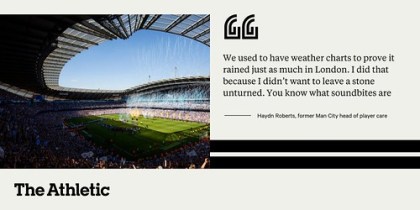
I recently saw the above quote in The Athletic magazine.
The idea that Manchester City – albeit during their less successful period – had to provide ‘rain charts’ to show potential signings that their city was not wetter than London surprised me.
Then I came to my senses.
Society has an incredible knack of trying to lift themselves up by putting others down.
Obviously racism is the work example of this, but we do it everyday in lots of little ways.
From blanket attitudes such as …
“People from the North are backwards”.
To city affirmations such as …
“Manchester is the musical capital of England”.
To hierarchy comparison such as …
“I may be from Nottingham but at least I’m not from Derby”.
It’s not only bollocks, it’s also often stated by people who have never gone anywhere near the cities/countries they are negatively judging. Now I know people will say it’s all a bit of a joke – and I appreciate between mates, it can be – but there’s a lot of perceived truth in those sorts of statements, which has been exploited by all manner of organisations, especially politics.
When I lived in China, I was shocked how hard it was to recruit people from outside of Asia to come and work at Wieden+Kennedy.
OK, it may have been because they didn’t want to work with me … but even then, the amount of people who started off claiming to be interested and then said ‘it wasn’t for them’, was incredible. [Though maybe you will still find it understandable. Bastards. Ha]
There was a time where I almost gave up wanting to hire people from outside the region due to it being so much hassle. But the reality was I always felt it important to have a real mix in the gang. Sure, the vast majority of them had to be from the country/region – but by incorporating people from outside of it, I felt it created a tension that led to better and more provocative thinking. In addition, it could also help stop the blind and blinkered views we kept seeing and hearing from the West … because the more Westerners we got to experience the crazy, infectious magic of the nation, the more positive voices we would infect the rest of the world with.
But many people we talked to weren’t interested in changing their blinkered opinion.
So many didn’t even bother to investigate more about China, they were just happy to keep making their false judgements.
Oh they were all very happy to work for Wieden+Kennedy, they just didn’t want it to be in China and would often say, “but if you could connect me to people in London/Portland/NY/Amsterdam” etc.
And if they were really interesting and had a valid reason to not leave their country, I would.
Didn’t happen often.
I find it amazing that people – especially planners – don’t want to explore the World.
Planners go on about curiosity but what they mean is they are curious under certain conditions of personal comfort.
Behind a desk.
Surrounded by people and things they know.
Never venturing outside of the bubble they’ve created.
Of course not everyone is like this, but there’s a lot who are. Viewing the world and passing judgement on it via Twitter rather than experience.
In the case of China – as with anywhere I’ve lived – if the issue became about the country we were in, it probably wasn’t going to work. Of course it was OK to have concerns and questions, but if I sensed you saw it as a hardship rather than an opportunity or you thought you knew everything when you would have to relearn everything, you were not going to be someone I wanted on the team.
I was, and still am, eternally grateful to everyone I’ve had the honour to work with – and I’ve been incredibly fortunate with the incredible and diverse talent I’ve inherited and nurtured – however those in China will always have a unique place in my heart.
Because whether they were from China, Asia or further afield, all of them knew what they were taking on with the job. Not just in terms of the standards and expectations of Wieden+Kennedy, but the inherent perceptions, prejudices and lies that existed in society – and the ad industry as a whole – towards China and Asia.
And it’s for this reason that I fucking loved seeing them do work others could only dream about, especially when the industries perception was ‘China doesn’t do great work’ or ‘there’s no good planning in Asia’ … often muttered by people who have neither been to China or done great work.
But even that doesn’t make me as happy as seeing where they have all ended up …
Not just in terms of the level they’re at – from running departments, big pieces of business or companies – but the actual organisations they work with or have worked with.
Nike. Ideo. Tik-Tok. Wieden. Mother. 72. Anomoly. Supreme. Playstation. Bill & Melinda Gates Foundation. Facebook. Google. Net-A-Porter. Instagram.
Not just in China but in countries that include America, Taiwan, Holland, UK, Singapore and Australia. Not forgetting the mob who decided to start their own thing and are now working on a bunch of fascinating projects from gaming to research.
I’m not just proud of them, I’m excited for them … because I truly believe they will do stuff that is interesting, intriguing and valuable for the rest of us.
And while most of their achievements are down to their talent and graft, another part is because of what China gave them.
Unique knowledge, experience and understanding of people and situations.
Some will never understand that.
Some will never value that.
But for those who were there – and the companies who hired them – they absolutely do.
Because while some make choices based on not wanting to leave things behind, this group of wonderful fools made their decisions based on what they could gain … and they didn’t need a rain comparison chart to convince them.
Thank you to all of them.
Thank you to anyone who runs towards the challenge not the comfortable.
Filed under: Attitude & Aptitude, Audio Visual, Authenticity, Comment, Confidence, Creativity, Culture, Design, Emotion, Empathy, Gaming, Marketing, Music, Social Divide, Social Media, Technology

The quote at the top of this page is what Frank Sinatra said about Elvis Presley.
If anything was going to turn youth towards the new musical force of the King, it was going to be comments like that.
But what I find interesting is the ad industry should understand this point more than most … however, I’m not sure we do anymore.
We appear to take more delight in being accurate than being exciting.
Now I appreciate this makes me sound like an old bastard but hang on for a second …
What I find interesting – at least where music is concerned – is that in the past, it was ‘the establishment’ who were frightened of the new and misunderstood, but that seems much less the case these days.
If anything, the establishment are bored nothing is scaring them.
Now there are some explanations for this …
Some of it is because of how the music industry has changed …
Rather than breaking new talent, they’re much more interested betting on certainties, because there goal is for lowering risk not pushing things forward. [Hence their appropriation of TikTok to flog back-catalogue tracks]
Some of it is because technology has allowed music to get ultra niche …
Thanks to music streaming platforms, people can now choose the genres they like and pretty much filter out everything else. What this means is we can kid ourselves into believing there’s less new dangerous music being created when the reality is we’re keeping it out rather than welcoming it in. Add to that the decline of radio – which was a central and universal place where a lot of music discovery took place – and we are actively cutting ourselves off from the new and uncomfortable.
Finally, some of it is because the power of music is not the cultural force it once was …

Don’t get me wrong, music is still ultra powerful, but in some ways, it seems to have gone from being at the forefront of culture to the background of it. Some will say that has always been the case – the ‘soundtrack to your life’ – but for people who have always lived for music, it was rarely just an accompaniment to whatever you were doing.
For me, a lot of the ‘danger’ that used to be synonymous with music has gone into gaming.
When Grand Theft Auto came out, it was almost like punk in the 70’s.
A game both universally loved and hated for what it represented.
Rather than trying to be something for everyone, it shamelessly wanted to be everything to someone … and because of the shifts in culture, technology, media, business model and price points, it meant it could be a very lucrative business to be in .
Of course, like all industries, too many companies simply try to jump on whatever bandwagon is cool in that moment … but for me, if you’re looking for the new rock n’ roll, it’s in gaming.
That does not mean dangerous music doesn’t exist.
But it’s power to change culture is not what it once was.
It’s more likely to be found in a game rather than us discovering a new artist.
Which reveals the dirty little secret about people.
The real reason people this there is a ‘lack of danger’ in music is because we’re lazy.
In the past, we would crash into it thanks to mass radio and media – but now, with everything at our command – it requires us to actively put ourselves out there to find it and frankly, we don’t want to.
For all the brilliant things technology can do for us, it has made us lethargically comfy.
We want everything on a plate.
We don’t want to lift a finger.
And while tech could also help overcome this, it’s been designed to satisfy not aggravate … which is why the only way you’ll find the dangerous edges is if you walk towards it rather than expect it to come to you.
It’s something adland needs to remember, because while some may say ‘exciting is indulgence’, it’s got more economic and cultural power than being ‘accurate’.
Filed under: A Bit Of Inspiration, Advertising, Agency Culture, Attitude & Aptitude, Authenticity, Comment, Confidence, Creativity, Culture, Cunning, Devious Strategy, Egovertising, Emotion, Empathy, Food For Thought, Health, Honesty, Influencers, Insight, Management, Marketing, Marketing Fail, Perspective, Prejudice, Relevance, Resonance, Social Commentary, Social Divide, Social Media, Standards

I’ve been watching a lot of movies that made a big impression on me in the late 80’s/early 90’s.
What a massive mistake.
Apart from Die Hard, Terminator and Point Break … everything else has been pretty horrific.
Seriously, either we had really, really, really low standards back then, or someone was putting something in the water.
Face/Off, Bad Boys and The Rock are particularly bad.
I LOVED those movies when I was younger. I thought they were amazing … but zoom forward 30 years and you want to scrub your eyes and brain with a wire brush.
It’s not the bad effects – I can understand them being rubbish – it’s everything else.
The lack of subtlety. The horrific dialogue. The insane levels of over-acting.
It is obvious that directors back then thought audiences were as thick as shit because the way they signpost every moment in the movie with overt ‘clues’ is insane.
From clunky dialogue that attempts to explain the implausible, to off-centre camera angles to highlight the ‘bad guy’, to music that blatantly tries to communicate how you’re supposed to feel or what you should be ready to experience.
One of the worst of all the moves I’ve seen recently is the 1991 Julia Roberts movie ‘Sleeping With The Enemy’.
I remembered this movie as one that tackled domestic violence at a time where it was hardly ever discussed.
That might be the only bit of it I remembered correctly.
Quite simply, it’s pants.
Filled with more holes than Edam cheese and more over-acting than an episode of ‘Crossroads’ from the 70/80′ … the only positive elements are the name of the film, Julia Roberts amazing smile and the house that features heavily in it.
What makes it all worse is the trailer doesn’t give any of that away.
I know trailers are designed to do exactly that, but the difference between what they set up and what you get is dramatic.
Here’s the trailer.
OK, so you either have to trust me this is setting you a false experience or you have to watch the movie for yourself and know it with all certainty … but none of this is actually the point of this post.
You see when I watch movies, I have this annoying habit of having to investigate their history while watching it.
The thing that caught my eye when I was watching Sleeping with the Enemy was that house.

Look at it.
So grand. So imposing. So much a symbol of wealth.
And while I saw places like that when I lived in the US, I was surprised to learn it was made just for the movie.
Of course I know this happens, but they tend to be on a set, not on a real beach … but here we were, with that exact situation.
And while it looks the home of the wealthy from the front, when seen from behind – it left a different impression.

That’s right, it looks like the sort of rubbish they used to make on Blue Peter with some cardboard and sticky black plastic.
And while this shouldn’t surprise me, it does highlight how much of life is an illusion.
From the social media we read to the pitches we embark on to the relationships we forge to the jobs we covet.
Of course, not everything or everyone is like this.
Some are like the famous Steve Jobs quote, “paint behind the fence”. … where their standards, values and attitude means they will do things others may not ever know or see, but is important to them as it not only gives them confidence of a job well done but let’s them feel they’re working for a company they can believe in.
However they are sadly the exception, even if they should be everyone’s ambition.
So as we enter 2021 with our hopes and dreams, it may be worth remembering so much of life is like the Sleeping With The Enemy house. Where what we are asked to see is not a true indication of what it going on.
And while that doesn’t mean it’s all bad, it does mean you can go into things with open eyes, you can avoid disappointment, you can set some boundaries, you can identify the real opportunity that will excite you, you can stop feeling bad if you have questions or doubts and you can be OK if you’re not living up to what others claim they’re living up to.
Because when we talk about a healthy work/life balance, it’s worth remembering it’s not just about time, it’s about attitude.
Filed under: A Bit Of Inspiration, Advertising, Attitude & Aptitude, Audio Visual, Authenticity, Chaos, China, Colenso, Comment, Confidence, Craft, Creativity, Culture, Emotion, HHCL, Imagination, Innovation, Insight, Marketing, Marketing Fail, Martin Weigel, Perspective, Planners, Planners Making A Complete Tit Of Themselves And Bless, Planning, Point Of View, Relevance, Resonance, Shanghai, The Kennedys, The Kennedys Shanghai, WeigelCampbell, Wieden+Kennedy
A while back, I did a presentation for the Brazilian APG about the dangers of perfect.
Or more precisely, the boredom of it.
It was my usual rambling mess of random pictures that goes off on tangents a protractor would find hard to calculate … but I still liked the underlying point that perfection stops possibilities whereas acts others may view as stupid … creates them.
[If you’re mad, you can see a static version of the presentation here]
I say I liked the underlying point until I saw this.
I really, really like this.
I love the idea that flaws help us connect.
I love that imperfection can make us feel normal. That it is something to aspire to.
Of course, the reality is perfection is just an illusion.
One persons definition of what is the ultimate expression of an idea.
A temporary moment, where they believe nothing better has been explored or revealed.
The problems start when that definition starts being challenged.
While some embrace it – seeing it as a way to push the boundaries of what they thought was possible – many fight it.
Using their definition to control, limit or devalue the work of the challengers.
Sometimes it’s due to ego.
Sometimes it’s due to money.
But everytime it aims to oppress rather than liberate.
It’s happening everywhere.
From technology processes to agency ‘proprietary’ tools.
And while there is a lot to be said for being proud of what you have done, when you use it to stop people creating their own version, it’s not.
I’ve seen too many people in too many companies follow the orders of their bosses simply because it’s easier to do that. Where they know expressing a different point of view will be seen as an attack rather than an attempt for everyone to be even better.
So while perfect might be nice and shiny and make you feel good, it also has the power to stop progress.
Or as the brilliant chart at the top of this post states, stop feeling you can relate.
Not because it’s so far ahead, but because of the speed society evolves, it’s too far behind.