
Filed under: A Bit Of Inspiration, Advertising, America, Apple, Attitude & Aptitude, Audio Visual, Australia, Authenticity, Business, Chaos, Charinee, China, Chinese Culture, Colenso, Comment, Confidence, Creative Development, Creativity, Culture, Differentiation, Diversity, Emotion, Empathy, England, Equality, Experience, Facebook, Innovation, Insight, London, Management, Marketing, New Zealand, Paula, Planners, Planning, Point Of View, Politics, Relevance, Resonance, Rodi, Ros, Shanghai, Singapore, The Kennedys, Wieden+Kennedy
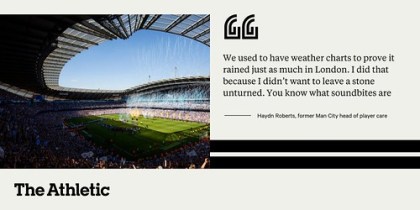
I recently saw the above quote in The Athletic magazine.
The idea that Manchester City – albeit during their less successful period – had to provide ‘rain charts’ to show potential signings that their city was not wetter than London surprised me.
Then I came to my senses.
Society has an incredible knack of trying to lift themselves up by putting others down.
Obviously racism is the work example of this, but we do it everyday in lots of little ways.
From blanket attitudes such as …
“People from the North are backwards”.
To city affirmations such as …
“Manchester is the musical capital of England”.
To hierarchy comparison such as …
“I may be from Nottingham but at least I’m not from Derby”.
It’s not only bollocks, it’s also often stated by people who have never gone anywhere near the cities/countries they are negatively judging. Now I know people will say it’s all a bit of a joke – and I appreciate between mates, it can be – but there’s a lot of perceived truth in those sorts of statements, which has been exploited by all manner of organisations, especially politics.
When I lived in China, I was shocked how hard it was to recruit people from outside of Asia to come and work at Wieden+Kennedy.
OK, it may have been because they didn’t want to work with me … but even then, the amount of people who started off claiming to be interested and then said ‘it wasn’t for them’, was incredible. [Though maybe you will still find it understandable. Bastards. Ha]
There was a time where I almost gave up wanting to hire people from outside the region due to it being so much hassle. But the reality was I always felt it important to have a real mix in the gang. Sure, the vast majority of them had to be from the country/region – but by incorporating people from outside of it, I felt it created a tension that led to better and more provocative thinking. In addition, it could also help stop the blind and blinkered views we kept seeing and hearing from the West … because the more Westerners we got to experience the crazy, infectious magic of the nation, the more positive voices we would infect the rest of the world with.
But many people we talked to weren’t interested in changing their blinkered opinion.
So many didn’t even bother to investigate more about China, they were just happy to keep making their false judgements.
Oh they were all very happy to work for Wieden+Kennedy, they just didn’t want it to be in China and would often say, “but if you could connect me to people in London/Portland/NY/Amsterdam” etc.
And if they were really interesting and had a valid reason to not leave their country, I would.
Didn’t happen often.
I find it amazing that people – especially planners – don’t want to explore the World.
Planners go on about curiosity but what they mean is they are curious under certain conditions of personal comfort.
Behind a desk.
Surrounded by people and things they know.
Never venturing outside of the bubble they’ve created.
Of course not everyone is like this, but there’s a lot who are. Viewing the world and passing judgement on it via Twitter rather than experience.
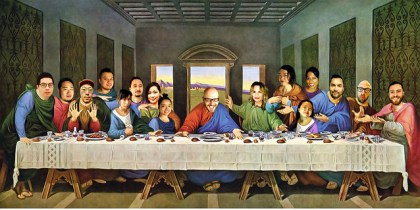
In the case of China – as with anywhere I’ve lived – if the issue became about the country we were in, it probably wasn’t going to work. Of course it was OK to have concerns and questions, but if I sensed you saw it as a hardship rather than an opportunity or you thought you knew everything when you would have to relearn everything, you were not going to be someone I wanted on the team.
I was, and still am, eternally grateful to everyone I’ve had the honour to work with – and I’ve been incredibly fortunate with the incredible and diverse talent I’ve inherited and nurtured – however those in China will always have a unique place in my heart.
Because whether they were from China, Asia or further afield, all of them knew what they were taking on with the job. Not just in terms of the standards and expectations of Wieden+Kennedy, but the inherent perceptions, prejudices and lies that existed in society – and the ad industry as a whole – towards China and Asia.
And it’s for this reason that I fucking loved seeing them do work others could only dream about, especially when the industries perception was ‘China doesn’t do great work’ or ‘there’s no good planning in Asia’ … often muttered by people who have neither been to China or done great work.
But even that doesn’t make me as happy as seeing where they have all ended up …
Not just in terms of the level they’re at – from running departments, big pieces of business or companies – but the actual organisations they work with or have worked with.
Nike. Ideo. Tik-Tok. Wieden. Mother. 72. Anomoly. Supreme. Playstation. Bill & Melinda Gates Foundation. Facebook. Google. Net-A-Porter. Instagram.
Not just in China but in countries that include America, Taiwan, Holland, UK, Singapore and Australia. Not forgetting the mob who decided to start their own thing and are now working on a bunch of fascinating projects from gaming to research.
I’m not just proud of them, I’m excited for them … because I truly believe they will do stuff that is interesting, intriguing and valuable for the rest of us.
And while most of their achievements are down to their talent and graft, another part is because of what China gave them.
Unique knowledge, experience and understanding of people and situations.
Some will never understand that.
Some will never value that.
But for those who were there – and the companies who hired them – they absolutely do.
Because while some make choices based on not wanting to leave things behind, this group of wonderful fools made their decisions based on what they could gain … and they didn’t need a rain comparison chart to convince them.
Thank you to all of them.
Thank you to anyone who runs towards the challenge not the comfortable.
Filed under: Attitude & Aptitude, Audio Visual, Authenticity, Comment, Confidence, Creativity, Culture, Design, Emotion, Empathy, Gaming, Marketing, Music, Social Divide, Social Media, Technology

The quote at the top of this page is what Frank Sinatra said about Elvis Presley.
If anything was going to turn youth towards the new musical force of the King, it was going to be comments like that.
But what I find interesting is the ad industry should understand this point more than most … however, I’m not sure we do anymore.
We appear to take more delight in being accurate than being exciting.
Now I appreciate this makes me sound like an old bastard but hang on for a second …
What I find interesting – at least where music is concerned – is that in the past, it was ‘the establishment’ who were frightened of the new and misunderstood, but that seems much less the case these days.
If anything, the establishment are bored nothing is scaring them.
Now there are some explanations for this …
Some of it is because of how the music industry has changed …
Rather than breaking new talent, they’re much more interested betting on certainties, because there goal is for lowering risk not pushing things forward. [Hence their appropriation of TikTok to flog back-catalogue tracks]
Some of it is because technology has allowed music to get ultra niche …
Thanks to music streaming platforms, people can now choose the genres they like and pretty much filter out everything else. What this means is we can kid ourselves into believing there’s less new dangerous music being created when the reality is we’re keeping it out rather than welcoming it in. Add to that the decline of radio – which was a central and universal place where a lot of music discovery took place – and we are actively cutting ourselves off from the new and uncomfortable.
Finally, some of it is because the power of music is not the cultural force it once was …

Don’t get me wrong, music is still ultra powerful, but in some ways, it seems to have gone from being at the forefront of culture to the background of it. Some will say that has always been the case – the ‘soundtrack to your life’ – but for people who have always lived for music, it was rarely just an accompaniment to whatever you were doing.
For me, a lot of the ‘danger’ that used to be synonymous with music has gone into gaming.
When Grand Theft Auto came out, it was almost like punk in the 70’s.
A game both universally loved and hated for what it represented.
Rather than trying to be something for everyone, it shamelessly wanted to be everything to someone … and because of the shifts in culture, technology, media, business model and price points, it meant it could be a very lucrative business to be in .
Of course, like all industries, too many companies simply try to jump on whatever bandwagon is cool in that moment … but for me, if you’re looking for the new rock n’ roll, it’s in gaming.
That does not mean dangerous music doesn’t exist.
But it’s power to change culture is not what it once was.
It’s more likely to be found in a game rather than us discovering a new artist.
Which reveals the dirty little secret about people.
The real reason people this there is a ‘lack of danger’ in music is because we’re lazy.
In the past, we would crash into it thanks to mass radio and media – but now, with everything at our command – it requires us to actively put ourselves out there to find it and frankly, we don’t want to.
For all the brilliant things technology can do for us, it has made us lethargically comfy.
We want everything on a plate.
We don’t want to lift a finger.
And while tech could also help overcome this, it’s been designed to satisfy not aggravate … which is why the only way you’ll find the dangerous edges is if you walk towards it rather than expect it to come to you.
It’s something adland needs to remember, because while some may say ‘exciting is indulgence’, it’s got more economic and cultural power than being ‘accurate’.
Filed under: A Bit Of Inspiration, Advertising, Agency Culture, Attitude & Aptitude, Audio Visual, Authenticity, Brand, Brand Suicide, Comment, Confidence, Consultants, Content, Creative Brief, Creative Development, Creativity, Culture, Dad, Design, Digital, Distinction, Emotion, Empathy, Experience, Finance, Honesty, Imagination, Insight, Internet, Legend, Love, Loyalty, Management, Metallica, Money, Planning, Point Of View, Positioning, Relevance, Resonance, Respect, Rick Rubin, Standards

I am a massive fan of Rick Rubin.
Actually that’s not quite right.
I am a massive disciple of Rick Rubin.
I think he is incredible. His ability to help others express their most powerful creative voice is amazing.
So much of this is down to how he see’s his role.
Not as a music producer, but as a sophisticated fan.
Someone who wants the band he loves to be their shameless best.
Protecting them from ever feeling they have to compromise on who they are or what they want to say because he fiercely believes the greatest return comes when you express your honesty and authenticity rather than play to be liked.
It’s why the artists he’s worked with reads like a ‘who’s who’ of the most culturally significant artists of their time.
Those who either defined a genre or validated it.
LL Cool J
Run DMC
The Beastie Boys
Slayer
Red Hot Chili Peppers
Tom Petty and the Heartbreakers
Rage Against The Machine
The Black Crowes
The Dixie Chicks
Johnny Cash
Look at that list. Look at it.
Hip Hop. Rap. Rock. Metal. Thrash. Blues. Country. Funk.
No one should be able to be so successful with that range of genre and artist.
It’s hilarious and yet there are so many more artists I could mention because for almost 4 decades, Rubin has helped artists not only express their truth but recognise the economic power from doing so.
He has created icons.
He has revived icons.
He has shaped, pushed and provoked culture.
He has influenced, shaped and changed music forever.
When we hear agencies talk about ‘creating culture’, most haven’t come anywhere close to what he has helped create.
But what I love the most about Rubin is how he decides who he is going to work with.
Basically his entire decision making process is based on one simple process.
Taste.
If Rubin likes what he hears, then he’s up for it.
It doesn’t matter whether it has any connection to anything he’d done before, he see’s it less about the music and more about the artist needing help to express … find … or rediscover their voice.
Not their singing voice. Their soul.
It’s not that far off what we as an industry say we do for brands.
Except we’re increasingly forgetting what brand is because we sacrifice it time and time again for the quick win.
I get it, we’re fighting for our lives … but in our quest to show we have value, we’re destroying what makes us valuable.
Oh I know we won’t admit that.
We’ll point to words like purpose, experience and membership as proof ‘we get it’.
We’ll say they’re representative of modern brand building and all else is old.
We’ll show 1000 page decks that show how our unique processes ‘guarantee’ success.
And some clients will buy this, which means we can go away thinking we’ve got it all sorted out and we’re legends.
Except we haven’t and we aren’t.
Yes, all those elements play an important role in building a modern brand … however they’re never the lead, always a supporting actor because …
Sales without distinction doesn’t build a brand.
Purpose without sacrifice doesn’t build a brand.
Data without understanding doesn’t build a brand.
User journeys without nuance doesn’t build a brand.
Eco-systems without an idea doesn’t build a brand.
Personalisation without being personal doesn’t build a brand.
Wanting to be something to everyone rather than everything to someone doesn’t build a brand.
The harsh reality is we’re dangerously close to confusing commoditisation with brand building. Of course this is not all our fault, but continuing to perpetrate it, most definitely is.
While I appreciate Rick Rubin didn’t mean the photo/quote that appears at the top of this page to be interpreted this way … he pretty much sums up how to build truly distinctive and definitive, culturally resonant brands.
And he does it in 10 words.
TEN!!!

And that’s part of Rubin’s magic.
He understands how to get to the simplest expression of his viewpoint, because he knows the simpler it is, the less obstacles to deal with.
Simple lets truth speak and rise.
Simple lets possibilities flourish.
Simple lets distinctiveness be expressed.
Simple is unbelievable power.
Now the irony of simple is it’s not easy to pull off.
Simple is definitely not simplistic. To be simple requires a hard work, experience and confidence … and while as an industry we have known this and advocated this for decades, we seem to have recently decided the opposite – where we celebrate complexity.
What the hell?!
Maybe it’s because we’re making more money from this approach. Or just feel more important. But the endless playbooks, frameworks, processes, tools and strategies we’re producing aren’t building better brands, just bigger obstacles.
Again, there’s a place for them. But the way they’re being used – they’re more like hammers than brushes – forcing them into the process, competing with all around them and ultimately leaving people lost with what they’re following, what they’re building and what they’re actually doing this all for.
As someone recently said to me – someone hugely successful in business – when companies make the solution more complex than the problem, they’re just creating another problem.
Please don’t think this means you skimp on standards or rigour.
If anything, it’s the exact opposite … but because everyone knows what they’re working towards [rather than doing their version of what they think everyone should be working towards], it means they can be sharp and focused and that means your work can be expressed in ways that lift things up rather than bogs them down.
I get some people won’t like this.
I get some people won’t agree with this.
I get some clients would never sign off on this.
But apart from the fact I doubt any of them will have come close to influencing, shaping or creating culture in the same commercially infectious way Rubin has, if they really believe selling the complexity of intelligence is a smarter way to operate, I’ll leave you with something my dad – who was pretty good on this whole intelligence thing – used to say to his lawyers:
“If you have to show how clever you are, you aren’t that smart”.
Filed under: Advertising, America, Apathy, Apple, Attitude & Aptitude, Audio Visual, Authenticity, Brilliant Marketing Ideas In History, Comment, Communication Strategy, Confidence, Consultants, Creative Brief, Creative Development, Creativity, Culture, Customer Service, Differentiation, Distinction, Emotion, Empathy, Experience, Fulfillment, Great Ads In History, Innovation, Insight, Internet, Management, Marketing, Marketing Fail, Nike, Packaging, Perspective, Positioning, Prejudice, Purpose, Relevance, Resonance

I’ve been very fortunate in my career to work with challenger brands.
Some were overtly challenger … some were more in terms of their internal attitude and approach … but in all cases, they were up for a fight and were happy to take it straight to the competitor they wanted to play against.
Now forcing people to pick a side is not a new strategy … it’s been around for ages.
From religions to rock bands to sport to almost everything in-between.
And while some of the challenger brands I’ve worked with over the years became the beast they were created to slay, what united them all wasn’t just their ambition, but their dedication to doing something that fundamentally challenged the convention.
I’m not talking about an ad that said they were different.
Or a single product ingredient that claimed they were different but were still exactly the same.
I’m talking about a fundamental, distinctive alternative to what has been there before.
From features, to behaviours, to values to standards to design.
All in commitment.
Shit or bust.
Now we have a lot of brands today that claim to do that and be that.
Brands that go direct to the customer.
Brands that offer their services on the internet.
In the majority of cases, they’re not real challengers.
They might like to think they are.
The people who led the change probably are.
But having an internet bank that claims to be different but offers exactly the same products and services – albeit with a ‘cool name and choice of ATM card design’ – is not challenging much.
Nor is the 15th razor/toothbrush/haircare company who go direct to their customers.
They’re definitely an alternative, but they’re not a challenger.
In fact, given in many cases, they offer no distinctive element to their product or service to build something bigger than simply supplying razor blades/toothbrushes/haircare products to people at the lowest rate possible, all they’re doing is commoditising themselves to oblivion.
No, challenger brands don’t enter the market with an attitude of ‘minimal viable product’ – which basically translates to “we’re interested to see if it works, but if it doesn’t – no biggie”, they enter it with fully focused, fully engaged commitment.
You can read a lot about these in Adam Morgan’s brilliant book Eating The Big Fish … though, because of when it came out, it only refers to a challenger brands from a certain period of time rather than the ones of the modern era … whether that’s Tony’s Chocolonely, Fenty, Fortnite or even Greta.
But the reason I’m talking about this is because of that picture at the top of the post.
The iconic ‘we try harder’ announcement by Avis.
Maybe the first example where marketing embraced being a challenger.
We forget how impactful this campaign was when it came out in the 60’s.
Back then, the industry was all about superlatives … the biggest, the most successful, the most loved etc etc.
For a brand to come out and say, “we’re not the first choice”, was a big thing.
But this was not a mere marketing trick, Avis did indeed have big ambitions and knew that the only way they stood any chance of making it was if they indeed, ‘try harder’.
From making sure every car was washed before it went out.
Checking that the glove boxes and – because this was the 60’s – ashtrays were emptied.
Customer service people trained to help, not just take your money.
Not having to wait for ages to get given your rental.
All sounds the standard now, but back then? No way.
And on top of that, they then ran ads telling people to complain if they found the experience didn’t match the promise … because they never wanted to be seen as having the passive attitude of a number 1 brand – where their goal is to protect their revenue rather than reward their customers.
Which leads to the point of this post.
This.

Yep, it’s a continuation of the We Try Harder campaign.
Though, calling it a ‘campaign’ cheapens it, because it was their purpose. I don’t mean that in the wank way it is being used today. At no point were Avis saying. ‘We Try Harder To Make The World Better’. No, this was all about them trying harder for them. Which is not only more believable, it had a genuine benefit to the people who used them.
Which leads back to the ad.
Specially, the ad that features the President of Avis’ phone number.
So you can complain.
Directly to them.
Imagine that today?
You can’t can you, because not only do companies – including Avis – give customers who wish to complain the absolute runaround with endless email forms, faceless processes and protocols – all while claiming this is a more ‘helpful and efficient’ process for their customers – but because you don’t feel many companies are really trying harder at all.
Now it’s all about efficiency.
Removal of friction.
Basically making you do it all yourself but charging you as if you weren’t.
Now I have to admit, I don’t know if this ended up being the real President of Avis’ phone number … even though I really hope it was … but I know this ethos drove that brand to continued growth for decades.
Sadly, at some point, it went from purpose to a tagline and then Avis as a cultural force was done.
Which is the big lesson for us all.
Because while few would ever start a company to be like everyone else, the reality is many end up doing just that.
And while we hear people all talking about being the next Apple or Nike, they have to understand you don’t get there with a playbook, you get there with a singular focus on what you believe, what you value and what you are going to destroy to create.
Filed under: A Bit Of Inspiration, Advertising, Attitude & Aptitude, Audio Visual, Authenticity, Chaos, China, Colenso, Comment, Confidence, Craft, Creativity, Culture, Emotion, HHCL, Imagination, Innovation, Insight, Marketing, Marketing Fail, Martin Weigel, Perspective, Planners, Planners Making A Complete Tit Of Themselves And Bless, Planning, Point Of View, Relevance, Resonance, Shanghai, The Kennedys, The Kennedys Shanghai, WeigelCampbell, Wieden+Kennedy
A while back, I did a presentation for the Brazilian APG about the dangers of perfect.
Or more precisely, the boredom of it.
It was my usual rambling mess of random pictures that goes off on tangents a protractor would find hard to calculate … but I still liked the underlying point that perfection stops possibilities whereas acts others may view as stupid … creates them.
[If you’re mad, you can see a static version of the presentation here]
I say I liked the underlying point until I saw this.
I really, really like this.
I love the idea that flaws help us connect.
I love that imperfection can make us feel normal. That it is something to aspire to.
Of course, the reality is perfection is just an illusion.
One persons definition of what is the ultimate expression of an idea.
A temporary moment, where they believe nothing better has been explored or revealed.
The problems start when that definition starts being challenged.
While some embrace it – seeing it as a way to push the boundaries of what they thought was possible – many fight it.
Using their definition to control, limit or devalue the work of the challengers.
Sometimes it’s due to ego.
Sometimes it’s due to money.
But everytime it aims to oppress rather than liberate.
It’s happening everywhere.
From technology processes to agency ‘proprietary’ tools.
And while there is a lot to be said for being proud of what you have done, when you use it to stop people creating their own version, it’s not.
I’ve seen too many people in too many companies follow the orders of their bosses simply because it’s easier to do that. Where they know expressing a different point of view will be seen as an attack rather than an attempt for everyone to be even better.
So while perfect might be nice and shiny and make you feel good, it also has the power to stop progress.
Or as the brilliant chart at the top of this post states, stop feeling you can relate.
Not because it’s so far ahead, but because of the speed society evolves, it’s too far behind.