
Filed under: A Bit Of Inspiration, Advertising, Agency Culture, Apathy, Attitude & Aptitude, Authenticity, Brand, Business, Communication Strategy, Content, Context, Creative Development, Creativity, Culture, Entertainment, Environment, Marketing, Mediocrity, Music, Relevance, Resonance, Respect

Hello daaaaarlings, I’m back.
What an amazing week.
I met so many incredible people and not one of them looked too disgusted at my outfits … except the designer from Celine, but then I was wearing a t-shirt featuring an image of my cat.
She literally asked, “which designer is that” … and when I told her it wasn’t a designer, it was my 16 year old cat, she smiled a smile that failed to convey her utter fear – to which she made her excuses and got the hell away from me, hahahaha.
That aside, the conference was a celebration of creativity and the stories that inspire it … which may explain why I loved the tweet – from Nick Beggs, at the top of this page – so much.
For those who don’t know who Nick is, he’s the virtuoso bass player who was once in the band Kajagoogoo.
This is what Kajagoogoo looked like.

For reference, Nick is the blonde spiky haired guy in the middle.
And for those who don’t know what the ‘Too Shy’ he’s refereeing to is … it’s this.
Oh – and finally – if you’re wondering why I called him a bass playing virtuoso, it’s because of this … playing with another 80’s icon, Howard Jones./font>
But the reason I love this tweet is not because I’m a fan of Nick or Kajagoogoo or even Howard – it’s because of that photo he posted.
Look at it.
A nondescript flat.
Nothing fancy. Nothing grand.
A place like millions all across England.
Filled with everyday people from all walks of life.
Likely struggling to balance the never-ending demands of life.
And yet, in 1982, some young guys got together and wrote one of the iconic songs of the 80’s.
Changing their life and creating a legacy.
And that’s what I think is so fucking fantastic about it …
A reminder that while so many in our industry like to talk about the processes and eco-systems, the reality of creativity is its born from environments – both physical and personal.
We are in danger of forgetting that.
We will be – and are – worse off for following that.
Hiring an ever-ending production line of similar people.
Putting the same set of case-studies on the same pedestals.
Following the same group of ‘best practice’ models that get us to the same places.
Forcing creativity to fit inside structures designed for convenience rather than connection.
People in power valuing duplication, rather than originality.
It’s why creating the conditions for creativity to thrive is not some sort of superficial vanity.
It’s total, fucking sanity.
Filed under: Advertising, Agency Culture, Attitude & Aptitude, Authenticity, China, Chinese Culture, Comment, Content, Context, Corona Virus, Creative Development, Creativity, Culture, Design, Differentiation, Distinction, Effectiveness, Emotion, Entertainment, Environment, Fashion, Imagination, Individuality, Innovation, Leadership, Management, Marketing, Metallica, Perspective, Point Of View, Positioning, Resonance, Respect, Shanghai, Strategy, Technology

I appreciate the title of this post sounds dodgy.
Not to mention that photo. Let’s face it, me and fashion are hardly bedfellows.
But that photo [which is real, by the way] is to celebrate that next week I’m in China to attend the WWD World Fashion Summit.
I know … I know … it all sounds like I’m making something up so I don’t have to write any blogposts next week, but it isn’t.
I am an invited guest at one of the fashion industries most important conferences.
Of course it’s not because of how I dress, but for the work I do for one of my clients … the godfather of global street culture and the founder of the most successful, progressive and innovative luxury [contemporary and street culture] retailers on the planet: SKP and SKP-S.
I wish I could talk more specifically about the work I’ve done for him over the past 3+ years … because it has been some of the most creatively rewarding, commercially informing and artistically collaborative times of my career.
Put simply, he is one of the most audacious people I’ve ever had the privilege of working with.
Even François-Henri Pinault – the CEO of Kering – calls him one of fashions greatest pioneers.
And he is …
Hell, when I met him, one of the first things he said to me was:
“I want people to get used to living on another planet, because one day – based on how we keep treating this one – they’re going to have to do just that”.
Sure, it’s the words only a billionaire can say, but who wouldn’t be captivated by that?
But he’s not crazy …
In fact, the more time I spend with him, the more I recognise his genius.
I could write a 1000 blog posts about what I’ve learned from him …
What real entrepreneurship is.
What true conviction in your beliefs means.
What category disruption and innovation really looks like.
What you do to ensure luxury embraces the influence of street culture.
But that’s maybe for another day. What I will say is that despite being one of the most important and influential figures in fashion, he also loves his anonymity – preferring to make statements through the work he does … from pretty much every up-and-coming street culture brand you can point a stick at … to helping build the next-gen of fashion icons like Fenty and Gentle Monster through to building the most brilliantly bonkers [and most profitable luxury store on the planet] SKP and SKP-S.
[To give you an idea of how bonkers, their new offering in China, features a tapestry of gardens – designed by the architects of The High Line, in NYC – that is ¾ of a mile wide. And the reason they were able to do that is because all the infrastructure has been placed beneath ground, so it’s invisible to the naked eye until you are in the place. And if you think that’s bonkers, every location is wildly different in look and theme … but connected by a unifying story that’s more Marvel than BusinessWeek.]

But if that wasn’t enough, I get to go back to China.
The last time I was there, was Jan 3rd 2020 … just before COVID closed the World.
I think everyone knows what China means to me. It is the most special place in my life.
Yes, I know there’s a bunch of fucked up stuff that happens there, but there’s a bunch of fucked up stuff that happens everywhere … and in my 7+ years of living in Shanghai, I can honestly say I was blessed with generosity, friendship and acceptance.
It’s why I am proud Otis was born there.
It’s why I will challenge any prejudice or ignorance spoken about there.
It’s why I am so happy that I get continue to work with clients who are based there.
Of course, I know a lot will have changed in the intervening 3 years.
We used to say that the speed of China was so fast, that it was like a new generation was born every six months. And while it’s not anywhere like that now, it’s still more dynamic than most countries … which is why it makes perfect sense to hold one of the most important global fashion conferences there.
For all the ‘superficiality’ people say about fashion, I can honestly say that the more I’ve spent deep in the industry, the more inspiring I’ve found it.
The craft.
The imagination.
The focus on society, art and design.
The openness to different influences and ideas.
The desire to continually explore, imagine and challenge.
Or said another way … the stubborn commitment to allowing creativity to thrive, wherever it may take you.
Like with Metallica, this client has invited me to places I never even knew existed, let alone ever imagined I could be.
Magical people … imaginative ideas … insane possibilities …
But what’s made it even more amazing is they have asked me collaborate with these people and ideas … to find new ways to allow creativity to flourish – be it architecture, robots or writing stories that unite different worlds in different ways.

I appreciate it sounds like I’m bragging.
I guess I am.
But the reality is it’s more shock and gratitude.
I do think I am good at what I do, but to have all this – especially at my stage of career – does feel like I’ve won some sort of creative lottery.
And in some ways I have.
But the prize is not simply the work – or the cash – but the reminder …
Because the ad industry often sees creativity only through the lens of ads.
Oh sure, we’ll talk about craft and design, but it tends to always be in the context of communication.
Hell, we bang on about ‘big ideas’ when all we’re really talk about is big ‘advertising’ ideas.
There’s nothing wrong with that … advertising is creative and important.
But creativity is more than ads.
It has the power to shape and influence.
To create new meaning to old things and ignite deep emotions in the new.
It values culture and imagination far more than media channels and eco-systems … which results in the work being far more than ‘packaging’ for selling stuff, but creating the things that are worth buying.
I love the industry I work in. It has given me a life richer than I could ever have imagined. But somewhere along the line, it seems we love everything but the thing we’re supposed to love. Distracted by terminologies and techniques that – ironically – makes more things the same than different.
But fashion isn’t like that.
My client isn’t like that.
Which is why – you will understand – I’m so happy I won’t be here to write any posts for another week.
For once, your gain … is also mine.
So until the week after next, have fun. I know I will be.

Filed under: Advertising, Apathy, Attitude & Aptitude, Brand Suicide, Cannes, Colleagues, Communication Strategy, Content, Context, Creative Development, Creativity, Culture, Effectiveness, Egovertising, Experience, Fake Attitude, Management, Marketing, Marketing Fail, Perspective, Point Of View, Professionalism, Relationships, Resonance, Respect, Standards, Toxic Positivity | Tags: om
Obviously I have a soft spot for Google.
From cynic to Colenso, they’ve been a constant in my professional as well as personal life.
They are intimately involved in so much of what I do every single day and I appreciate the possibilities they have enabled me to embrace because of them existing.
I know … that sounds unbelievably gushing doesn’t it.
That doesn’t mean there’s not stuff that drives me nuts …
From the way some of their products work [Google Slides, I’m looking at you] through to the passive behaviour they are increasingly showing in the face of challenges that their smarts/money/tech could fundamentally change for the benefit of millions – if not billions – of people. However even with all that, it pales into comparison to this:
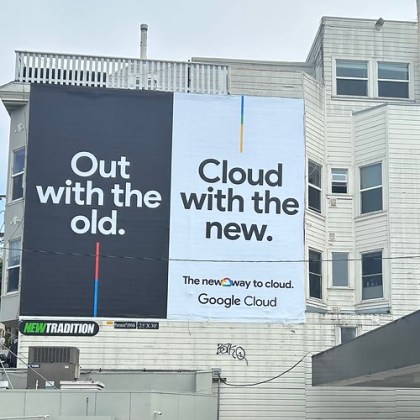
What. The. Hell?
Not only is it an absolutely terrible attempt to make a terrible pun, I still don’t know what ‘the new way to cloud’ is. Or means. Or why I should give a second of attention to it.
For a company so full of smart people, how can this happen?
Seriously, this sort of work does the absolute opposite of what Google want.
It makes people question how smart the company is.
It makes people ask if Google know how to talk to people.
It makes people wonder if Google know how to make tech that understands our needs.
It makes people ask if this is the sort of organisation we should trust to shape our future.
Sure, it’s just a random billboard … but for a brand that once represented humanities hope for ensuring technology enabled and empowered a better, brighter, more equal future for all, this work feels more like a politician pretending to smile while they’re busy oppressing us.
I know this isn’t the case, but bloody hell, it’s rubbish.
Which leads me to this.

I don’t know who is behind it. I don’t know if it’s an agency or an internal group. But I have to believe this was made because senior people mandated it or influenced it. Either directly, or indirectly. Which serves as a really good reminder about the dangers of corporate structures.
As Martin, Paula and I said in our Cannes talk, toxic positivity is ruining brands and people.
The idea that ‘team’ is now interpreted as blind complicity and conformity is insane.
But it’s happening. We all see it or have experienced it.
Worse, there’s an underlying attitude that the only way to get ahead is manage up. What I mean is that rather than do the right thing for your audience, you do the right thing by your boss. Doesn’t matter if it makes no sense. Doesn’t matter if it actively confuses the people it is actually designed to communicate to. As long as it hits the ‘cues’ your boss likes, you’re good.
As I wrote recently, toxic positivity is leading to the systematic destruction of knowledge and experience. Great ideas and people are literally being moved out of organisations to be replaced by conformists and pleasers.
Yes, company culture is important.
It has an incredible power to achieve great things.
But here’s the thing too many companies just don’t seem to get.
If you’re mandating it, you don’t have it.
Because real company culture is born from the people within the company. Yes, the people at the top shape and influence it – often through beliefs and a way to look at the world – but the moment you try to dictate or define it, you lose it.
But here’s the thing …
Even when a company gives you something to believe in, they know the real key is to give every employee the power to feel they can be themselves. That they trust them to want to make things better, rather than break things apart.
Which is why they encourage debate.
They value different opinions and ideas.
Because as long as it’s not in a self-serving, divisive manner … it’s almost the ultimate demonstration you want to help make things better.
There are a lot of companies who get this.
There’s sadly far more who don’t.
And everyone loses because of it. Because if companies stopped thinking of company culture in-terms of efficiency and optimisation – and more about standards and quality control – we would all get to better places faster.
Or at the very least, less ads that say everything by saying absolutely nothing.
Filed under: A Bit Of Inspiration, Advertising, Attitude & Aptitude, Brand, Business, Comment, Communication Strategy, Creativity, Culture, Customer Service, Effectiveness, Food, Loyalty, Management, Marketing, Membership, Relationships, Relevance, Resonance, Respect, Strategy, Trust
So Kevin Chesters recently posted some work from the far distant past.
It was work that I adored at the time and even now, I feel is one of the best pieces of communication ever made.
EVER. MADE.
But it’s not NIKE. Or Apple. Or anything approaching ‘cultural cool’ … it’s for a supermarket.
Oh, but wait … there’s more.
Because it’s not a brand ad – though it does a ton for the brand – it’s a retail ad.
But instead of starbursts and shelf wobblers … it’s a masterclass in craft and smarts. Where the majestic charm and wry humour not only treats the audience with intelligence, but communicates price in a way you see value both in the product and the company selling it.
Regardless of the item.
Regardless of the audience ‘segment’.
Regardless of whether it’s selling food or their loyalty scheme.
It’s incredible and what’s more … it’s from the early 2000’s.
I think.
But despite being almost 20 years old, it’s still one of the best examples of a brand that knows who they are, knows who their audience is and knows the relationship they would like to have with their audience.
More than that, they know the problem they’re solving.
Not just in a general sense … but in terms of the potential barrier for each item.


In a world of wish-standard Nike knockoffs, this is an example of advertising not just communicating, but undeniably contributing to the growth, value and reputation of the company it represents.
When it wants to be – and when it’s allowed to be – this industry can be outstanding.
While we can’t control the standards other parties may demand, we can control what ours are.
Of course, in these ‘procurement-led times’ you could say ‘you get what you pay for’.
And I get that.
But watching the value and standards of what we do fall down a drain doesn’t seem a particularly good business approach.
Which is why I find myself repeating what an old boss of mine used to say to me.
“What happens next is up to us”.
He’s never been more right.
Filed under: Advertising, Attitude & Aptitude, Communication Strategy, Context, Creativity, Culture, Effectiveness, Emotion, Empathy, Honesty, Insight, Loyalty, Management, Marketing, Marketing Fail, Perspective, Professionalism, Relevance, Research, Resonance, Respect, Trust, Truth

Back in 2021 – on April 1 no less, even though it was not a joke – I wrote how I had spoken to a hostage negotiator.
Among the many things he said to me, one that stood out most was this:
“If you have clients that think words – and how you say them – don’t matter, bring them to me. After all, my job is marketing too”.
Of course, the idea hostage negotiating is similar to marketing is absurd … but what I guess they were trying to say is that by understanding the needs, triggers and context of your ‘audience’, you increase the odds of being successful.
Please note the words ‘increasing the odds’.
I say that because the way our industry talks about ‘certainty’ is disturbing.
That doesn’t mean we’re a stupid risk.
Nor does it mean we can’t be more successful than anyone hoped.
But if you’re working with someone ‘guaranteeing’ the outcome, then they’re either downgrading the metrics and criteria for what they classify as success. Messing with the numbers to suit their own needs. Or just bullshiting.
And there’s a lot of bullshitting out there …
Because so much of what we do is only notionally focused on the needs of the audience.
The reality is the vast amount of attention is directed on the wants of our clients.
On one level, I get it. Our job is to help our clients be more successful than they dared imagine. But often we’re not given the chance to do that, because context and criteria has been set. Using data that is has been focused only on the point of purchase … as if there is absolutely no interest whatsoever in who they are, how they feel, the tensions they face and the situations they deal with.
Said another way … how they live, not just how they buy.
And that’s why the comment from the hostage negotiator was really what they thought marketing should be, rather what it often ends up being.
Which is why the real opportunity for us is to learn from them, not the other way around.
Because they’re proof the more you understand your audience – rather than just what you want your audience to do – the more you can make a difference, rather than just make a sale.
To prove that, I encourage you to watch this.
It’s long. But – as is the case with anything you emotionally engage with – it’s worth it.
Especially when you see how much it means to the negotiators. Let alone the hostages.
Which challenges you to think when was the last time you worked with someone who cared so much about who they served, rather than what they could sell them.
Who knows, it might just change your life or career. Or even save it.