
Filed under: A Bit Of Inspiration, Advertising, America, Attitude & Aptitude, Authenticity, Brand Suicide, China, Chinese Culture, Comment, Confidence, Creative Development, Creativity, Culture, Cunning, Embarrassing Moments, Fake Attitude, Food, Marketing, Marketing Fail, Mischief, New Product Mentalness, Packaging, Standards, Viz
The fast food industry is having a hard time.
As tastes change and a more healthy lifestyle becomes more desirable, it is getting more difficult for them to operate as they once did.
While some brands are evolving their offering – like McDonald’s – others are taking a more pragmatic perspective.
The most famous, recent example is the BK Mouldy Burger which ignited all manner of debate – often with people quick to say it won’t work without anyone actually knowing what the goal of the work actually was.
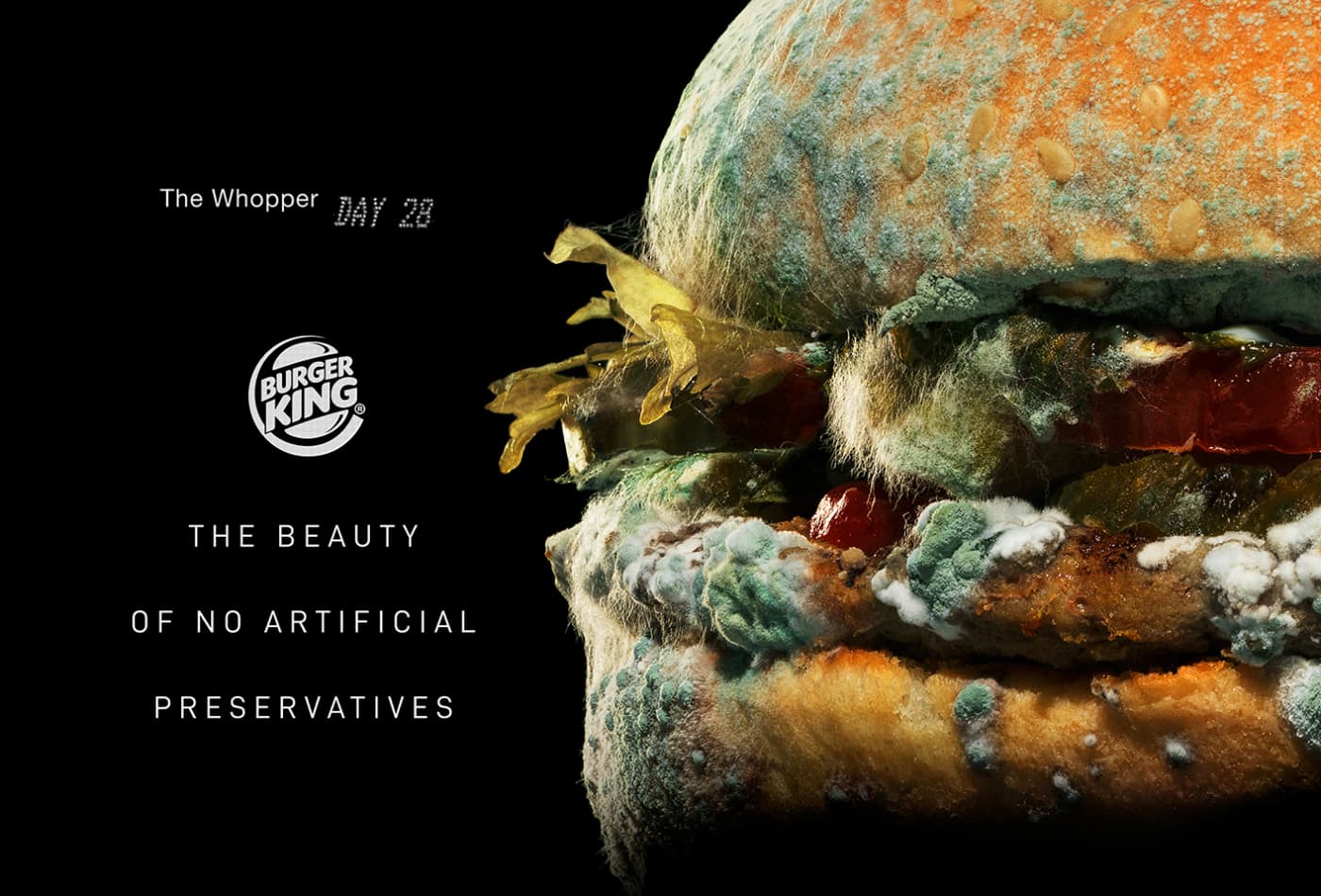
Well in South Korea there’s a burger company that makes BK look positively innocent.
It’s not just how they used Supreme to inspire their logo in a way Uncle Martian would be jealous of.
Nor is it their audacious copyright infringement of famous cartoon characters to talk about themselves.
And it’s not even their proud claims of being ‘100% Beef Meat’.
No … it’s none of those, it’s their utter confidence of their product over their competitors.
Take a look …

Amazing eh?
Not just the aggressiveness … but the choice of words.
Linking the words ‘burgers’ and ‘shit’ makes a mouldy burger look positively appetising.
Then there’s the fact it’s in English.
When I lived in China, there were a bunch of stores that used English in their copy.
Sometimes it was for the audience it was targeting.
Sometimes it was because they thought it made them look ‘sophisticated’.
But a lot of the time – as I think is the case here – they did it because it enhanced their ‘authenticity’.
Given burgers are very American, I feel their idea was that by using English and being aggressive in their tone, they encapsulated the American spirit and as such, could say their burgers were authentic.
Of course, given Burger King and McDonald’s are also American slightly undermines that idea, but hey – it doesn’t seem they really put too much thought into how they came across.
I must admit, when I saw it, I couldn’t help feel it was like a Viz fake-ad from the 80’s.
Viz – for those who don’t know – was/is an English ‘adult-humour’ comic.
Years ago, I approached them about starting an ad agency.
They said no, which still disappoints me as not only were their spoof ads brilliant, but based on both Billionbox and BK’s recent work … there’s more and more brands seemingly trying to copy their style but without the brilliance, clarity, humour or memorability as them.

Filed under: A Bit Of Inspiration, Advertising, Attitude & Aptitude, Authenticity, Brand, Brilliant Marketing Ideas In History, Comment, Communication Strategy, Confidence, Craft, Creative Development, Creativity, Culture, Design, Emotion, Experience, Imagination, Luxury, Marketing, Premium
So last week, the disgustingly talented Nils Leonard posted this on his instagram.

I have to say, I love it.
Sure, it’s for Mothers Day that affords more creative licence in terms of how a brand expresses themselves, but given Chanel has only celebrated elegance and perfection for years, it’s a huge leap.
Apparently it was drawn by a Chanel employees daughter on a ‘bring your kids to work’ day.
I can’t imagine how much money this saved them in terms of ad agency costs.
Though of course, this is less about being cheapskates and more the changing face of luxury.
For too long the category has been a closed shop.
It dictated terms, rejected new entrants and ruled by an iron fist.
Cold. Clinical. Aloof. Exclusive.
But the shift has been happening.
The rules of luxury are changing.
And while the establishment may look down at brands like Supreme as nothing more than expensive hype, the reality is the new generation of luxury buyers feel differently.
They don’t want to be part of the old rules, they want luxury to reflect them and how they live.
Personal. Emotional. Ridiculous and audacious. Human. Fun. A new definition of perfection.
And with brands like Mr Ji and Gucci both embracing this change and driving it … it will be interesting to see how many other luxury brands start stretching the boundaries of who they are and who they associate with moving forward.
Though I accept there’s a good chance they’ll just do what they’ve always done – especially with designers – and just try and buy the brands/people who are making waves.
Then assimilate them into their system.
Wow, look at me talking about fashion. And luxury. Who Am I?
Filed under: A Bit Of Inspiration, Advertising, Agency Culture, Attitude & Aptitude, Comment, Confidence, Creativity, Culture, Digital, Embarrassing Moments, Emotion, Empathy, Entertainment, Immaturity, Innocence

In these days of working at home, the possibility of making a video-conference disaster are quite high.
I’ve already had some ‘incidents’ …
For example I was on a concall recently and Rosie – our cat – decided that would be the perfect moment to release the World’s biggest hairball right by the microphone of the laptop.
That went down well.
Then there was the moment Jill and Otis thought it would be fun to fire water pistols against the window I was working from. What they didn’t know was that I – you guessed it – was on a concall again.
The photo at the top of this post captures that moment.
Then there was the second ‘cat’ incident.

I was on a video conference with a client when I noticed them smiling.
“Hey Rob …”, they said, “… your cat seems to have climbed your wardrobe”.
Now given Rosie is so old she won’t even jump on my lap, I looked behind me to see what he was going on about.
“Oh,” I replied, “that’s not my cat, that’s a cuddly toy”.
The client laughed and said, “Wow, it looks very life like” to which I responded …
“I hope so, I paid a fortune to have it made to look exactly like my cat”.
He quickly changed the subject, but he had that unmistakable look in his eye … the look of, WHY HAVE I LET THIS LUNATIC WORK ON MY BRAND?
But for all those incidents, nothing – absolutely NOTHING – compares to this …
Do I feel sorry for ‘Jennifer’?
Sure. But my god, it made me laugh.
I know for a fact if I was on a zoom call and did this in front of my team, not one of them would say a word.
Not because they would be wishing they were blind, nor because they’d be vomiting on sight … but because they’d be busy instagramming the shit out of it.
And I don’t mind telling you, I’d be very proud of them for their evil genius.
Then I’d release all the bad instagram photos I’ve taken of them.
Filed under: A Bit Of Inspiration, Advertising, Agency Culture, Apple, Attitude & Aptitude, Authenticity, Brand, Business, Comment, Communication Strategy, Confidence, Creativity, Culture, Management, Marketing, Nike, Perspective, Positioning, Relevance, Resonance, Wieden+Kennedy
After my post about Nike/Jordan, here’s another.
But before we get there … I need to take you on a little story.
Years ago, Wieden Tokyo were doing some research for Tabasco Sauce.
As part of the adventure, we went to the American south and interviewed chefs from the region.
One of them told us something that had a huge impact on me.
“The more confident the chef, the more simple your dish”
I love it.
For me, it communicates everything about belief and confidence.
Saying and doing exactly what needs to be said and done and not a sentence more.
Sadly this is a lesson that seems to have been forgotten.
Nowadays, companies have endless pages of terminologies, explanations and behaviours … often to disguise the fact that they don’t really know who they are or what they are here for.
I recently met a Venture Capitalist who told me the biggest mistake companies make is not knowing what business they’re in.
They think one thing but are something else.
And by not knowing this they undermine their present and their future.
However recently I saw something that showed me a company who ‘gets it’.
A company who has always ‘got it’.
Similar to the Apple memo I wrote about recently, this is a celebration of knowing who you are.
As you will have already worked out – mainly because I said it in the first line of this post – it’s NIKE.
Look at this document from the 70’s, entitled ‘Principals’.

One page.
Clarity and direction.
Fight and function.
All you need to know about what how the company behaves, what it values and what it believes …
I love it.
I love how it is so simple yet says so much.
I love how it acknowledges what it can control and what it can’t.
I love how it conveys the attitude of the brand through the battle it is undertaking.
I love how it celebrates the ugly reality of hunger, ambition and commitment while also advocating integrity and responsibility.
But most of all, I love how it acknowledges that they’ll make money as a byproduct of what they do rather than that being the focus.
And while they don’t mention the words ‘sport’ or ‘athlete’ anywhere in this page, it’s not hard to see what they are describing are the principals of building a team.
One that has a common goal, a common fight and a common belief and reliance on each other.
All on a single page.
Which is still their single page [albeit with an updated swoosh]
Because they are confident in know who they are and what they are about.
In these days where companies churn out endless pages about who they are … endless statements about what they do … endless updates to their terminologies, platforms and positioning statements, I find it interesting the companies that attract the most loyalty from audiences and the most jealousy from corporations are the ones who have been fiercely consistent about who they are, what they believe and what they stand for.
All expressed succinctly, yet passionately.
From Apple. To Nike. To Wieden.
Because the more confident the company, the less they need to say about themselves.
Filed under: A Bit Of Inspiration, Advertising, Attitude & Aptitude, Authenticity, Chaos, Comment, Communication Strategy, Confidence, Context, Craft, Creative Brief, Creative Development, Creativity, Culture, Design, Differentiation, Digital, Emotion, Fulfillment, Honesty, Imagination, Innovation, Insight, Internet, Love, Loyalty, Management, Marketing, Martin Weigel, Perspective, Planners, Planning, Point Of View, R/GA, Resonance, Talent, Technology, WeigelCampbell
Before I write today’s post, I want you to listen to something …
Yep, that’s the White Stripes with their now classic, ‘Seven Nation Army’.
I say classic, because it is.
It was recorded in 2002 as a bit of fun and yet now it is deeply entrenched in culture.
Sung at concerts.
Sporting events.
Pubs.
It’s the modern equivalent of Smoke In The Water … the go-to song for any guitarist starting out. [And the nightmare for any guitar shop employee]
But the thing about it that I never realised is that it’s a song without a chorus.
Nothing.
Nada.
It’s deliberate, because one day Jack White liked the idea of – in his own words – “creating a compelling song without a chorus”.
And he did.
A song that will no doubt outlive him because – like Queen’s We Will Rock You – is a simple, repetitive riff that allows audiences to not just join in, but be an integral and active participant in the music.
When you look at the ad industry, while we have evolved from talking AT audiences, our version of audience involvement is still largely based getting them to be an extension for what we’re doing rather than be an integral part of it.
Now of course, I get an audience doing stuff for a band they love is very different to getting people who are mildly interested in a brand, to do something for us … but the main point here is we are not pushing any boundaries right now.
Oh of course there’s agencies constantly pronouncing they have just executed a ‘world first’, but apart from the fact it’s often just a slight variation of something that has previously been around, it’s almost always done to benefit the agencies and clients ego and no one else.
But where is the bolder stuff?
The writing a compelling song without a chorus stuff?
If adland was about writing music, you can bet EVERYTHING would have a chorus.
It would also probably be a pop-song, 3 minutes long [MAX], as simplistic as they can make it and designed to be so palatable as to not offend a soul.
It would be this song …
Hell, even Matt Beaumont thought so in his brilliant book, E.
OK, I’m being a bit mean because its not like there aren’t some agencies doing amazing pieces of work using the ‘traditional’ model not to mention those who are genuinely trying to push the boundaries of what creativity can be – and do – for clients, like this brilliant Planned Parenthood campaign we did at R/GA recently … but in the main, the focus is not about breaking new ground it’s about treading carefully over the old.
Look, I get it … this stuff costs a lot of money.
There’s a bunch riding on it.
But where this ‘minimum risk’ approach fails is when brands talk about wanting to make a big impact in culture … something that powerfully differentiates themselves from the competition … an idea that change attitudes and behaviour … because the most effective way to increase the odds of this happening is to literally do something that runs counter to traditional norms.
An airport lounge that is modelled on a Rock Stars house.
An electric car with an insane button.
A ravioli where the pasta disappears.
An ad that talks about failure.
Now I know what you’re thinking, most companies will never do that.
And you’re right.
But what I find amusing is that we all know doing the same as everyone else produces, in the main, even less chance of breakthrough success than walking into the unknown or unexpected.
The harsh reality is that while many companies talk about breakthrough … innovation … provocation … what they really mean is – at best – being a degree or two better than their competition or – at worst – simply playing catch-up
Or as Lee said, they confuse innovation with modernisation.
And while I know there is a lot of talent in our biz – talent who use creativity to create incredible ways to either deal with old problems or create new normals – we are in danger of letting ourselves just become executioners of clients transactional requirements, and if that happens, we lose any chance of regaining/retaining our seat at the boardroom table. Because in my experience what the best C-Suite want aren’t companies who simply execute their requirements, but those who see the World differently to them, so they can help them get to places in ways they never imagined possible.
In other words, creative people with commercial appreciation rather than commercial people with creative appreciation.
Now the problem is we live in times where the money men value consistency more highly than boldness … which is ironic given they them place them under immense pressure to keep finding new ways to grow, transform and unlock new revenue streams.
An oxymoron if you will.
Which, for me, highlights 3 things.
1. Independence is power.
2. As Martin and I talked about at Cannes last year, chaos can achieve what order can’t.
3. The only things worth doing are the ones that can break your heart.