
Filed under: A Bit Of Inspiration, Advertising, Apathy, Attitude & Aptitude, Brand, Brand Suicide, Communication Strategy, Complicity, Content, Context, Corporate Evil, Creative Brief, Creative Development, Creativity, Culture, Distinction, Effectiveness, Egovertising, Emotion, Film, Loyalty, Management, Marketing, Marketing Fail, Point Of View, Provocative, Queen, Reputation, Success, Succession, Television

This is a long post.
Proper long.
And given I overwrite everything, that is probably a scary thought.
But I hope you hang in there, because it’s something important – at least to me. And who knows, it may trigger some thoughts – or hate – and I’ll consider that a win. Maybe, ahem.
So I don’t know about you, but I miss the TV show, Succession.
I miss the characters … the writing … the inconvenient truth how companies – and some families – work.
And while there are many articles and reports dedicated to explaining what ‘worked’, I recently read something that captured how it worked.

I love that write up.
I love it for a whole host of reasons … of which one is acknowledging that to make something that can capture so many people’s attention for so long, is an act of creative magnificence.
And while we may all nod our heads in agreement, the thing is we forget that.
We forget the challenge of keeping millions engaged and interested over a period of time.
Or maybe more specifically, we have forgotten HOW to do it.
Let’s be honest, the attitude of many brands is ‘keep things the same’ or ‘don’t fuck it up’ … while not realizing the biggest risk to achieving what they want to achieve is literally doing the same thing, in the same way, over-and-over again.
Of course, a big reason for their attitude is their quest for attribution.
Where the brand is synonymous and attributed to what they do/say/communicate.
However, rather than achieve this by doing interesting things that audiences value and can engage in – which is literally, the fastest, most effective way to build active, interested, engaged and committed attribution – we see more of the lazy approach. An approach sold by people with methodologies that mistake repetition as reputation.
Hence, we see countless campaigns featuring ‘consistent fictional characters’ doing variations of the same thing no one really cares about or relates to as if they’re trying to do a homage to the ‘Gold Blend’ coffee ads from the UK. WHICH CAME OUT IN THE 1980’S!!! Or the modern equivalent, where every element of every piece of communication is plastered with cues of whatever colour a brand is associated with. All the while ignoring the fact what it actually does is pull people out of their engagement with the communication because they’re questioning/wondering/laughing what sort of person drives a red car, lives in a red house – with red wallpaper – and only eat red vegetables. But even that isn’t the lowest of the low. No … that belongs to the work that shoves a watermark of the brand logo/name into the top left-or-right-hand-side of all their work … as if acknowledging their communication is so boring that the only way to know who it is from is to literally shove it in front of their faces.
I’m not saying ‘brand assets’ aren’t a thing … but they only become that with creativity.
Over time.
Continually reinforced … expressed … added to.
Without that, you end up with things that are more like weights than rockets.
And that’s the problem I have with so a bunch of the marketing practice being peddled …
Because they fail to appreciate the difference between recognition and value.
Or meaning.
Or resonance.
Or connection.
As I said to a client recently, just because I know what the swastika is, doesn’t mean I want to be a Nazi.
But that’s where we’re at right now … repeat, repeat, repeat.
Which is why that comment on Succession is so important.
Because they understand the importance of constantly adding to the narrative, not repeating it.
Keeping viewers not just interested … but on their toes.
Which leads to them engaging with the show, even when they’re not watching it.
Talking, discussing, sharing, commenting, deducing, arguing.
A program where none of the characters had many redeeming features, kept millions around the world coming back to them.
To learn. To listen. To grow. To hate. To debate.
Is that hard to do?
Of course.
Is it impossible to do?
Nope … especially when you hire proper talent and let them do what they’re great at, rather than value talent on how little they cost and then tell them what to make. Even though you don’t have experience in knowing how to make things people want to engage with.
But as a friend said to me recently, there were no conversations about ‘attribution’ with Succession were there!?
Nope. Not one. Not even from the first episode.
And maybe that was because they didn’t start the show with the intent of creating the lowest common denominator of recognition … then repeating it over and over and over again. No … their intention was to make something interesting … and then keep adding to that so their audiences would keep giving a fuck.

Look, I have no problem with marketing practice.
It is important and has a real role and value in building brands and driving effective marketing.
But that role and value is only released when it is done well and honestly … and right now, it feels there’s a lot of soundbites and not a lot of depth.
Selling systems that promise simplicity but ultimately are outsourcing responsibility.
Outsourcing responsibility to people who can profit from it, despite having no experience in actually creating it.
The irony is we all want the same thing.
Hell, we all need the same thing.
But there’s a major difference between playing not to lose and playing to win so maybe there needs to be more conversations about that, rather than blindly follow people who present themselves as business liberators when really, they’re good insurance salespeople.
Of course, the reality is that, despite what some may say, there’s not one ‘all encompassing’ answer to all this.
I get how expensive everything is so the temptation to stick and stay with what you know and what is working for you, is high. But regardless who you are, it will not last forever and it’s far better to own the change than be left behind by it.
Just ask the Disney execs how they’re feeling as they watch their Marvel universe start to implode.
Building anything is a journey that goes through highs and lows along the way.
But it’s the people who think – or say – they can stop that, who end up creating branded mediocrity.
Or should I way, ‘mediocrity attribution’.
Which is why there is one final example of the commercial value of adding to a story rather than repeating it and that’s Queen.
Specifically their recent sale of their back catalogue for ONE BILLION POUNDS.
Whether you like the band or not, you can’t say that is not an impressive number.
And while even I – a massive Queen fan – accept that in 1986, they stopped being musicians and became entertainers [aka: ‘turned crap’] … it’s the music they made until that point that gave them their legacy, fans and economic value.
Because rather than basically repeat their first hit over and over again … they kept taking people to different and interesting places.
Filed under: A Bit Of Inspiration, Advertising, Attitude & Aptitude, Brand, Brand Suicide, Brilliant Marketing Ideas In History, Comment, Communication Strategy, Confidence, Context, Crap Marketing Ideas From History!, Creativity, Culture, Devious Strategy, Differentiation, Effectiveness, Entertainment, Happiness, Innovation, Luxury, Mischief, Packaging, Planning, Professionalism, Relevance, Resonance, Strategy
This is the last post for a week because I’m off again.
I know … I know … it’s getting ridiculous, but consider my jet-lag, your mental health.
Talking of mental health … I’ve not had a drop of alcohol for 38 years.
THIRTY EIGHT.
But despite that, I do find myself buying it on occasion … mainly when those occasions are an extremely rare dinner invite and/or a desire to show gratitude towards someone in particular.
And when that happens, I remind myself how easily influenced I can be.
Because as we saw in 2007, my biggest motivator is the packaging rather than the quality of the product.
Well, I say that, but it has to be a brand I’ve at least heard of – a brand I associate with some sort of quality – but fundamentally, it’s all about the packaging.
Recently I wanted to get something for our old neighbour in LA.
It was his birthday … he’s an amazing human … and he invited me to his dinner. [I was in town, so it wasn’t some totally empty gesture]
So I rushed to a bottle shop and was immediately hit with a wealth of choices and options and so what did I end up choosing?
This.

Yep, a bottle of Veuve in a pseudo orange SMEG fridge.
Frankly it looked ridiculous … hell, it is ridiculous … but it’s also my kind of ridiculous, despite even my low-class tastes thought that for 2 brands that are supposedly ‘premium’, the way they combined looked cheap and tragic.
But unsuprisingly, my inner Dolly ‘it-costs-a-lot-of-money-to-look-this-cheap’ Parton, took over and I handed over my cash and walked out full of smugness and slight humiliation.
Now I don’t know the background to this collab.
I don’t know the process they took to get here,
And while on one level it makes some-sort-of-sense, it also is completely and utterly bonkers … and that’s why I love it.
Because in a world of sensible, it’s nice to see ridiculous win.
Yes, I appreciate Apple’s ‘ceremony of purchase’ packaging strategy is next level … but in terms of what I call, ‘social luxury’, the use of ridiculous packaging – as seen in the fragrance industry – is arguably, the most sensible thing they can do.
For all the processes, models and eco-systems being pushed by so many people right now, it’s interesting how few actively encourage searching for the weird edges. Ironically, they build approaches where the aim is to filter these out before they even have a chance to see what they can do. Which is why as much as the we laugh at the superficiality of fragrance companies and some alcohol brands, they can teach us more about standing out than all these models that seem obsessed with making sure we all ‘fit in’.
So who are the stupid ones now eh?
Filed under: A Bit Of Inspiration, Advertising, Apathy, Attitude & Aptitude, Australia, Brand, Brand Suicide, Comment, Communication Strategy, Creative Brief, Creative Development, Creativity, Culture, Distinction, Effectiveness, Embarrassing Moments, Emotion, Empathy, Fake Attitude, Government, Insight, Internet, Management, Marketing, Marketing Fail, Mediocrity, Nike, Planners, Point Of View
OK, I’m back.
Again.
And this time, I’m not going to be going away for …. hmmmmm, actually let’s not go there.
Let’s move on shall we?
So before I start, there’s 2 things to say.
1. Some may have seen this before, because I accidentally put the wrong publish date on it.
2. This is a week of long and – for me – serious posts. So don’t say I didn’t warn you.
The good news is that on Friday, you’ll be rewarded for it, with some news that benefits you as much as it does me.
Kinda.
Maybe.
OK, so one thing that drives me nuts is when brands talk in totally different voices to different audiences.
But there’s something that gets to me more, and that’s when the brand in question has tried to position themselves as some sort of ‘brand of the people’.
Case in point, Reddit …

I really like Reddit.
I think their ‘front-page of the internet’ is a brilliant place to play.
And then I saw this …
‘Where Engagement Meets Results’.
What the fuck is that about?
Oh I know what some will say …
“They’re trying to reach business people who discount Reddit as a commercially valuable platform”.
And maybe they are. But the irony is the easiest way to discount Reddit as a commercially valuable platform is having clients on there who only can communicate in the corporate monotone of the meaningless mission statement.
How insincere is a brand who speaks to their customers one way and business another?
How crazy is it that some think business people are a different species to ‘normal’ people?
How badly will Reddit’s audience react to work from companies who only speak business?
Now some may think I’m going over-the-top … they will remind me that we all ‘change’ our tone and personality dependent on who we are talking to.
And that’s true … to an extent.
But this isn’t a tonal change, this is character.
I read that and it’s a brand I don’t recognise …
Feels more like they should be called Beigeit rather than Reddit.

The ability to adapt your voice to different audiences shouldn’t mean changing who you are.
People who play golf have a dramatically different view to sport than those who play football … but Nike still do it in a way where you know and feel it’s them. Just like CTO’s in major corporations has different requirements to those who want a laptop for home … but you never feel Apple changes who they are to communicate with them.
Brands who fundamentally change their personality in a bid to engage different audiences literally don’t know who they are. Worse, their customers may start to question that too.
Reddit are amazing.
Their audience is diverse, engaged and productive.
And while I appreciate some in business may not understand that, if you have to alter who you are, do you want them anyway?
Years ago I was doing work for Triple J … a government funded, youth radio station in Australia.
Unlike other ‘government funded’ media, Triple J was someone with real credibility, driven by championing and breaking new artists, discussing topics commercial radio wouldn’t touch with a barge pole and absolutely no advertising.
So when they came to us asking for help, we knew straight away that whatever we did had to ensure their current audience didn’t feel Triple J was selling out by advertising for more listeners.
While you may think this meant we went niche, we did the opposite.
Built off an idea we called, ‘enemy of the average’ … we went into mainstream media with messages that challenged audiences about the mediocrity they were engaging with.
Radio.
Newspapers.
Cinema.
Magazines.
Nightclubs.
Television.
Wherever mainstream audiences were, we were there too.
And while many hated our work [it was even discussed in Australian Parliament] it not only attracted the largest audience increase in Triple J’s history, it reinvigorated their existing audience because they saw the brand they love stay true to who they are, despite wanting what they didn’t have.
I get we’re in different times.
I appreciate the idea of any risk is unpalatable for so many.
But nothing is as dangerous as changing who you are to attract people who aren’t your audience.
The brand voice is more than how you talk. Or look. It’s how you look at the world … and if you’re consistent with that, then you can express yourself in a million different ways and always be yourself.
But too many brands, despite what they say, don’t want to be distinct.
They see it as having the potential to alienate an audience.
To which I say this …
While you may think being something to anyone means you can engage more people, the fact is, the most power to build the value of your brand is when you are everything to someone.
Filed under: Advertising, Apathy, Attitude & Aptitude, Brand Suicide, Cannes, Colleagues, Communication Strategy, Content, Context, Creative Development, Creativity, Culture, Effectiveness, Egovertising, Experience, Fake Attitude, Management, Marketing, Marketing Fail, Perspective, Point Of View, Professionalism, Relationships, Resonance, Respect, Standards, Toxic Positivity | Tags: om
Obviously I have a soft spot for Google.
From cynic to Colenso, they’ve been a constant in my professional as well as personal life.
They are intimately involved in so much of what I do every single day and I appreciate the possibilities they have enabled me to embrace because of them existing.
I know … that sounds unbelievably gushing doesn’t it.
That doesn’t mean there’s not stuff that drives me nuts …
From the way some of their products work [Google Slides, I’m looking at you] through to the passive behaviour they are increasingly showing in the face of challenges that their smarts/money/tech could fundamentally change for the benefit of millions – if not billions – of people. However even with all that, it pales into comparison to this:
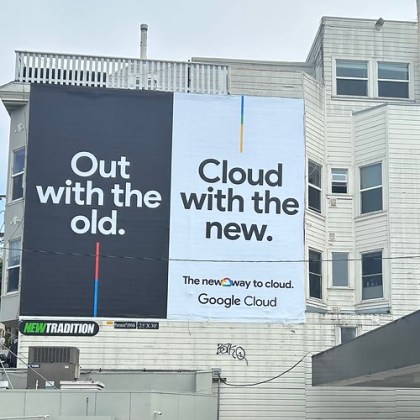
What. The. Hell?
Not only is it an absolutely terrible attempt to make a terrible pun, I still don’t know what ‘the new way to cloud’ is. Or means. Or why I should give a second of attention to it.
For a company so full of smart people, how can this happen?
Seriously, this sort of work does the absolute opposite of what Google want.
It makes people question how smart the company is.
It makes people ask if Google know how to talk to people.
It makes people wonder if Google know how to make tech that understands our needs.
It makes people ask if this is the sort of organisation we should trust to shape our future.
Sure, it’s just a random billboard … but for a brand that once represented humanities hope for ensuring technology enabled and empowered a better, brighter, more equal future for all, this work feels more like a politician pretending to smile while they’re busy oppressing us.
I know this isn’t the case, but bloody hell, it’s rubbish.
Which leads me to this.

I don’t know who is behind it. I don’t know if it’s an agency or an internal group. But I have to believe this was made because senior people mandated it or influenced it. Either directly, or indirectly. Which serves as a really good reminder about the dangers of corporate structures.
As Martin, Paula and I said in our Cannes talk, toxic positivity is ruining brands and people.
The idea that ‘team’ is now interpreted as blind complicity and conformity is insane.
But it’s happening. We all see it or have experienced it.
Worse, there’s an underlying attitude that the only way to get ahead is manage up. What I mean is that rather than do the right thing for your audience, you do the right thing by your boss. Doesn’t matter if it makes no sense. Doesn’t matter if it actively confuses the people it is actually designed to communicate to. As long as it hits the ‘cues’ your boss likes, you’re good.
As I wrote recently, toxic positivity is leading to the systematic destruction of knowledge and experience. Great ideas and people are literally being moved out of organisations to be replaced by conformists and pleasers.
Yes, company culture is important.
It has an incredible power to achieve great things.
But here’s the thing too many companies just don’t seem to get.
If you’re mandating it, you don’t have it.
Because real company culture is born from the people within the company. Yes, the people at the top shape and influence it – often through beliefs and a way to look at the world – but the moment you try to dictate or define it, you lose it.
But here’s the thing …
Even when a company gives you something to believe in, they know the real key is to give every employee the power to feel they can be themselves. That they trust them to want to make things better, rather than break things apart.
Which is why they encourage debate.
They value different opinions and ideas.
Because as long as it’s not in a self-serving, divisive manner … it’s almost the ultimate demonstration you want to help make things better.
There are a lot of companies who get this.
There’s sadly far more who don’t.
And everyone loses because of it. Because if companies stopped thinking of company culture in-terms of efficiency and optimisation – and more about standards and quality control – we would all get to better places faster.
Or at the very least, less ads that say everything by saying absolutely nothing.
Filed under: Advertising, Agency Culture, Attitude & Aptitude, Brand Suicide, Communication Strategy, Crap Marketing Ideas From History!, Creativity, Culture, Embarrassing Moments, Management, Marketing, Marketing Fail, Music

First of all, this is the last post for a week.
I’m away next week for a talk – I know, I know – and not back till Thursday evening so you can go into the weekend with an extra big smile on your face. Assholes.
Anyway, back to the post.
Over the years, this industry has shown an alarming lack of judgement in how it presents itself.
However, of all the terrible ideas, the absolute worst has to be when they decide to show how ‘fun’ they are through the art of song.
There’s been so many examples.
Sapient Nitro – remember them? – started it with something I can’t remember.
Then Mindshare Amsterdam got in the act saying they ‘work hard for your money’.
Not to be left out … Leo Burnett Sydney did – I think – a Sister Sledge song for a pitch.
Then Ogilvy Athens wrote a ‘ballad’ dedicated to David Ogilvy.
And then – one of my car-crash favourites – the Singapore Media Development Authority did a rap that, rumour has it, almost stopped Eminem wanting to continue his career. Maybe.
Despite having written a few times about these symphonies of shit, the reason there are so few links is because over the years, the guilty parties realised it made them look like a bunch of lunatic impersonator ‘entertainers’ appearing on a revival of Stars in Their Eyes.
Which is why I’m so happy that someone has decided to revive the trend with an epic re-write of Elton John’s ‘I’m Still Standing’ … filmed where the original video was shot. Cannes.
Better yet … at Cannes while I believe the festival was on.
Now, to be fair, it is way, way better than the other films mentioned and shown in this post.
That doesn’t mean much given they were worse than the worst musical duo on Britain’s Got Talent musical duo in history, but beggars can’t be choosers.
But I still can’t grasp why anyone would do this.
Don’t get me wrong, you don’t have to take yourself seriously while still taking what you do seriously … but to decide you have to ‘show’ you’re fun outside the context of how you’d actually interact with a client seems crazy. Almost as crazy as thinking this shows you’re ‘fun’.
And remember, this is coming from me … who did iPod Singing and wear birkenstocks!!!
So with that, let me send you off to your weekend with this rendition of I’m Still Standing … which still you might think is a joke but I can assure you isn’t as bad as sitting in the Majestic during the festival and watching people pour 2 grand bottles of champagne down their throat while publicly banging on about the economic crisis facing them and their clients.
Happy weekend.