
Filed under: A Bit Of Inspiration, Advertising, Apathy, Attitude & Aptitude, Australia, Brand, Brand Suicide, Comment, Communication Strategy, Creative Brief, Creative Development, Creativity, Culture, Distinction, Effectiveness, Embarrassing Moments, Emotion, Empathy, Fake Attitude, Government, Insight, Internet, Management, Marketing, Marketing Fail, Mediocrity, Nike, Planners, Point Of View
OK, I’m back.
Again.
And this time, I’m not going to be going away for …. hmmmmm, actually let’s not go there.
Let’s move on shall we?
So before I start, there’s 2 things to say.
1. Some may have seen this before, because I accidentally put the wrong publish date on it.
2. This is a week of long and – for me – serious posts. So don’t say I didn’t warn you.
The good news is that on Friday, you’ll be rewarded for it, with some news that benefits you as much as it does me.
Kinda.
Maybe.
OK, so one thing that drives me nuts is when brands talk in totally different voices to different audiences.
But there’s something that gets to me more, and that’s when the brand in question has tried to position themselves as some sort of ‘brand of the people’.
Case in point, Reddit …

I really like Reddit.
I think their ‘front-page of the internet’ is a brilliant place to play.
And then I saw this …
‘Where Engagement Meets Results’.
What the fuck is that about?
Oh I know what some will say …
“They’re trying to reach business people who discount Reddit as a commercially valuable platform”.
And maybe they are. But the irony is the easiest way to discount Reddit as a commercially valuable platform is having clients on there who only can communicate in the corporate monotone of the meaningless mission statement.
How insincere is a brand who speaks to their customers one way and business another?
How crazy is it that some think business people are a different species to ‘normal’ people?
How badly will Reddit’s audience react to work from companies who only speak business?
Now some may think I’m going over-the-top … they will remind me that we all ‘change’ our tone and personality dependent on who we are talking to.
And that’s true … to an extent.
But this isn’t a tonal change, this is character.
I read that and it’s a brand I don’t recognise …
Feels more like they should be called Beigeit rather than Reddit.

The ability to adapt your voice to different audiences shouldn’t mean changing who you are.
People who play golf have a dramatically different view to sport than those who play football … but Nike still do it in a way where you know and feel it’s them. Just like CTO’s in major corporations has different requirements to those who want a laptop for home … but you never feel Apple changes who they are to communicate with them.
Brands who fundamentally change their personality in a bid to engage different audiences literally don’t know who they are. Worse, their customers may start to question that too.
Reddit are amazing.
Their audience is diverse, engaged and productive.
And while I appreciate some in business may not understand that, if you have to alter who you are, do you want them anyway?
Years ago I was doing work for Triple J … a government funded, youth radio station in Australia.
Unlike other ‘government funded’ media, Triple J was someone with real credibility, driven by championing and breaking new artists, discussing topics commercial radio wouldn’t touch with a barge pole and absolutely no advertising.
So when they came to us asking for help, we knew straight away that whatever we did had to ensure their current audience didn’t feel Triple J was selling out by advertising for more listeners.
While you may think this meant we went niche, we did the opposite.
Built off an idea we called, ‘enemy of the average’ … we went into mainstream media with messages that challenged audiences about the mediocrity they were engaging with.
Radio.
Newspapers.
Cinema.
Magazines.
Nightclubs.
Television.
Wherever mainstream audiences were, we were there too.
And while many hated our work [it was even discussed in Australian Parliament] it not only attracted the largest audience increase in Triple J’s history, it reinvigorated their existing audience because they saw the brand they love stay true to who they are, despite wanting what they didn’t have.
I get we’re in different times.
I appreciate the idea of any risk is unpalatable for so many.
But nothing is as dangerous as changing who you are to attract people who aren’t your audience.
The brand voice is more than how you talk. Or look. It’s how you look at the world … and if you’re consistent with that, then you can express yourself in a million different ways and always be yourself.
But too many brands, despite what they say, don’t want to be distinct.
They see it as having the potential to alienate an audience.
To which I say this …
While you may think being something to anyone means you can engage more people, the fact is, the most power to build the value of your brand is when you are everything to someone.
Filed under: Advertising, Apathy, Attitude & Aptitude, Brand Suicide, Cannes, Colleagues, Communication Strategy, Content, Context, Creative Development, Creativity, Culture, Effectiveness, Egovertising, Experience, Fake Attitude, Management, Marketing, Marketing Fail, Perspective, Point Of View, Professionalism, Relationships, Resonance, Respect, Standards, Toxic Positivity | Tags: om
Obviously I have a soft spot for Google.
From cynic to Colenso, they’ve been a constant in my professional as well as personal life.
They are intimately involved in so much of what I do every single day and I appreciate the possibilities they have enabled me to embrace because of them existing.
I know … that sounds unbelievably gushing doesn’t it.
That doesn’t mean there’s not stuff that drives me nuts …
From the way some of their products work [Google Slides, I’m looking at you] through to the passive behaviour they are increasingly showing in the face of challenges that their smarts/money/tech could fundamentally change for the benefit of millions – if not billions – of people. However even with all that, it pales into comparison to this:
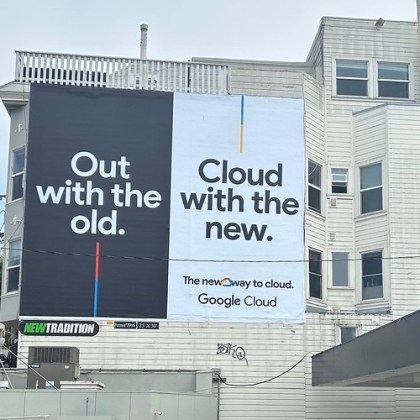
What. The. Hell?
Not only is it an absolutely terrible attempt to make a terrible pun, I still don’t know what ‘the new way to cloud’ is. Or means. Or why I should give a second of attention to it.
For a company so full of smart people, how can this happen?
Seriously, this sort of work does the absolute opposite of what Google want.
It makes people question how smart the company is.
It makes people ask if Google know how to talk to people.
It makes people wonder if Google know how to make tech that understands our needs.
It makes people ask if this is the sort of organisation we should trust to shape our future.
Sure, it’s just a random billboard … but for a brand that once represented humanities hope for ensuring technology enabled and empowered a better, brighter, more equal future for all, this work feels more like a politician pretending to smile while they’re busy oppressing us.
I know this isn’t the case, but bloody hell, it’s rubbish.
Which leads me to this.

I don’t know who is behind it. I don’t know if it’s an agency or an internal group. But I have to believe this was made because senior people mandated it or influenced it. Either directly, or indirectly. Which serves as a really good reminder about the dangers of corporate structures.
As Martin, Paula and I said in our Cannes talk, toxic positivity is ruining brands and people.
The idea that ‘team’ is now interpreted as blind complicity and conformity is insane.
But it’s happening. We all see it or have experienced it.
Worse, there’s an underlying attitude that the only way to get ahead is manage up. What I mean is that rather than do the right thing for your audience, you do the right thing by your boss. Doesn’t matter if it makes no sense. Doesn’t matter if it actively confuses the people it is actually designed to communicate to. As long as it hits the ‘cues’ your boss likes, you’re good.
As I wrote recently, toxic positivity is leading to the systematic destruction of knowledge and experience. Great ideas and people are literally being moved out of organisations to be replaced by conformists and pleasers.
Yes, company culture is important.
It has an incredible power to achieve great things.
But here’s the thing too many companies just don’t seem to get.
If you’re mandating it, you don’t have it.
Because real company culture is born from the people within the company. Yes, the people at the top shape and influence it – often through beliefs and a way to look at the world – but the moment you try to dictate or define it, you lose it.
But here’s the thing …
Even when a company gives you something to believe in, they know the real key is to give every employee the power to feel they can be themselves. That they trust them to want to make things better, rather than break things apart.
Which is why they encourage debate.
They value different opinions and ideas.
Because as long as it’s not in a self-serving, divisive manner … it’s almost the ultimate demonstration you want to help make things better.
There are a lot of companies who get this.
There’s sadly far more who don’t.
And everyone loses because of it. Because if companies stopped thinking of company culture in-terms of efficiency and optimisation – and more about standards and quality control – we would all get to better places faster.
Or at the very least, less ads that say everything by saying absolutely nothing.
Filed under: A Bit Of Inspiration, Apathy, Attitude & Aptitude, Authenticity, Brand Suicide, Business, Comment, Complicity, Confidence, Consultants, Context, Corporate Evil, Corporate Gaslighting, Creative Development, Creativity, Culture, Fake Attitude, Imposter Syndrome, Leadership, Management, Marketing, Marketing Fail, Mediocrity, Prejudice, Professionalism, Relationships, Relevance, Resonance, Respect, Succession, Toxic Positivity, Trust, Truth

I appreciate that at my age, the title of this post may suggest I’m going to whine about companies overlooking people of a certain age for younger, cheaper, hungrier individuals.
I’m not. I get it.
Not only that, while age and knowledge have some level of interconnectedness … I’ve met countless young people who are bloody brilliant [not relative to their age, just bloody brilliant] as well as plenty of people with ‘experience’ who, frankly, aren’t.
What I’m talking about is the blinkered confidence some companies place in their people simply because they’re their people.
On one hand I suppose I should celebrate it, given its not that long ago that companies overlooked internal capability for the external shiny and new.
And while this post does not reflect any of the clients I specifically work with directly, I am seeing and hearing more and more companies go to this other extreme and worse … enabling a level of arrogance in their people that results in any objectivity they face – regardless of the knowledge and expertise of the person delivering it, let alone the desire to help make things more successful – as a threat.
Complicity is the name of the game these days.
Blind acceptance that whatever the person ‘in charge’ says, is right.
A belief internal employees are better informed about every topic than people who are experts in specific topics … so companies can feel great about themselves.
Of course, the issue with this approach is that when things go wrong – or don’t go right enough – everyone else gets the blame. Not just by the person in charge [which you almost expect] but by the company they work for, despite the fact the only reason they gave this employee the project is because they knew a bit more about a subject than senior management, so they saw them as [1] an expert in the field and [2] a cheaper option that bringing in external expertise.
Now you’d think the fear of this outcome would ensure people would stand up for what they believe is right.
Not because they’re arrogant, but because they know their experience and knowledge can disproportionally benefit the end result.
And some do. At least the really good ones …
But even they are under increasing pressure to go along with the whims and wants of certain people/companies … because the whole industry is seeing more and more work being handed to people and companies who simply say yes to whatever is wanted.
Or said another way, convenience and fawning is more valued then expertise, knowledge and standards.
Now of course, it’s human nature to believe we can do more than we actually can.
We all like to think we are ‘special’.
We all like to be acknowledged as important.
We’ve all heard the ‘fake it till you make it’ philosophy.
But the truly special are the ones who know that however good they are, having people around them who are better than them – in different fields – can make them even more effective.
It’s why the World’s best athletes have coaches.
It’s why the World’s best musicians have producers.
It’s why my brilliant ex-NIKE/FFI client, Simon Pestridge, said: “middle management want to be told they’re right. Senior management want to know how they can be better”.

The reason I say all this is that I recently reached out to one of the best organisational psychologists in the World. They work with the CEO’s of some of the most respected and successful companies in the World including Apple, NIKE, Ferrari and Electronic Arts to name a few.
This is what they said when I talked to them about what I was seeing:
_________________________________________________________________________________________________________________
“I call them professional imposters and the reason so many succeed in corporations is because they target other imposters. It becomes a co-dependent relationship where they ensure their ego, status or promotion opportunities won’t be challenged.”
_________________________________________________________________________________________________________________
To be honest, I was not shocked by their view, I was more shocked by the acknowledgment.
Of course, I probably shouldn’t be. It’s hardly a new phenomenon and we also had one of the most successful shows in TV history shine a light on it …
Succession was a celebration of the role of co-dependence and complicity within organisations.
As I wrote recently, Tom was the epitome of it.
But this post is about Tom before he ‘won’ [even though he is still a pawn to the real power] … this is about Tom when he just wanted to please to win favour. Where he thought nothing of being vicious and vindictive to those beneath him because he knew that didn’t just please the people above him, it let him feel he was above everyone around him.
And so Tom eventually gets promoted beyond his capability …
Where the illusion of power and external fawning is more important to him than pay checks.
Where his belief is he is superior to all, regardless of knowledge or experience.
Where his understanding of situations is the only understanding of a situation.
Yeah, it’s bleak. It’s fucking bleak. Because while Tom was fiction, Trump got to be President of America. And what makes it worse is we all see it. Hell, we’ve probably all been exposed to it. And yet it goes on.
If companies truly want to be great, then they’ve got to kill and stop rewarding toxic positivity … because value will be revealed when they allow more people to say no to them and they say yes to more people.
Filed under: A Bit Of Inspiration, Advertising, Agency Culture, Attitude & Aptitude, Brand, Brand Suicide, Comment, Communication Strategy, Confidence, Consultants, Corporate Evil, Creative Development, Creativity, Culture, Cunning, Devious Strategy, Effectiveness, Fake Attitude, Grifting, Marketing, Marketing Fail, Planners, Planners Making A Complete Tit Of Themselves And Bless, Planning, Relevance, Scam, Strategy

I’m all for people expressing their opinion.
I’m all for people being excited about things they see as having great possibilities.
I’m all for people trying to find new ways to evolve, grow and make money.
But come on …
It’s getting to the point where Linkedin should be renamed Disneyland given how much fiction and fantasy are going on.
What’s worse is among all the ‘consultants’ and ‘new business development people’ claiming expertise, are a bunch of strategists.
Now I know as a discipline we think we have the answer to everything … but we don’t.
Fuck, even the people who are developing the technology, don’t.
But what bothers me is the reason behind why so many people are claiming expertise.
OK, so I know some have a real understanding of the technology and its possible implications. And in that, I include certain strategists – we all know who those brilliant people are.
And I also appreciate some mistakenly believe that because they’ve used ChatGPT, they think they now know everything about the technology.
But others – and this is potentially the majority of them – are doing it because they see it as a chance to personally gain from it.
In essence, their perspective is that as long as a subject matter is highly topical and others – especially companies – don’t know about it, then they can profit from it because they can say anything because no one will know enough to tell them they’re wrong.
You can tell who this group are because they’re the one’s who are either the loudest to declare their knowledge or the first to say they had identified the trend … despite never doing anything with their ‘expertise’ or because of their ‘vision’.
Putting aside how this sort of behaviour can damage the reputation of real experts, disciplines and entire industries … the issue I have is how it is often justified as hustle culture.
I’ve written my issue with hustle culture in the past, but the fact is, this isn’t hustling … it’s grifting and the impact of it is not just damaging people and companies, but it killing the potential of technology before it has a chance to find it’s real possibility.
I appreciate this is quite a heavy post from what was just a piss-take image of Homer … but the best comedy is always based on a truth we often like to deny.
Filed under: A Bit Of Inspiration, Apathy, Attitude & Aptitude, Brand Suicide, Comment, Complicity, Corporate Evil, Egovertising, Fake Attitude, Grifting, Innovation, Management, Technology
Warning. This post is topical.
In fact, it may be the most topical post I’ve ever written on here for 20 years.
Please read, while sitting down in case shock overwhelms you.
This is the end of this public service announcement.
So over the years, at Wieden and R/GA, I had a few dealings with WeWork.
And while I admit at the very beginning I thought it was a genius idea – specifically the way they were creating a business that dramatically profited from sub-letting space that was designed to appeal to a particular audience who felt they deserved to work in a particular kind of environment – after I met them, I started thinking something didn’t quite add up.
Please don’t think I am trying to suggest I had any idea of the level of craziness that was going on because I didn’t … I just couldn’t understand why they kept talking about themselves as a tech company and experts in work environments and culture when they were just a new generation of business space renting organisation.
But billions were poured into them and they were the darling of so many – especially those investor/companies who love to talk about ‘disrupting categories’, despite the fact most are about as conservative as you can get.
But over time – as numerous books, documentaries and news reports have documented – WeWork was proven to be a case of Emperor’s New Clothes.
And founder ego and delusion.
Specifically one founder … because on the few occasions I met him, Miguel seemed decent and grounded, whereas Adam most certainly didn’t.
Zoom forward to today and the company has filed for bankruptcy protection.
All that money and they still fucked it.
Worse, the delusional, ego-maniac that is Adam Neumann – who took a good idea and killed it with his God complex – got to walk away with a level of wealth that will last a thousand lifetimes.
Multiple billions.
BILLIONS!
But this isn’t a post about unfairness or WeWork’s craziness – I’ve written loads about that – this is about the challenge to encourage new thinking while not being blinded by it.
We live in divisive times.
Everything seemingly turns into a war.
Those who believe and those who don’t … and that extends to new ideas.
The amount of time I’ve seen people immediately dismiss new concepts or thinking simply because they are not as perfect as something established that has had years to work through issues and train people to conform.
But by the same token, I’ve also seem people blindly back a new concept or thinking because they seemingly want to associate themselves with the topical.
We saw this last one on a grand scale with so many people on Linkedin suddenly announcing themselves as AI experts, in a desperate bid to exploit the market interest and the market lack of knowledge.
Which gets to the heart of this post which is the importance of independent, critical thinking.
Where you are supportive of new ideas and thinking but know it is OK to ask questions about actions and decisions. Not to tear things down, but to better understand what is being done.
Starting from a position of ‘they could be right’ rather than ‘they’re obviously wrong’.
Focusing on the business not the hype … which, as Lee Hill once told me … is often as simply as acknowledging ‘profit is sanity, turnover is vanity’.
Critical, independent thinking isn’t celebrated enough.
Oh we may think it is, but what often we’re seeing is blinkered ego thinking.
Not enough understanding.
Not enough knowledge.
Not enough homework.
Not enough questions.
Not enough patience.
WeWork has cost millions of people billions of dollars … and yet you can’t help but think it didn’t have to be that way.
Their original business idea was a good one.
But the promise of trillions seduced people to lose their ability to think.
Critically and independently.
I wrote about this years ago with a lesson from the master conman, Bernie Madoff:
“I succeeded because when you offer people a deal that’s too good to be true, they never want to look too hard into the facts. They say it’s because of trust. I say it’s because of greed.”
We need to encourage positive pessimism.
The ability to champion new ideas without blindly being seduced by them.
To want to help people succeed without falling into being an accomplice for any delusion or slight of hand.
It’s not hard … but the more we promote blinkered ‘framework and eco-system’ thinking, the more we lose the value of independent thinking and then everyone loses in every way possible.
Especially those who have exciting new ideas that just need our encouragement and time.