
Filed under: Advertising, Agency Culture, Attitude & Aptitude, Authenticity, Brand Suicide, Colenso, Comment, Consultants, Context, Creative Brief, Creative Development, Creativity, Culture, Differentiation, Distinction, Emotion, Empathy, Experience, Happiness, Honesty, Innovation, Insight, Management, Marketing, Marketing Fail, Metallica, Perspective, Planners, Planning, Point Of View, Politics, Premium, Professionalism, Relationships, Relevance, Resonance, Respect, Rick Rubin, RulesOfRubin, Standards, Uncommon, WeigelCampbell, Wieden+Kennedy

So I know I said last week was the last of the Rules By Rubin … but then I did also say there may be some more in the future.
Well consider this the future.
Shit isn’t it?
Don’t worry, it’s just for today and tomorrow then we go back to normal.
So just as shit. Sorry.
Anyway this is about the state of the creative industry.
Whereas once, it was filled with companies all wanting to create wonderful things to put into the world – regardless of their individual discipline or expertise – the emergence of consultancies has led to the industry now falling into 2 groups
Those who can’t help finding ways to put creativity out into the world in interesting ways and those who seemingly do all they can to never put anything out whatsoever.
While I sort-of understand the theory why agencies would like the idea of being like a consultancy, what I’ve found especially bizarre is that in doing that, they’re seemingly happy to dismiss making any actual creativity at all.
At first I was really confused how they thought they’d stay in business.
I mean, there are as many competitors as there are in adland.
Their entire model is designed around making actual creative work.
The lack of C-Suite engagement is more individual than entire industry.
Then I thought maybe I was completely wrong.
That they did want to make work.
After all, why else would their excellent strategists continually write 100 page decks filled with charts, ecosystems, frameworks and playbooks to every single client meeting?
Surely that is a sign of a company actually wanting to make something.
But then on closer inspection, I saw a lot of those decks had no creativity mentioned in them whatsoever.
And the conversation around audience was simplistic, generalist and utterly contrived.
In essence, they talked a hell of a lot but actually said very little.
“What the hell was going on?” I would ask myself.
And then on a cold night one Wednesday, I worked it out.
Those planners aren’t writing strategic decks, they’re creating remuneration landfill.
Thank fuck for the others.
The ones who know who they are.
The ones who push rather than pander.
The ones who create opportunities not wait for them.
The ones who run to the edge rather than run on the spot.
The ones who finish interesting things to start making more interesting things.
Filed under: A Bit Of Inspiration, Advertising, Agency Culture, Attitude & Aptitude, Brand, Brand Suicide, Comment, Confidence, Creativity, Culture, Differentiation, Distinction, Diversity, Innovation, Insight, Loyalty, Management, Marketing, Marketing Fail, Perspective, Planners, Point Of View, Resonance, Respect, Rick Rubin, RulesOfRubin
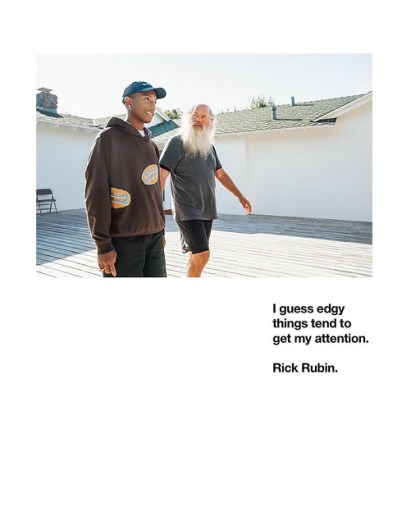
So this is the end of the week so this is the final Rules of Rubin.
To be honest, I’ve got at least another 3 weeks worth of posts I could do, but I want to write about some other stuff.
Yes, less valuable, less relevant, less interesting stuff.
Hey, this blog hasn’t got to where it is by writing stuff that is good. That’s why where this blog is, is at the bottom of everything.
But in all seriousness, maybe I’ll write more about the lessons from Rick later – I’ve certainly enjoyed it – but if you are interested, below is the list of quotes I’ve used and if you click here, you can read my write-ups on all of them.


However this last one is one of the most important.
One of the things I’ve never understood are brands consistently playing to the middle.
I get their thinking.
It’s a mass audience.
It’s a relatively safe audience.
It increases the odds of scalable success rather than risk.
But the thing is, playing to the middle is just the illusion of safety.
Apart from the fact lots and lots of brands are all playing there, all you’re actually doing is – at best – staying where you are, but more likely going backwards.
You might not notice it at first.
You may think everything is fine and dandy and slap yourself on the back for being so brilliant and successful.
But what starts off slow eventually turns in the blink of an eye as the brands or people who play and push to the edge take away all the safety you thought you had.
And what’s worse is because you’re high and dry and left far behind, your legacy and capabilities are impacted.
You’re tainted with being part of the past rather than the present, but even worse than that, your operational capabilities have been built around optimising rather than advancing so the best you can achieve is to play catch up.
This is a nightmare situation, based on one simple reality.
When you are playing catch up, your starting point is where everyone else is. But the problem is that by the time you get there, everyone is even further ahead and you’re back where you started.
A bit like Kyle in this episode of South Park
Of course it doesn’t have to be that way.
Some get that the only way to truly catch up is to leap frog current standards to set the next standard, but few companies have the courage to do that, let alone the money.
Oh they’ll suggest they can.
They’ll make all the right noises.
They’ll invest in some new technology, research or corporate ‘tagline’
They’ll even hire the odd new person from a new discipline with new ideas [though in many cases, they’ll then get moved on with the excuse ‘they weren’t the right cultural fit’] … but the reality is they’ll remain in this endless cycle of catch up.
I’ve seen it.
Hell, I’ve worked in some companies that have practiced it.
Because for all the desire to not get left behind, nothing feels as good as feeling in control.
Even if that’s just an illusion.
Because doing this means their position is protected.
It means they don’t have to look at their entire business model.
But more importantly, it means they don’t have to take a long hard look at their contribution for being in this situation.
So while I totally get why choosing to stand still may sound like the wisest option for so many, the problem with it is that it ignores one pretty vital consideration.
Culture never stops moving.
If you don’t want to get left behind, always play to the edge.
Filed under: A Bit Of Inspiration, Advertising, Agency Culture, America, Attitude & Aptitude, Authenticity, Brand Suicide, Comment, Communication Strategy, Confidence, Consultants, Creative Brief, Creative Development, Creativity, Culture, Devious Strategy, Diversity, Education, Egovertising, Emotion, Empathy, Equality, Fake Attitude, Focus Groups, Fulfillment, Honesty, Innocence, Innovation, Insight, LaLaLand, Management, Marketing, Marketing Fail, Planners, Planning, Point Of View, Professionalism, Relationships, Relevance, Resonance, Respect
Toxicity.
It’s a great word to describe a terrible thing.
It perfectly captures the strategy so many companies, people, governments have adopted to get ahead regardless of the cost.
But what a cost it is.
As the stories of Corporate Gaslighting highlight, it is destructive, debilitating and harmful and its rightfully being called out more and more.
However one of the byproducts of this rightful shift has been the increasing number of companies and agencies who will only accept ‘the positive’.
I’m not talking about them wanting to offer optimism in a challenging world, I mean they are actively dismissing or ignoring anything that they deem as bringing negativity into the conversation.
Questions about decisions.
Realities about their audiences.
Considerations about the categories.
No … no … no … no … no!!!
It’s the ultimate sign of privilege. Not to mention arrogance. An ability to simply close eyes and ears to the realities millions face every single day, just so they can continue living in their own Disneyland of the mind.
Actually Disneyland isn’t right, because their stories involve struggles and challenges … so we’re talking about organisations who make Disney look negative.
Jesus Christ!!!
And yet in the same breath, they will wax lyrical about wanting to have ‘deeper connections with their customers’ as well as ‘living their brand purpose’.
Of course it’s complete bollocks.
Deeper understanding equates to ‘how can we sell more stuff to them’.
And brand purpose is …. well, you know my view.
Can brand purpose have value?
Absolutely.
But brand purpose isn’t something you can ‘invent’ on a whim.
Nor is it a marketing tool to drive sales.
And it absolutely isn’t about saving the world.
It can be.
For some.
But it probably isn’t for most.

Which is why pharmaceutical companies saying stuff life, ‘We exist to rid the world of pain’ … makes me laugh so much I get a headache.
The reality is pain makes these companies oodles of money. The last thing they will ever want to do is rid the world of it.
And you know what … I’m cool with that.
Pain happens and they help it stop.
Cool.
But to say they want to get rid of it all?
Forever?
Are they forgetting how pain can actually be useful to people.
How it can help us understand our limits?
Can guide us to better decisions?
Without pain, can you imagine the trouble we would be in?
Which all explains why I – and shitloads of the planet – don’t believe a word they say when they, and countless other companies in countless other categories, go on about ‘their purpose’, especially when it’s obviously the total opposite of what funds their business?
And yet this delusional positivity of purpose is everywhere.
And what’s worse is we’re seeing more and more companies and agencies actively celebrate it, encourage it and demand it.
I cannot tell you how many planners I’ve spoken to about not being allowed to bring truth to their meetings and conversations.
I talked a lot about this – and the reasons behind it – in my rant at WARC, but it still blows my mind that companies and agencies expect planners to adopt this approach when it’s literally the opposite of what our jobs are about.
Planners are not blind cheerleaders.
We liberate through filter-free truth.
That means we’re supposed to question, challenge, have a hint of cynicism, push buttons.
Not to be dicks, but to help you be better.
It you want a planner to just accept whatever alternative reality you live in, go hire a bunch of Alexa’s.
You can say as much as you like that …
“We don’t really have competition”.
Or
“We don’t like negative insights”
Or
“We don’t want to talk about negative comments about us”
… but that doesn’t mean we should just accept it.
I don’t get why some people have this belief questioning is wrong.
At its most basic level, questioning is about wanting to understand more and surely that’s a good thing.
And even if we challenge what we’re hearing … it’s not to cause upset, it’s to get to truth.
Real truth, not corporate.
The truth that helps create great work. Not just in terms of creativity and cultural resonance … but commercial value.
If you don’t want to hear that, then frankly, you don’t want to grow. Or evolve. Or do something that can genuinely mean something.
Anyway, the reason for this post is because I was recently talking to a couple of creative mates of mine and they introduced me to the most perfect expression for this new attitude of only wanting and accepting ‘the positive’.
It’s this …

Oh my god, how good is that!!!
I cannot tell you how much I love it.
Not just the expression of Toxic Positivity, but the definition.
“The belief no matter how dire or difficult a situation is, people should maintain a positive mindset. It’s a “good vibes only” approach to life.”
Both are utterly, undeniably, absolutely bloody perfect.
Because both are utterly, undeniably, absolutely bloody true.
When I heard it, it immediately helped explain why I found so many things in LA, so annoying.
Don’t get me wrong, there were amazing people there. And the country is amazing in many ways.
I absolutely feel a deep sense of gratitude for the experience my family and I got to have there.
However quite a lot of people I met had this ability to blatantly ignore reality in favour of repetitively repeating some superficial and delusional positivity while trying to look like they weren’t annoyed when I asked what the hell they were talking about.
Even the mere suggestion that everything was not quite as perfect as they are trying to claim was met with an icy smile.
I think I’ve written about it before, but America taught me the difference between truth and honesty.
For me, truth is often uncomfortable.
It doesn’t mean it’s done to be harmful, but it does force situations to be seen, explored, discussed and dealt with.
But honesty – at least the version of it I experienced in the US – was different.
Honesty there, was truth with so many layers of sugar-coating on it, you didn’t taste any bitterness or sharpness.
What it meant was everything was designed to be easy to swallow … to give the impression of openness without being open.
Silicon Valley are particularly good at this approach.
White people – dealing with issues regarding race – are exceptionally good at this approach.
An ability to ignore reality by communicating an alternative version of it.
One that bursts with positivity and happiness. And if they could add a Unicorn to it, they would.
But it seems Toxic Positivity is becoming more and more prevalent.
And while the picture above shows Zuckerberg, it’s not specifically about him.
It’s about any organisation who deals with the raw realities of life with a thin, pained smile while they slowly and calmly explain to you everything is great and everything their company does is great and to even suggest otherwise – even if it comes from a desire to help make things better – is an act of intolerable aggression.
As much as toxic negativity is a dangerous act, so is toxic positivity.
It denies the truth for the people who need it the most.
And while I get why some companies would rather not deal with that, actively shutting it down to spout some inane and delusional ‘happy clappy’ message is equally as destructive, debilitating and harmful as it’s more negative cousin.
The reality is truth and transparency makes things better.
Nothing shows greater respect than giving someone objective truth for the single reason you want them to succeed more powerfully.
I appreciate it might not always be easy, but it’s always worth it.
Filed under: A Bit Of Inspiration, Advertising, Attitude & Aptitude, Authenticity, Brand Suicide, Cars, China, Comment, Consultants, Creativity, Culture, Differentiation, Distinction, England, Management, Marketing, Marketing Fail, Positioning

Recently I saw this ad for British Leyland cars.
British Leyland was a – surprise, surprise – British car manufacturer formed in the late 60’s.
As you can see, they made a huge array of cars but the joke was they weren’t very well made.
If I remember rightly, there was a joke that said:
“Buy British … they fall apart more quickly so you can buy a proper car”.
I don’t know if that was true – though the way British manufacturing has fallen by the wayside, suggests there could be some truth to it – but I do know I thought the TR7 and MGB, the two cars at the top of the pile, were cool.
But let’s look at that ad for a moment.
Cramming four different models of vehicle on a single page is bad enough. But when it has been art directed to look like they’re all on top of each other – resembling a scene from a scrapyard – is hardly the best way to sell ‘British’.
And they are selling ‘British’ because if you look at the very bottom of the ad, you see it’s got a New Jersey address, which suggests this ad was for the US market.
While I get the reason they would want to do that [the US market was huge and the amount of ‘foreign cars’ available at that time was small] I don’t know if that image would make the average American want to give up their GM or Chrysler … especially when the justification British Leyland have for ownership is ‘their appeal is reflected in their recent sales performance’.
Hahahahahahahahaha.
What makes it worse are those words associated with each model.
Bold.
Lively.
Practical.
Legendary.
It all just smacks of early brand consultant bollocks doesn’t it.
And while I kind of get why they chose those words – though labelling the Jag, ‘a legend’, somehow makes it feel old rather than cool – I can’t help feel sorry for the Marina, tagged ‘practical’.
At least those other models have words that suggest some element of energy and dynamism to them, but ‘practical’ just sounds like they’re trying to say ‘shit’ in a more polite way.
To be fair, they’re right. It was shit.

My Dad had – for a short while – a Marina.
In mustard yellow and brown.
It was utterly horrific.
Even though his was the ‘fastback’ model, I still remember being utterly embarrassed by it.
The colour, The shape. The everything.
I was so glad when he got rid of it, though I have a horrible feeling he changed it for another yellow car – this time a Fiat 128 – but at least that had 4 doors, which made it feel a step up.
But imagine how a Jag owner would feel after spending thousands on their car, only to see that piece of Marina engineering shit was ‘on top’ of their premium priced motor.
British Leyland always seemed to have a knack of fucking things up.
Continually chasing others success with bad interpretations of their own.
It’s a bit like small film studios …. who on seeing another movies success, launch a tsunami of similar themed films, all with names that are derivatives of the original, in the hope people may get confused and see their’s instead.
British Leyland totally adopted this strategy.
The TR7 was the Fiat X/19
The Marina was the Ford Cortina
And in 1980, the Mini Metro was their version of the Mini.
Oh my god, I remember the launch of that car.
It was heralded as the pinnacle of the British car industry and launched with one of the most jingoistic ads you’ll ever see.
Did you see it?
Jesus christ … it’s like it was written by the Far Right.
Or the Daily Mail.
I still remember when it got unveiled and just thinking, “it looks shit”.
Well, while it didn’t end up ‘taking over the world’, it was successful in the UK and even saved British Leyland from bankruptcy – for a while – but what it all ends up reminding me is how many companies forget that just because something is successful in one country doesn’t mean it will work in another.
I’ve seen – and worked in – too many organisations who think they are the best in the World.
That their worst is better than everyone else’s best.
That sort of thinking is a recipe for disaster.
Not just in terms of encouraging laziness, but it’s one thing to think you’re good, but it’s another thing altogether to think everyone else is just a lesser version of you.
The amount of companies I saw crash and burn in China was amazing.
Thinking that by simply being ‘Western’, they would be appealing.
Maybe that worked before, but what they failed to realise is that in a nation where everything said something about you, it quickly became the most brand literate nation on the planet.
The old premise remains.
If you want others to respect you, respect them … and it starts by not just trying to sell something because it convenient to you.
Amazing how few people still seem to understand that.
Filed under: Advertising, Agency Culture, Apathy, Attitude & Aptitude, Authenticity, Brand, Brand Suicide, Colenso, Comment, Communication Strategy, Confidence, Crap Campaigns In History, Crap Marketing Ideas From History!, Creative Brief, Creative Development, Creativity, Differentiation, Distinction, Emotion, Empathy, Equality, Experience, Fake Attitude, Focus Groups, Honesty, Imagination, Innovation, Insight, Management, Marketing, Marketing Fail, Only In Adland, Perspective, Planners, Planning, Point Of View, Relevance, Resonance, Stubborness, Uncommon, Wieden+Kennedy
So many ads today end up just being fancy sales brochures.
A nondescript, stylish image that either has some meaningless line thrust upon it or a literal lift of the proposition from the brief to become the headline.
Clients love it because they think there’s no wastage.
That there’s no ‘thinking’ that the audience has to do to ‘get the message’.
I remember years ago – when I was working on SONY – the client kept referencing Mr Bean.
No, I’m not joking.
They kept saying Mr Bean is understood by all. Loved by all. Communicates a message without saying a word. They were really trying to push this until I pointed out that while that’s the case, no one would spend thousands buying a TV made by Mr Bean.
Then Balls got made and undermined my argument for years. Hahahaha.
And while I hate looking backwards, I can’t help but think the past was far more interesting creatively than where we’re at today.
These days Audi talk about ‘Future is an attitude‘ when once they talked about Vorsprung Durch Technik.
We have Chivas Regal going on about ‘every taste is an experience’ when once they talked about ‘giving Dad an expensive belt‘.
Heineken now ‘open your world‘ when they once ‘refreshed the parts other beers can’t reach‘.
We have countless other brands who were once so powerful with their brand voice who have now become bland.
[Nothing sums it up like this Audi ad for the same car with pretty much the same line]
What really gets me, is we have the talent in the industry to change this.
We have the hunger as well.
But while there are exceptions – and I mean it in terms of agencies who consistently bring the work rather than the odd bit of work getting through – somewhere along the line, we seem to have chosen a path of complicity.
Without doubt the research techniques becoming more and more favoured by companies plays a part in this. As our clients who are more focused on not making a mistake than making an impact. But it cannot be ignored that agencies have a lack of desire to stand up for what they believe is right. Preferring to be complicit rather than respected.
Which may explain why so few of them believe it is worth investing in finding out what is really going on in culture – preferring instead, to either outsource it or just accept the viewpoint of whichever ‘paid for’ 3rd party the client has hired to do the work for them.
What brought this all up was seeing an old Honda ad from the late 70’s/early 80’s.
OK, so Honda have a long history of doing great work – especially from Wieden London – but it’s always been a brand that has run to its own rhythm with its own idiosyncrasies. But even they – these days – are falling into the trap of rubbing off the edges that defines who they are to become like everyone else.
This ad – like so many of the truly great early 80’s ads – came from Chiat/Day.
My god, what an agency they were.
Sadly I say ‘were’ because as much as they still have great people in there and pull off the occasional truly interesting bit of work, when you compare them to what they were like decades ago, there is no comparison.
Brave. Honest. Distinctive. Creative as hell.
Hell, even when they lost, they did it in a way where they would win.
Every single person in adland – especially at C-Suite level – should read this brilliant article by Cameron Day, son of Guy Day … one of the founders of Chiat.
‘How Big Till We Go Bad’ is a fantastic guide on how to build a truly great agency. And then destroy it.
Anyway, I digress.
The Honda ad I saw of theirs was this …
No, your eyes are not deceiving you.
Once upon a time, car manufacturers – or at least some of them – understood equality.
No cliches.
No pandering.
Just treating their audience as adults and equals.
It’s not really that hard is is, but if you compare it to what we see today, it feels we’ve regressed. [Read more about car ad devolution – with a few exceptions – here]
I do not want to look in the past.
I believe my best creative work is ahead of me.
Or at least the potential of it.
To paraphrase Death of a Salesman – or the equally brilliant Nils of Uncommon – we shouldn’t be interested in stories about the past or any crap of that kind because the woods are burning, you understand? There’s a big blaze going on all around.
But the problem is, people have to see the woods are burning and I worry a bunch of the fuckers think it’s a sunset. Then again, it will be … because if we don’t push forwards, it will be the sunset on our industry and that will be the ultimate insult, because the past should never be more exciting and interesting than the future.