
Filed under: Advertising, Airports, Attitude & Aptitude, Chocolate, Corporate Evil, Crap Marketing Ideas From History!, Environment, Honesty, Marketing Fail, Reputation, Respect

A lot of companies think ad agencies lack business credibility.
We’re self-indulgent, selfish, and should serve … not challenge.
To be fair, there are some agencies that prove that but – and it’s a big but – you can point the finger of failings the other way around.
Nestle have recently proved that size doesn’t equate to smarts.
Having seen the impact of Tony’s Chocolonely – both in terms of sales, share and corporate responsibility – they have come to the party by creating their own product.
A sustainably sourced, eco-conconious chocolate.
Now normally I would say this is a brilliant thing, because the more brands who embrace ethical production, the better things will become for everyone.
Except given Nestle’s history, you know the reason they’ve chosen to do this is far more about exploitation and profit than doing the right thing.
And nothing shows that they don’t really get it than their distribution model.
Because while I appreciate chocolate sales at airports are big – because they’re either a last minute present or a quick personal treat – the last place … literally the last place a sustainably sourced, eco-conconious chocolate should be sold … is a fucking airport.

Seriously, what the hell were they thinking?
Of course the reality is the only thing they were thinking about is cash.
I swear to god, if they thought they could make an extra $2 a year, they’d sell it at Fossil Fuel Power Stations. And probably still not see the irony in their actions.
Which is why for all the shit companies throw at agencies about their business naiviety, we can throw it right back about their blinkeredness towards human understanding.
Filed under: A Bit Of Inspiration, Attitude & Aptitude, Context, Creative Development, Creativity, Culture, Egovertising, Empathy, Honesty, Leadership, Management, Marketing, Marketing Fail, Professionalism, Provocative, Relevance, Reputation, Research, Resonance, Respect
A few weeks ago, I saw this post from the CEO/Founder of Liquid Death …

Putting aside that another bunch of kids somewhere in the US had done a similar thing with my ol’ mate Rick Astley … Mike at Liquid Death’s admiration for what they did kinda explains why I like hiring people who have done interesting stuff rather than those who just know interesting stuff. Even more so when the interesting stuff they spout is something someone else actually did or said.
Don’t get me wrong … opinions, considerations and evaluations have an important role to play in the industry, but if you haven’t actually made any actual work worthy of note, then the question is ‘do you really understand what it takes?’
The challenges.
The decisions.
The choices.
The craft.
The reality is anything is easy if you’ve never done it or have to do it … which is why those who try – even if they fail – will likely have more interesting perspectives than those who just express from a pedestal or vacuum.
It’s why I find so many of those newsletters being flogged on Linkedin amusing … because many are written by people who are not associated with any work of note. Or any work for that matter. And so while they are absolutely entitled to their opinion, it is just that – an opinion with a bit of context rather than the ‘undeniable fact’ they like present themselves as having.
To a much lesser degree, the same could be said about certain marketing practice experts who love to suggest they have all the answers and yet have also never actually made – or built – something of significance. Unless you count their own publicity machines.
OK, I know I’m being a condescending bastard. And the reality is I don’t mean it as much as I’ve made it sound.
[At least where the marketing practice experts are concerned anyway. Or some of them, ha]
But here’s the thing …
Do you know what else is massively condescending?
Listening to people who have never actually made anything of note putting down the credibility, expertise and knowledge of those who have … just so they can raise their own profile and ego.
Shockjocking for the clicks.
Shameless in their desire for the attention.
One minute claiming a discipline is dead … and then next minute, flogging their own ‘system’ that’s basically the same discipline they said was caput. But with added over-inflated academic value and self-congratulations for personal pleasure and good measure. Or associating themselves with famous work because they were employed – albeit for 2 seconds – at the company who originally made it. Despite not working on it or even being within 1000 feet of it. But still offering tips on how to make it like they are the CEO of said brand.
OK Rob, calm-the-fuck-down.
B-R-E-E-E-E-E-E-A-T-H-E-E-E-E-E-E.
OK, I feel a bit better now.
Look, I’m not saying there isn’t value in what they think and do – there is. Or at least with many of them. But the way they dismiss the work and value of those who literally create the stuff they claim to be an experts in – despite having never made it at that level, or in some cases, at all – is pretty shit.
And do you know what the great irony of all this is?
The reason there’s so much bad work out there is because of them. Because these ‘hypeists’ have succeeded in getting senior execs to believe their opinion is more valuable than the people who have actually been there, done that and keep doing it.
So instead of listening to those with the real experience, they are choosing to follow those who talk loudly from their self-built pedestal.
Where they talk and shout about why they are right.
Talk and shout about what they say is good work.
Talk and shout about why only their process is the one to follow.
Despite the fact – at best – they’ve never made the work they reference or – at worst – have never made any work at all. Certainly not at anything approaching the level their ego plays at.
So sure, I’m probably being a condescending asshole, but then so are the people who casually dismiss the value of those brave enough to put their ideas out into the world to be judged by people who don’t even know how to create it, let alone actually make it.
You don’t have to like it. But you should acknowledge you’ve also never done it.
Filed under: A Bit Of Inspiration, Advertising, Attitude & Aptitude, Brand Suicide, Brands, Business, Comment, Context, Corporate Evil, Creativity, Culture, Differentiation, Distinction, Honesty, Innovation, Management, Marketing, Marketing Fail

I saw these 2 brilliant cats starring each other down when I was in Utrecht a few months ago.
Look at them.
Focused. Determined. Pissed off.
Trying desperately to intimidate each other while obviously being scared of each other.
Maybe not in terms of size … or beauty … but in terms of one being able to pull off something better, quicker or smarter than the other.
Trapped in an endless cycle of statue paralysis or trying to micro ‘one up’ the other.
The cat cold-war so to speak.
And what is funny is this is often how many brands behave.
Looking sideways rather than ahead.
So lost in what one other brand is doing – or could be doing – they ignore what’s going on around them.
What others are achieving without them.
Sometimes this is not simply driven by a competition, but greed.
A desire to make sure nothing is left on the table.
Hoovering up every scrap.
Believing they are in control and in power so nothing can challenge or take them.
So lost in their self-belief that they fail to see they’re being left behind.
Blinkered by ego.
We saw it with Nokia when Apple launched the iPhone.
We saw it with Listerine when Wrigley’s positioned chewing gum as dental care.
We saw it with Kodak when they chose to protect their photo processing profits rather than launch their digital camera.
We have seen it over and over again.
And while sometimes, having a focused enemy can push you to greater heights than you would be able to achieve on your own … driving you to make things better, rather than to look for things never done before [because often, those things are stupid or self-indulgent] like most things in life, the key is knowing when this approach starts to be counter productive.
When the focus is pulling you back than pushing you forward.
Blinkering your view rather than opening your perspective.
Losing your edge rather than fuelling your ambition.
But sadly, too many brands act like those two cats in Utrecht.
Unable to look away but without the looks to make others still want to come to them.
Which is why as much as there’s a lot to be said for exploiting and optimising the failings and learnings of your numero uno foe, there’s also a lot to be said for remembering to keep looking up and out from your blinkered bubble.
Or said another way …
When you ensure you’re focused on where culture is heading, you don’t get lost following where your competition is staying.
Filed under: A Bit Of Inspiration, Advertising, Agency Culture, Attitude & Aptitude, Colenso, Colleagues, Comment, Communication Strategy, Creative Development, Creativity, Culture, Cynic, Empathy, Honesty, Marketing, Media, Perspective, Planning, Point Of View, Provocative, Relevance, Resonance, Wieden+Kennedy
This blog has been going for a loooooooong time.
Which means, it’s had its fair share of April Fool posts.
Some have been very good [even though I say it myself] with different industry people picking it up and commenting on it thinking it’s real.
And some being utterly, utterly shite.
But this year I decided not to do one.
Not because I couldn’t be bothered.
Nor because I couldn’t think of what to do.
Not because it was an Easter holiday on April 1.
But because after a while, it just becomes a bit boring.
I say this because a lot of brands don’t seem to get that. Instead, they keep doing the same thing over and over again without realising the audience have moved on.
That might be because of ego. That might be because of a lack of self-awareness. That might be because they don’t even know who the fuck their audience is … but whatever the reason, they keep doing what they do regardless.
And one of those things they keep repeating is ‘hijacking culture’.
By that I mean either during or after a topical event … they hire a van, slap a billboard on the back, put some headline on it that refers to whatever event they are ‘leveraging’ and then drive back and forth so a photographer can snap it in situ and then send it to the press or put it on the socials.
Hey, sometimes it’s really good.
But often, it just feels pretty sad.
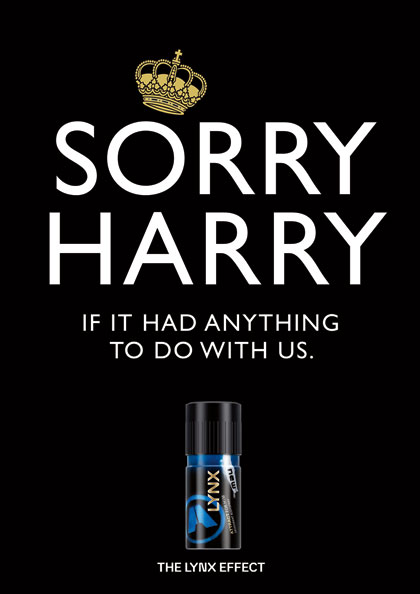
Especially when lots of companies are all trying to do exactly the same thing for the same event at the same time.

Look I get it … it’s a way to get boost attention.
It’s also a way to show your client – or their bosses – you’re ‘on the ball’.
Can’t criticise that … except in many cases, it also seems to have a subliminal admission that they need to borrow from others to make people care about them.
Which is less good.
Yes, I know I’m being a bit of a pedantic asshole here, but here’s the thing … when people expect brands to do this stuff, then you have to accept that you’re no longer ‘hijacking’ anything, you’re simply conforming.
Of course there are ways to do it well.
Wieden were the masters and – arguably – the originators of it.
Which was basically to do stuff that ‘added to the cultural conversation, not just stole from it.
They did it with NIKE for literally decades.
Olympics.
Superbowls.
World Cups.
Winning.
Failing.
Achievements.
Retirements.
Fines.
Spectaculars.
But achieving it wasn’t simply down to great talent, great clients or being quick at doing stuff like this, it was down to 3 things.
Creatives co-run/run the account, not simply make the ads.
They understand the culture around the category, not just the category.
They think in terms of owning the brand voice, not just launching campaigns.
What the combination means is everyone feels there role and purpose is more than just making advertising, but finding how … where … when and who the brand can/should a voice and point of view. It’s more than just being pro-active, it’s a confidence in your preparation.
You know what the brand will say.
You know how the brand will say it.
You know what the culture of the audience want and need.
You’re moving things forward because you’re always moving things forward. Seeing your role as far more than simply fulfilling ‘campaign requirements’ and ‘unexpected opportunities’ but directly and continually driving, shaping and influencing the behaviour and energy of the vision and role of the brand in culture.
Many people will say they do that, few do.
Instead they just churn out stunts or puns that often end up being more for the ego of the people involved than the benefit of the audience it is supposedly for.
Which is the heart of what, in my opinion, separates brands/agencies who get it and those who pretend they do.
Because the wannabes and imposters talk about how they will make the masses love their brand, whereas the real deal know it’s about the brand showing and expressing who they love and who they are for.
Filed under: A Bit Of Inspiration, Advertising, Attitude & Aptitude, Authenticity, Brand, Cannes, China, Comment, Complicity, Context, Creative Brief, Creative Development, Creativity, Culture, Differentiation, Distinction, Effectiveness, Honesty, Imagination, Marketing, Martin Weigel, Metallica, Nike, Paula, Planners, Point Of View, Provocative, Succession, Uncorporated, Wieden+Kennedy

When Tiger and Nike recently ended their relationship after close on 3 decades, there was a lot written about why.
Hot takes.
Wild ideas.
Conspiracy theories.
But among them all was a post by Tom Bassett – a brilliant ex-Wieden strategist who was there when so much of what became Nike folklore was written.
The reason his voice stood out is because it wasn’t WHY the relationship ended, but why it started.
At the heart of his story was the brief Phil Knight gave for NIKE Golf.
He said: “Get NIKE to be #1 in golf or we get out the category all together”.
Having had the errrrm, pleasure(?) to meet and present to Mr Knight a few times, I can literally hear him saying/barking this … and what I love about it is the stubborn, blinkered ambition.
We seem to live in a world where the majority of conversation is around optimization … efficiency … brand assets … and basically how to get the most out of what you’ve got.
There’s nothing wrong with that, except it’s all about not being wrong than being as good as you can be.
Or said another way, being comfortable with what you’ve got as opposed to being impatient for what you want to have.
Get to #1 is a proper goal. One where the evaluation criteria is very fucking simple.
No hiding behind incremental growth or internal metrics … #1 is a criteria that dictates decisions and investment rather than the other way around.
Sure, there are ways #1 could be reframed in an attempt to look like you’re doing better than you are . Let’s face it, we see this sort of shit in the ad industry all the time, especially around award time … but Phil Knight wasn’t about skewing results but going right at them … which is why he didn’t place any additional burdens on how to achieve goal, other than demand it was true to the sport and how NIKE see’s the athlete.
Sounds easy, but it isn’t.
To do that takes a lot of confidence.
Confidence in who you are … confidence in your team … confidence in what your company stands for and confidence your company is full of people who know what that translates to in terms of behaviour, consideration and action.
And that’s why we often undermine the value of confidence and right it off as bravado.
Of course it can be that, but it is also about trust, experience, knowledge and openness.
As a chef once told me when we were doing Tobasco research at W+K, “the more confident the chef, the less ingredients they use”
And that’s why I love the clarity of Phil Knight’s objective.
He could have added a million mandatories, but he knew that would add a million reasons why his objective would then be almost impossible to achieve.
At least in a realistic timeline.
Which is why, as difficult as the objective was, he increased its chances of success by being clear as fuck and – to a certain degree – open as fuck. Enabling the team to not just tackle the project head on – rather than tap-dance around politics and restraint – but to also place responsibility back on the company in terms of what it needed them to do to help make it happen.
Not just in terms of money, but action and change.

It is one of the many reasons why I loved my time in China … why I loved Branson’s brief for the Virgin lounge … why I love working for Metallica and Mr Ji.
Sure, in China’s case, it was often more the ambition and scale than the clarity … but for the others, it is/was the single-minded, stubbornness of their objective, the trust they placed in the people they were asking to help them do it, the commitment of the whole organisation to give it the best chance of making it happen and the willingness to walk away rather than accept a poor substitute of what they wanted to change.
We need more of that.
Creative work would be more amazing for that.
Effectiveness would be more powerful for that.
But sadly we’re in a world where it’s all about hedging bets, outsourcing responsibility and managing internal politics rather than being focused, fierce and open on creating change.
Proper change.
Real change.
Massive change.
It all kind of ties in with the ‘Strategy Is Constipated, Imagination Is The Laxative’ talk Martin, Paula and I did in Cannes last year.
The obsession with playing to the process while being continually outsmarted by those who are focused on enabling the possibility.
And while some claimed we were being irresponsible, unrealistic and even unprofessional in what we were saying, the reality is we have – and are – in the incredibly fortunate position of working with brands/people who prove the most responsible way to create powerful and lasting change is not by hedging your bets, but being willing and open to fight for it all.