
Filed under: America, Attitude & Aptitude, Brand, Brand Suicide, Cars, Corporate Evil, Design, Marketing, Marketing Fail, Technology, Twitter

Tesla.
When they launched, they were a glimpse into the future of mobility.
A way to combine technology to drive sustainability while keeping all the excitement of performance. Something that had previously been seen as impossible to create.
But they did and with it … it positioned Elon Musk as a modern day genius.
Edison x Einstein x Jobs. Maybe.
He added to his legacy when he launched a self-landing rocket.
The first time I saw that, it was – similar to sitting in a Tesla for the first time – like living in a sci-fi movie, such was it’s impressive impact.
But now?
Not so much.
Elon – through his actions, behaviours and attitude – has demonstrated that either he was trolling us or his immense success has resulted in him believing he is better than the rest of us.
The purchase of Twitter.
Accusing innocent people of pedophilia.
His treatment and attitude towards members of his family.
Claiming ‘freedom of speech’ except when it revolves around him.
There’s been so, so many moments of him revealing his ugliness.
That doesn’t mean he’s not very smart – he obviously is – but sadly where once we hoped it was to help lift everyone up, it’s apparent his focus is about lifting himself up. It all feels like he is seeking revenge for all the girls at school that turned him down and all the boys that wouldn’t let him play in their game of soccer.
We can’t say we weren’t warned.
His ex-wife’s interview in Marie Claire back in 2010 was a major red flag … which we collectively ignored because back then, he was still making headlines for good things more than satisfying his immense ego.
But now, his true character is fully on display and nothing sums this up more than the design of his cyber-truck … also known as the ‘middle-aged, white republican male, steroids-on-4-wheels-mobile’
Recently I read a designers review [@no_commercial_value] of the Cyber Truck aesthetic and it was the most perfect description of the philosophy and attitude of it’s creator … and the people who seem to love it the most.
It was this …

Paramilitary Cosplay is the most perfect description I think I’ve ever heard.
And the other definitions aren’t bad either.
It reminds me of the time Cynic did some research for Hummer and heard from interviews how the ‘feature’ many owners aspired to have was a ‘gun turret’ … I kid you not.
I also remember one person complaining about glove boxes you could close, because that was ‘pandering to the weak’.
I suppose none of this should come as a surprise because apparently when the iconic movie ‘Die Hard’ was first shown to test audiences featuring American men, many saw John McClane/Bruce Willis as ‘a coward’ as they interpreted his actions as ‘running away from trouble and that’s not what America does’.
Kind of explains a lot doesn’t it … including the rise of Trump and – getting back on subject – Musk.
Yes, I know Musk is South African, but his behaviour is pure Americana. Or should I say, 80’s Americana, as depicted in movies featuring Stallone, Schwarzenegger and van Damme.
Which all feels like the ‘theme’ behind the Cyber Truck.
A futuristic vision of a totalitarian regime. Where the rich are powerful and intimidating [and white] and the poor are disposable and weak.
Paramilitary Chic … as it were.
No doubt we can expect to see Putin, Trump and every other right-wing leader wearing 80’s style, Hugo Boss suits with massive shoulder pads soon … looking like some cartoon general with a metaphorical chest full of [fake or self-anointed] medals.
In many ways, they are a perfect example of a powerful brand … where society either loves them or hates them, but rarely apathetic towards them.
This revelation initially petrified me because this is kind-of what our industry is here to do.
I was going to point out that we should be careful what we aspire to.
But then I looked at what we’re producing all over the world – and what clients think is edgy – and realised there’s absolutely no danger of any of this happening, which might be a tragic indictment of the state of our industry but a relief that we’re not adding to a world of egomaniac, dictator-fantasist fuckwits.
Filed under: A Bit Of Inspiration, Advertising, America, Attitude & Aptitude, Brand Suicide, Confidence, Creativity, Culture, Law, Marketing, Marketing Fail
Whenever I am in the US, the thing that always shocks me – regardless how many times I’m there – are the pharmaceutical and lawyer ads.
Pharmaceutical on TV.
Legal on billboards.
They’re everywhere … forcing themselves on you like double glazing salesman who senses a moment of weakness in your resolve.
And while you tend to ignore the pharmaceutical ads – because they’re boring as fuck, long as hell and then filled with disclaimers that try to write-off ‘death’ as a casual side-effect – I am transfixed by the lawyer billboards.
Loud. Egotistical. Blustering in confidence.
They’re almost a parody except they’re deadly serious.
My Dad hated the US legal system … because according to him, it made a mockery of the law. Designed either to ambulance chase for quick wins or keep big cases going to maximise fees.
Anyway, recently on a trip to LA, I sat behind a bus with this:

On first glance, I just saw the URL and thought ‘Lemon Daddy’ may be a euphemism for some sort of sugar-daddy dating service. [I know, I know]
Then I saw the line ‘why are you still driving that piece of shit’, and it made me properly interested … especially when my taxi driver told me the guy in the pic was the basketballer, Austin Reaves, who plays for the Lakers.
Soon after that, I saw the name of the law firm ‘Drake’ and it all made sense – or should I say more sense – and by checking out the URL, I saw it was an ad for a law firm who specialise in taking on cases relating to faulty cars.
Frankly, the website reinforced what my Dad thought about a lot of American law … it’s a hard sell masterclass, but I still couldn’t work out why the NBA player was there unless:
1. It was just another way to try and get noticed.
2. Austin had a financial interest in the company.
So I did a bit of digging and – to be honest – the answer was more complicated than the most complicated law case. Have a read of this.
Now for someone who has been in this industry and worked in a lot of countries – including LA, where they’re based – but I’ve never heard of Black Llama creative. But that means fuck all. However – and I appreciate the snobbishness of this comment – I have been in this industry long enough to know what good work is and frankly, I have opinions about the claims they make about themselves:
Black Llama, a renowned creative advertising agency recognized for its innovation and expertise in brand development, played a pivotal role in the inception and execution of Lemon Daddy. Black Llama’s exceptional creativity, coupled with their strategic prowess, ensured that the Lemon Daddy campaign resonates with consumers, captivating their attention and generating engagement.
To be fair, they definitely achieved the latter part of their claim … but not by their innovation, expertise in brand development or exceptional creativity, but because they put a swear word in the headline and – for me – some random dude holding a basketball.
Look, I’m all for people having a go – and I appreciate everyone thinks they have something to offer that no one else has – but confidence means little when it’s so obvious you live in a bubble where you are the only one who judges what is great.
[One look at their website may highlight this is the case with them]
Good on them for making this happen.
Good on them for getting an NBA player involved.
Good on them for working with a client that seems to have a good idea.
But if I was Austin, I’d be online looking for SueMyManagementForBadEndorsementDeals.com
Filed under: A Bit Of Inspiration, Advertising, Agency Culture, Attitude & Aptitude, Brand Suicide, Complicity, Consultants, Context, Craft, Crap Products In History, Creative Development, Creativity, Devious Strategy, Experience, Innovation, Leadership, Management, Marketing, Marketing Fail, Mediocrity, Reputation, Strategy, Technology
A few years ago, my wife – a designer – was working for a company on a freelance project.
She met them for the briefing and they told her, “We want people to see us as innovative”.
To which she replied, “I think the only way you do that is by doing innovative things”.
Now she wasn’t saying this to be an asshole, she was trying to be helpful … but, of course, they didn’t see that, even though she was absolutely right.
OK, some companies get away with it.
There’s one I know very well who position themselves as progressive … but look a little deeper and you see the innovation is more in their language and wrapping than anything truly ground breaking. And what’s more, they do the same thing – albeit with a different skin – for different companies time and time again.
To be fair, some of what they do/did is truly progressive, but that is most definitely the exception rather than the rule because their current business model appears to be far more about duplication and replication than innovation.
And that would be fine … except they position themselves as innovation pioneers.
It works because nothing attracts conservative companies than the ability to pretend/think they’re innovative or disruptive when – as Lee Hill once brilliantly observed – all they’re really doing is simply ‘modernising to the times’.
Or said another way, they’re simply catching up to where everyone else is, rather than leaving them behind.
It’s a commercial co-dependency.
They talk to you so you can think you’re innovative and you pay them to allow them keep thinking they are.
The reason I say all this is because I recently saw this in Pudong Airport …

It’s for Austrian/American chef Wolfgang Puck and his restaurant chain.
Now Wolfgang has achieved a great deal in his life …
He is the only chef awarded the ‘Outstanding Chef of the Year’ award on multiple occasions.
His 1982 restaurant Spago – which was a revelation – created the concept of the open kitchen.
He is responsible for serving celebrities a special banquet after the Academy Awards.
All good and grand.
However for all the ‘innovation and success’ Wolfgang has achieved, his Wolfgang Puck chain is anything but … exemplified by the fact that this hoarding claims, “To be truly original is to invent the future of food … to question, to experiment” and yet all the pictures accompanying this statement are about as basic as my dress sense.
Cheeseburger.
Prawn salad.
Steak.
Now I am not saying this food won’t be tasty. But I am saying it is not original and it most definitely is not inventing the future of food.
Of course, there is a lot of [bad] marketing that is underpinned by exaggeration and hype. And I totally appreciate China loves the superlative … however, as exciting as the people behind this restaurant may be about this concept and regardless how ‘new’ this may be to China [clue: it’s not] they’re selling the illusion of innovation rather than the reality of it.
And why do I care?
Because people are falling for this shit.
And while that is their issue, the result of this is the systematic downgrading of standards and ambition.
And truth.
Where more and more people are falling for average because it’s been sold to them as exceptionalism.
And it is convenient for them to believe that because it doesn’t challenge or question, it just comforts with convenience.
The result being those who are being innovative … the ones who are trying to do things differently … are met with immediate distain and dismissal. Judged, insulted and dismissed.
Please note I am not in any way claiming to be one of these people. But I know those who truly are. And so many have failed to achieve the impact and success they deserve because the business of illusion innovation is easier to buy than actual innovation.
And while I could say that is their problem, a lot of it is because of what they refuse to do.
Like guarantee results.
Or sell one-size-fits all process.
Or blindly accept the opinion and views of people because of their title.
Or follow research methodologies that are designed for totally different scenarios.
But that happens a lot. I’ve seen it. We all have.
Which is why I think the best thing that can save marketing is maybe to stop marketing.
Stop playing the games of how so many operate.
Stop valuing convenience, complicity and popularity in favour of truth, action and change.
Stop judging people on how much cash they bring in and more on what they’ve done/do.
Stop playing down to a price rather than up to a quality.
This industry is littered with brilliant creative, innovative, progressive doers and thinkers.
They’re everywhere and yet they rarely seem to be championed or celebrated.
At best they’re viewed as a novelty. At worse, a destructive force.
The Emperor’s New Clothes may get short-term economic results.
It may keep people employed and give the C-Suite big, fat bonus cheques.
But what it is also doing, is ensuring we fall backwards.
Not just killing our credibility, but denying a future to those who could bring us back.
And as acts of corporate hostility go, I find that one of the worst of all.
Filed under: A Bit Of Inspiration, Advertising, Apathy, Attitude & Aptitude, Australia, Brand, Brand Suicide, Comment, Communication Strategy, Creative Brief, Creative Development, Creativity, Culture, Distinction, Effectiveness, Embarrassing Moments, Emotion, Empathy, Fake Attitude, Government, Insight, Internet, Management, Marketing, Marketing Fail, Mediocrity, Nike, Planners, Point Of View
OK, I’m back.
Again.
And this time, I’m not going to be going away for …. hmmmmm, actually let’s not go there.
Let’s move on shall we?
So before I start, there’s 2 things to say.
1. Some may have seen this before, because I accidentally put the wrong publish date on it.
2. This is a week of long and – for me – serious posts. So don’t say I didn’t warn you.
The good news is that on Friday, you’ll be rewarded for it, with some news that benefits you as much as it does me.
Kinda.
Maybe.
OK, so one thing that drives me nuts is when brands talk in totally different voices to different audiences.
But there’s something that gets to me more, and that’s when the brand in question has tried to position themselves as some sort of ‘brand of the people’.
Case in point, Reddit …

I really like Reddit.
I think their ‘front-page of the internet’ is a brilliant place to play.
And then I saw this …
‘Where Engagement Meets Results’.
What the fuck is that about?
Oh I know what some will say …
“They’re trying to reach business people who discount Reddit as a commercially valuable platform”.
And maybe they are. But the irony is the easiest way to discount Reddit as a commercially valuable platform is having clients on there who only can communicate in the corporate monotone of the meaningless mission statement.
How insincere is a brand who speaks to their customers one way and business another?
How crazy is it that some think business people are a different species to ‘normal’ people?
How badly will Reddit’s audience react to work from companies who only speak business?
Now some may think I’m going over-the-top … they will remind me that we all ‘change’ our tone and personality dependent on who we are talking to.
And that’s true … to an extent.
But this isn’t a tonal change, this is character.
I read that and it’s a brand I don’t recognise …
Feels more like they should be called Beigeit rather than Reddit.

The ability to adapt your voice to different audiences shouldn’t mean changing who you are.
People who play golf have a dramatically different view to sport than those who play football … but Nike still do it in a way where you know and feel it’s them. Just like CTO’s in major corporations has different requirements to those who want a laptop for home … but you never feel Apple changes who they are to communicate with them.
Brands who fundamentally change their personality in a bid to engage different audiences literally don’t know who they are. Worse, their customers may start to question that too.
Reddit are amazing.
Their audience is diverse, engaged and productive.
And while I appreciate some in business may not understand that, if you have to alter who you are, do you want them anyway?
Years ago I was doing work for Triple J … a government funded, youth radio station in Australia.
Unlike other ‘government funded’ media, Triple J was someone with real credibility, driven by championing and breaking new artists, discussing topics commercial radio wouldn’t touch with a barge pole and absolutely no advertising.
So when they came to us asking for help, we knew straight away that whatever we did had to ensure their current audience didn’t feel Triple J was selling out by advertising for more listeners.
While you may think this meant we went niche, we did the opposite.
Built off an idea we called, ‘enemy of the average’ … we went into mainstream media with messages that challenged audiences about the mediocrity they were engaging with.
Radio.
Newspapers.
Cinema.
Magazines.
Nightclubs.
Television.
Wherever mainstream audiences were, we were there too.
And while many hated our work [it was even discussed in Australian Parliament] it not only attracted the largest audience increase in Triple J’s history, it reinvigorated their existing audience because they saw the brand they love stay true to who they are, despite wanting what they didn’t have.
I get we’re in different times.
I appreciate the idea of any risk is unpalatable for so many.
But nothing is as dangerous as changing who you are to attract people who aren’t your audience.
The brand voice is more than how you talk. Or look. It’s how you look at the world … and if you’re consistent with that, then you can express yourself in a million different ways and always be yourself.
But too many brands, despite what they say, don’t want to be distinct.
They see it as having the potential to alienate an audience.
To which I say this …
While you may think being something to anyone means you can engage more people, the fact is, the most power to build the value of your brand is when you are everything to someone.
Filed under: Advertising, Apathy, Attitude & Aptitude, Brand Suicide, Cannes, Colleagues, Communication Strategy, Content, Context, Creative Development, Creativity, Culture, Effectiveness, Egovertising, Experience, Fake Attitude, Management, Marketing, Marketing Fail, Perspective, Point Of View, Professionalism, Relationships, Resonance, Respect, Standards, Toxic Positivity | Tags: om
Obviously I have a soft spot for Google.
From cynic to Colenso, they’ve been a constant in my professional as well as personal life.
They are intimately involved in so much of what I do every single day and I appreciate the possibilities they have enabled me to embrace because of them existing.
I know … that sounds unbelievably gushing doesn’t it.
That doesn’t mean there’s not stuff that drives me nuts …
From the way some of their products work [Google Slides, I’m looking at you] through to the passive behaviour they are increasingly showing in the face of challenges that their smarts/money/tech could fundamentally change for the benefit of millions – if not billions – of people. However even with all that, it pales into comparison to this:
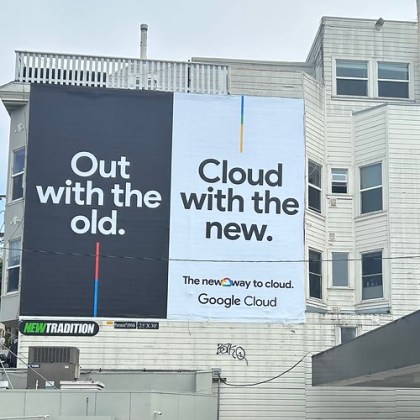
What. The. Hell?
Not only is it an absolutely terrible attempt to make a terrible pun, I still don’t know what ‘the new way to cloud’ is. Or means. Or why I should give a second of attention to it.
For a company so full of smart people, how can this happen?
Seriously, this sort of work does the absolute opposite of what Google want.
It makes people question how smart the company is.
It makes people ask if Google know how to talk to people.
It makes people wonder if Google know how to make tech that understands our needs.
It makes people ask if this is the sort of organisation we should trust to shape our future.
Sure, it’s just a random billboard … but for a brand that once represented humanities hope for ensuring technology enabled and empowered a better, brighter, more equal future for all, this work feels more like a politician pretending to smile while they’re busy oppressing us.
I know this isn’t the case, but bloody hell, it’s rubbish.
Which leads me to this.

I don’t know who is behind it. I don’t know if it’s an agency or an internal group. But I have to believe this was made because senior people mandated it or influenced it. Either directly, or indirectly. Which serves as a really good reminder about the dangers of corporate structures.
As Martin, Paula and I said in our Cannes talk, toxic positivity is ruining brands and people.
The idea that ‘team’ is now interpreted as blind complicity and conformity is insane.
But it’s happening. We all see it or have experienced it.
Worse, there’s an underlying attitude that the only way to get ahead is manage up. What I mean is that rather than do the right thing for your audience, you do the right thing by your boss. Doesn’t matter if it makes no sense. Doesn’t matter if it actively confuses the people it is actually designed to communicate to. As long as it hits the ‘cues’ your boss likes, you’re good.
As I wrote recently, toxic positivity is leading to the systematic destruction of knowledge and experience. Great ideas and people are literally being moved out of organisations to be replaced by conformists and pleasers.
Yes, company culture is important.
It has an incredible power to achieve great things.
But here’s the thing too many companies just don’t seem to get.
If you’re mandating it, you don’t have it.
Because real company culture is born from the people within the company. Yes, the people at the top shape and influence it – often through beliefs and a way to look at the world – but the moment you try to dictate or define it, you lose it.
But here’s the thing …
Even when a company gives you something to believe in, they know the real key is to give every employee the power to feel they can be themselves. That they trust them to want to make things better, rather than break things apart.
Which is why they encourage debate.
They value different opinions and ideas.
Because as long as it’s not in a self-serving, divisive manner … it’s almost the ultimate demonstration you want to help make things better.
There are a lot of companies who get this.
There’s sadly far more who don’t.
And everyone loses because of it. Because if companies stopped thinking of company culture in-terms of efficiency and optimisation – and more about standards and quality control – we would all get to better places faster.
Or at the very least, less ads that say everything by saying absolutely nothing.