
Filed under: A Bit Of Inspiration, Agency Culture, Attitude & Aptitude, Authenticity, Business, Collegues, Complicity, Confidence, Culture, Emotion, Empathy, Freddie, Friendship, Honesty, Individuality, Leadership, Legend, Queen, Relationships, Reputation, Respect
Once upon a time, I wrote a post about why we should be like Freddie Mercury in the boardroom.
To be honest, I also wrote about how we should be more like Freddie Mercury fullstop.
I still think that … but I also think there is another member of my favourite band we should embrace.
Not Brian May with his degrees, poodle haircut and home built guitar.
Nor drummer Roger Taylor … with his rock star smile, lifestyle and notches on the bedpost.
No, I mean the bassist … John Deacon.
On first impressions, John is a typical bass player.
Quiet.
Comfortable in the background.
Doing everything to not bring attention to himself.
Yes … I appreciate there are a few exceptions to this rule – Flea, Nikki Sixx, John Entwistle, even Level 42’s thumb slapping maestro, Mark King – but John is not one of them.
I once had him driving behind me in London and he was in a Toyota Yaris.
But behind the introverted persona was someone who was most definitely exceptional.
Not just in terms of writing some of the bands biggest hits – from Another One Bites The Dust to I Want To Break Free.
Nor do I mean in terms of still being married to his first love and having a bunch of kids who all live happily in Putney.
[His son used to have a great Youtube channel but sadly he took it all down a while ago]
No … what I mean by calling him exceptional is that he’s 10000% his own person.
Not in an arrogant rockstar way, but in his own way.
Have a look at this …

I bloody love that photo.
Love it.
Not just because it’s Queen live on stage.
Nor because Freddie is in his magnificent prancing poser phase.
But because despite being on stage, playing at deafening and blinding volume and wattage to tens of thousands of adoring fans, standing behind one of the most flamboyant and iconic rock stars of all time as – at the time of that photo – a member of the biggest band on the planet … John looks like he’s just come from his job working as an insurance salesman at a building society in Norwich.
Put simply, John didn’t give a fuck.
He loved the band – at least the majority of the time – but not enough to change who he was.
Where many would have succumbed to the pressure of being more ‘rock star’, John simply wanted to be more him.
Whatever ‘him’ was on any given day.
And what I love as much is the band didn’t give a fuck about it either.
Despite the other 3 members embracing their rock god characteristics – at least on stage – they accepted John for who he was.
Not that they could have got him to change if they tried.
Because while it has been well documented that John was a fragile soul – suffering from depression and always feeling slightly disconnected given he was the last member to join the band – John was as stubborn as a mule.
Not in terms of not listening to reason, but in terms of knowing who he was and what he believed.
At a time where the word ‘authenticity’ is banded about like it’s confetti … no one deserves that label more than John Deacon.
And while I am sure that led to all manner of tension in the band, they obviously trusted and respected him, even to the point they let him take control of the bands financial dealings … which not only resulted in them becoming multi, multi, multi millionaires, but – for a couple of years – becoming the highest paid company directors in the World.
We live in times where complicity is not just expected, but often demanded.
Where the rule of thumb is you fall in line with whatever the whim of whoever calls the shots.
But John Deacon didn’t follow that path.
Not because he was a rock n’ roll rebel … but because in his quest to be as good as he could be, he didn’t want it to come at the cost of losing who he was.
And while that may have resulted in John Deacon being one of the most underrated bass players of his time, we cannot forget it also resulted in him becoming one of the most successful musicians of all time.
And richest.
Despite never fitting in …
Be that with his choice of stage attire or the expectations of others.
Which leads to the point of this post …
Too often we feel we need to be like others to be accepted by others.
Adland is typical in this, but then so many other industries operate the same way.
It’s like group-think oppression … a clique that you feel you have to be a part of to stand a chance of being seen for yourself.
Which is mad and shit and rarely works out.
Which is why John Deacon should be a role model for us all.
Someone who never lost sight of who he was, what was important or what he expected from those around him.
Forever working hard but never taking anything for granted.
Including himself and his family.
From the outside, Queen may not come across as the poster child for ‘healthy working environment’.
And John Deacon doesn’t appear as the most natural of role models.
But as role models go – it may not be very rockstar – but it is very good advice to follow.
So wherever you are in your life or your career, be more John Deacon and find a job where they accept you like a member of Queen.
Filed under: A Bit Of Inspiration, Advertising, Bank Ads, Brand, Business, Comment, Complicity, Confidence, Corporate Evil, Finance
I’ve been a customer with Natwest Bank since 1987.
It was the first bank I ever had a salary put into and continues to be a bank account I use regularly, despite no longer living in the UK.
On top of this, since 1995 I’ve had the privilege of never needing to use the overdraft facility they gave me.
It’s only ever been 500 pounds, but I’ve never once needed it.
Anyway, due to some stuff we’re doing, I’ve withdrawn all but a few hundred pounds from the account over the past few days.
It is only temporary as this is the account where a bunch of different things get money paid into them … but it’s telling that on the 4 days there has been the least amount of money in it for almost 30 years [because I definitely used my overdraft when I was younger, on a monthly basis] I get this.

So despite never once going overdrawn …
Despite never once being late for a payment …
Despite never once asking them for help …
Natwest decided NOW is the time to lower my overdraft.
On one level, I shouldn’t care – I don’t use it and I’m in the incredibly fortunate position of not needing it – but there’s 2 things that bug me.
One.
It feels they’ve chosen this time because they’ve seen my balance basically disappear and fear I may be in financial hardship.
Two.
Like NIKE – who said they were always looking for ways to benefit their customers, before announcing they were pulling out of NZ – Natwest are trying to say this is for my own good.
That they’re doing ‘what’s right for me’.
What’s right for me?
More like what’s right for themselves.
Because for all their talk of wanting to be there for their customers.
… for all their claims of being there if anyone is facing financial hardship.
… for all their proclamations of wanting to be a financial partner to their customers.
You can’t help but feel they’re making sure they reduce any exposure to customer debt as is physically possible.
Not that they are in debt. Or face any risk of it.
Last year they made almost 5 billion in profit pre-tax … up a third on the previous year.
And let’s not forget the taxpayer bailed them out to the tune of 45 billion pounds in 2008.
As I said. I’m in the incredibly fortunate position of no longer needing to use my overdraft … but I know there’s lots of people who do. And if they will do this to someone who has been in credit for almost 30 years, what are they doing to those who haven’t?
The reality is, I’m fine with them reducing my overdraft limit … what I’m not fine with is their attempt to claim they’re doing ‘what’s best’ for me, when it’s painfully obvious they don’t give a toss about me.
They could have said, ‘you’ve never used your overdraft so we’re getting rid of it’.
Or ‘you’re not using it so we’re reducing it so we can provide more help to those who need it’.
Hell, they could have just kept everything the same because nothing has changed, even if my recent bank balance has.
But they didn’t do any of those things …
Instead they chose to basically bullshit so they could feed their ego and pretend they’re saviours all while making a decision designed to protect themselves from a financial situation, that they – in part – encouraged because of decisions and actions over the past few years.
Banks have an important role in society.
They could be seen in favourable terms by society.
But time and time again, their actions defy their advertising claims.
And yet they wonder why they find it hard to build trust and value with customers.
Filed under: A Bit Of Inspiration, Advertising, Agency Culture, Apathy, Attitude & Aptitude, Authenticity, Brand, Business, Communication Strategy, Content, Context, Creative Development, Creativity, Culture, Entertainment, Environment, Marketing, Mediocrity, Music, Relevance, Resonance, Respect

Hello daaaaarlings, I’m back.
What an amazing week.
I met so many incredible people and not one of them looked too disgusted at my outfits … except the designer from Celine, but then I was wearing a t-shirt featuring an image of my cat.
She literally asked, “which designer is that” … and when I told her it wasn’t a designer, it was my 16 year old cat, she smiled a smile that failed to convey her utter fear – to which she made her excuses and got the hell away from me, hahahaha.
That aside, the conference was a celebration of creativity and the stories that inspire it … which may explain why I loved the tweet – from Nick Beggs, at the top of this page – so much.
For those who don’t know who Nick is, he’s the virtuoso bass player who was once in the band Kajagoogoo.
This is what Kajagoogoo looked like.
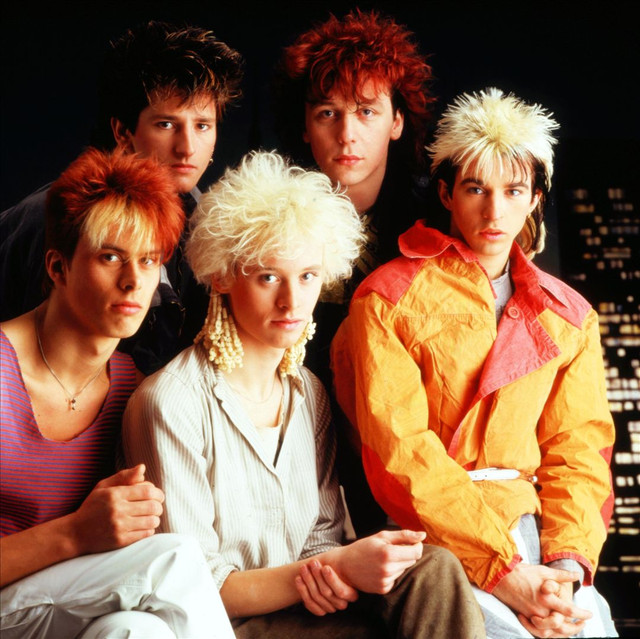
For reference, Nick is the blonde spiky haired guy in the middle.
And for those who don’t know what the ‘Too Shy’ he’s refereeing to is … it’s this.
Oh – and finally – if you’re wondering why I called him a bass playing virtuoso, it’s because of this … playing with another 80’s icon, Howard Jones./font>
But the reason I love this tweet is not because I’m a fan of Nick or Kajagoogoo or even Howard – it’s because of that photo he posted.
Look at it.
A nondescript flat.
Nothing fancy. Nothing grand.
A place like millions all across England.
Filled with everyday people from all walks of life.
Likely struggling to balance the never-ending demands of life.
And yet, in 1982, some young guys got together and wrote one of the iconic songs of the 80’s.
Changing their life and creating a legacy.
And that’s what I think is so fucking fantastic about it …
A reminder that while so many in our industry like to talk about the processes and eco-systems, the reality of creativity is its born from environments – both physical and personal.
We are in danger of forgetting that.
We will be – and are – worse off for following that.
Hiring an ever-ending production line of similar people.
Putting the same set of case-studies on the same pedestals.
Following the same group of ‘best practice’ models that get us to the same places.
Forcing creativity to fit inside structures designed for convenience rather than connection.
People in power valuing duplication, rather than originality.
It’s why creating the conditions for creativity to thrive is not some sort of superficial vanity.
It’s total, fucking sanity.
Filed under: A Bit Of Inspiration, Advertising, Attitude & Aptitude, Brand, Business, Comment, Communication Strategy, Creativity, Culture, Customer Service, Effectiveness, Food, Loyalty, Management, Marketing, Membership, Relationships, Relevance, Resonance, Respect, Strategy, Trust
So Kevin Chesters recently posted some work from the far distant past.
It was work that I adored at the time and even now, I feel is one of the best pieces of communication ever made.
EVER. MADE.
But it’s not NIKE. Or Apple. Or anything approaching ‘cultural cool’ … it’s for a supermarket.
Oh, but wait … there’s more.
Because it’s not a brand ad – though it does a ton for the brand – it’s a retail ad.
But instead of starbursts and shelf wobblers … it’s a masterclass in craft and smarts. Where the majestic charm and wry humour not only treats the audience with intelligence, but communicates price in a way you see value both in the product and the company selling it.
Regardless of the item.
Regardless of the audience ‘segment’.
Regardless of whether it’s selling food or their loyalty scheme.
It’s incredible and what’s more … it’s from the early 2000’s.
I think.
But despite being almost 20 years old, it’s still one of the best examples of a brand that knows who they are, knows who their audience is and knows the relationship they would like to have with their audience.
More than that, they know the problem they’re solving.
Not just in a general sense … but in terms of the potential barrier for each item.


In a world of wish-standard Nike knockoffs, this is an example of advertising not just communicating, but undeniably contributing to the growth, value and reputation of the company it represents.
When it wants to be – and when it’s allowed to be – this industry can be outstanding.
While we can’t control the standards other parties may demand, we can control what ours are.
Of course, in these ‘procurement-led times’ you could say ‘you get what you pay for’.
And I get that.
But watching the value and standards of what we do fall down a drain doesn’t seem a particularly good business approach.
Which is why I find myself repeating what an old boss of mine used to say to me.
“What happens next is up to us”.
He’s never been more right.
Filed under: Advertising, Attitude & Aptitude, Business, Corporate Evil, Creativity, Culture, Embarrassing Moments, Finance, Grifting, Marketing, Marketing Fail, Money, Scam
Scams.
They’re bloody everywhere.
SMS. Email. People knocking on the door.
There seems to be three types …
The hopeful … which is sending the same thing to tons of people and see if it will stick.
The too-good-to-be-true … which is promising untold riches for a fraction of investment.
And the invisible … where it has been so well planned, you may not realise it’s happened until its happened.
While I understand how the latter works – having once been a victim of it – it’s amazing how often the first 2 do.
Part of that can be down to blinkered greed.
The belief we’re all ‘special’ and while friends may think it’s a scam, they stick with it as it reinforces what they’ve aways felt about themselves.
Until it doesn’t.
The other group are people who are desperate – whether financially or lonely – so they take part in a desperate bid to escape their own personal hell.
So while its easy to laugh at people who we think have been stupid, the reality is there are always mitigating circumstances that add to the scammers success.
And nothing shows how successful the crims are by their exaggeration. Look at this …

For just NZ$400, you can get a ‘guaranteed’ NZ$7800 every month.
EVERY MONTH … where do I sign?
But the scammers aren’t completely stupid, so they’ve added a picture of Elon Musk.
Now whether that’s because he’s super rich or is OK with losing billions – as demonstrated with Twitter – is anyone’s guess, but given they’ve bought a ton of ads all over Facebook and other social media channels means they think it makes what is one of the most ridiculous financial investment promises in history, legitimate.
And you know what, it seems it has … which is a great reminder for the marketing community that while customers are often much smarter than we give them credit for, they rarely adopt the logic we like to think/claim they do because ultimately – and here’s the big reminder – they buy for what they’ve need, not what we want them to need.