
Filed under: A Bit Of Inspiration, Advertising, Agency Culture, Attitude & Aptitude, Authenticity, Business, Comment, Communication Strategy, Confidence, Content, Creativity, Culture, Differentiation, ECommerce, Emotion, Insight, Management, Marketing, Packaging, Positioning, Relationships, Relevance, Resonance

I have a confusing relationship with Amazon.
I use them a lot.
I admire what they do.
I appreciate how they operate.
But I don’t know if they’re a great brand.
Without doubt they’re a great company and have created a clear role in people’s lives … but in terms of brand, I’m not so sure.
That’s weird, because in many ways, they have achieved all the things a great brand requires, but at the end of the day – I have no emotional relationship with them, it is entirely functional.
Does a brand need to have emotional value to be great?
No. But I think it is the difference between being seen as a great transactional brand and a great brand.
But what surprises me most is Bezos understands business and brands better than many.
Not just CEO’s, but marketing folk … exemplified by this statement he made.

Which leads to the point of this post.
Brands.
As I’ve said a billion times, I’m an unashamedly huge believer in them.
If done well, they enable differentiation, cultural connection and economic power.
But the emphasis is ‘done well’.
And frankly, I don’t see a lot of that.
What I do see is a lot of companies spending of an awful lot of time and money on what they want to talk about.
What they think people should care about.
What audience should buy their product.
What they want their product to be used for.
What they want people to discuss about them.
What words they want people to associate with them.
What they want people to view as a threat or a competitor.
Them. Them. Them. Them. Them.

Now don’t get me wrong, you have to know what you stand for. What your values are. What your role is and why you do what you do, well. Not to mention what your point of view on the World is.
But you don’t just churn them out like some political manifesto brochure. Boring people into submission.
And yet that is the practice of so many … minus the point of view, which would at least make it relevant to culture instead of using a ‘proposition’ that is like a cement block, standing firm regardless what the headwinds that surround it are.
But it gets worse.
Because often what they do is wrapped up in some contrived ‘purpose/manifesto’ message in an attempt to make it look like it’s not all about them, which doesn’t convince anyone because it’s all about them.
Everything.
And it comes across exactly like that.
Self serving. Self indulgent. Self important.
Because the people behind these campaigns live in a bubble of corporate complicity.
Where ‘real life’ is closer to a sitcom sketch than anything resembling reality. Where families are always perfect and together. Where there is no problem that can’t be solved with [insert brand here] and their [insert meaningless ingredient]. Where the undertone of the work is to scare/shame/blame audiences into purchase submission – regardless how happy the soundtrack is or how saturated the images. All backed up and reinforced by a research report that has been specifically designed to fit in with the clients processes than representing truth.
Welcome to the world of marketing truth – a parallel universe to real truth that exists next to the Marketing solar system.
And that’s why, love him or loathe him, you have to respect Bezos.
Yes he has a world of data. Yes he has a universe of information.
But he knows it’s what people say when you’re not watching or listening to them that really reveals what they think of you.
At a time where so much work is done behind the desk, there’s never been as important a time as to get out, talk to real people, understand the texture, nuance, and chaos around the category … so we can help our clients with the most important foundation you can have in getting to great work.
Truth.
Of course, it is not always easy for clients to swallow.
Of course, they may prefer agencies that pander sweet bullshit to them.
But as Mr Bezos knows, you don’t get culture to truly buy into you, if you don’t know what culture really thinks of you.
Filed under: A Bit Of Inspiration, Advertising, Agency Culture, Attitude & Aptitude, Authenticity, Comment, Confidence, Context, Creativity, Culture, Management, Professionalism, R/GA, Relevance, Resonance
I’m back.
OK, I know I’ve written a few posts in the 3 weeks I’ve been away, but I’m officially back.
And I want to say a big thank you to everyone who reached out after my news.
I appreciate it very much and can assure you I’m fine.
For now, hahaha.
I was overwhelmed by the generosity I received and I actually have a bunch of news to announce soon, however I need a little longer before I can do that due to the usual dotting i’s and crossing t’s – but, as some of you already know, one of the reasons has to do with this …

More of that soon, so until then, let’s get on with now shall we?
I should point I wrote this post a while ago.
So long ago, I had a full time job.
But it is important I point out the title of this post is not a euphemism for ‘self-love’.
No.
It’s about the feelings many people are going through as they start to realistically think about returning to work.
By which I mean an actual office rather than in their own home.
I don’t know about you, I’m a bit nervous.
As I’ve written before, the situation with COVID has been a very different experience to us than it has to many, many people.
I absolutely recognise my privilege in that statement.
I would happily not have had this time if people had not had to suffer.
I truly mean that.
But working from home has had a profound effect on me.
I sleep longer.
I am not doing 2+ hours of commute a day.
I am here for lunch and dinner with my family.
I am being much, much more effective in what I do.
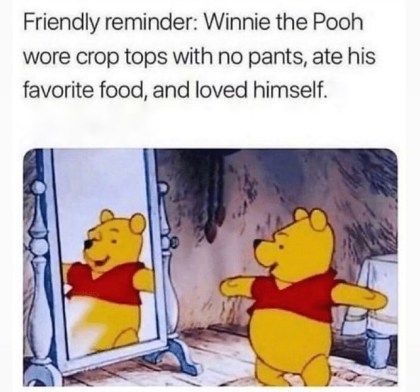
I love being able to wake up, put on some shorts and a t-shirt and walk into the room that has now become my office.
Seamless.
But the idea of going to an office is making me nervous.
Any office.
Not just because the COVID rates are on the rise again, but for other reasons too …
Will I be able to function once I’ve given up all the lovely things I’ve discovered?
Will wearing long trousers and not eating a packet of Quavers everyday undermine my effectiveness?
Will it affect the energy and fight I have for the work I do?
Then someone sent me the image below and I realised that working from home hasn’t made me a lesser version of myself, it’s revealed how I truly like to work and I feel much better about myself.
And before anyone says it, yes, this is an extremely long post of utter bollocks just so I could use this image.
Sue me.
Filed under: A Bit Of Inspiration, Advertising, Agency Culture, Attitude & Aptitude, Authenticity, Comment, Communication Strategy, Confidence, Context, Corporate Evil, Creativity, Culture, Cynic, Differentiation, Emotion, Empathy, Experience, Finance, HHCL, Imagination, Innovation, Insight, Management, Marketing, Marketing Fail, Meetings, Planners, Planning, Point Of View, Positioning, Premium, Professionalism, R/GA, Relevance, Resonance, Standards, Wieden+Kennedy

A while back I wrote a post about the best bit of advice I’d ever had regarding solving problems.
Or should I say, on how to present how you are going to solve a problem.
But this is dependent on knowing what is the right problem to solve … and quite often, it ends up being the problem we want to solve versus the problem that needs solving.
Now of course, we can only solve the problem that relates to our particular discipline.
For example, as much as adland likes to claim it can solve everything, we can’t build a car.
[Trust me, I’ve tried]
But that’s not what I want to talk about.
Too often, when there is a huge piece of business on the table, our goal is to get all of it.
Every last piece.
Doesn’t matter if it’s not our core expertise.
Doesn’t matter if the work won’t be interesting.
We. Want. It. All.
Now there’s many reasons for this – mostly around money – but what it often ends up doing is destroying everything we’ve spent decades trying to build up.
It burns out staff.
It undermines the creativity of the agency.
It forces quick fix solutions rather than ideas that create sustainable change.
It creates a relationship based on money. rather than creativity.
It positions the agency more as a supplier than a partner.
Now don’t get me wrong, money is important, but when you let that be the only focus – it is the beginning of the end.
Before you know it, the money becomes the driving factor of all decisions and – because you have had to scale-up to manage the huge business you’ve just won – you end up looking for similar sized clients to ensure the whole agency is being utilised rather than chase the business that can elevate your creative reputation.
Oh agency heads will deny this.
They’ll say they still value creative, regardless of the size of client they work on.
And maybe I’m utterly wrong.
But as I wrote a while back, we had a [small scale version] of this situation when we had cynic … and while we were making more money than we had ever earned, it had made us more miserable than we’d ever been.
Thank god we noticed in time, because we were in danger of seeing more economic value in the processes we were creating for the client than the work and then that would be it.
People would leave.
Our reputation would be damaged.
We’d have to pay more to bring people in to deal with the situation.
The profit margin money we were making from the client would be impacted.
Soon we would be doing work we didn’t like without even the excuse of making tons of cash.
The client would call a pitch.
We would have to do it because we were so dependent on them financially.
They’d pick someone who would do things cheaper.
We’d crash and burn.
We would hate ourselves.
OK … OK … that is a particularly bleak possible version of events and I know there’s a lot of big agencies that have found a way to manage doing work for big clients while marrying it with maintaining their creative credentials [but not as many as they would like to admit] but I am surprised how few agencies say which part of a big job they want to do.
I get why, because there’s fear the client will write you off because they want a simple solution rather than a complex.
But if you’re really good at something, then you have the power to change that mindset from complexity to effectiveness.
Of course, to pull that off, you have to be exceptional.
A proven track record of being brilliant at something few others can pull off.
Which means I’m not talking about process or procedures … but work.
Actual, creativity.
In my entire career, there’s only been 3 agencies I’ve worked at – and one of those I started – who have told clients they only want a slice of the pie rather than the whole thing.
More than that, they also told the client how they believed the problem should be handled rather than simply agreeing to whatever the client wanted in a bid to ‘win favour’. Of course, the slice they focused on was not only their core area of brilliance, but also the most influential in terms of positioning the entirety of the brand – the strategic positioning and the voice of the brand – so what it led to was a situation where the benefits for the agency far exceeded just an increase in revenue.
They had the relationship with the c-suite.
They set the agenda everyone else had to follow.
They were paid for quality rather than volume.
They made work that enhanced their reputation rather than drag them down.
They were more immune from the procurement departments actions.
All in all, they ended up having a positive relationship rather than a destructive one.
Now, I am not denying that in all 3 cases, the relationship lasted less time than those who were willing to take everything on. In many cases, once the initial strategy and voice work was done, many companies felt we were no longer needed. Not all, but a few.
And while many will read this and say my suggestion to choose the part of the work you want rather than take it all on is flawed … my counter is not only did all 3 agencies enjoy a reputation, relationship and remuneration level that was in excess of all the other agencies they worked with – and often delivered in a fraction of the time – but they ended up in a position where they attracted new business rather than had to constantly chase it.
In all business, reputation is everything.
Don’t make yours simply about the blinkered pursuit of money.
Filed under: A Bit Of Inspiration, Advertising, Agency Culture, Apple, Attitude & Aptitude, Audio Visual, Comment, Content, Context, Craft, Creative Brief, Creativity, Culture, Design, Emotion, Experience, Imagination, Innocence, Innovation, Insight, Marketing, Music, Planning, Presenting, Professionalism, Relevance, Resonance, Standards, The Beatles, The Kennedys, The Kennedys Shanghai, Unexpected Relevance, Wieden+Kennedy
One of the things I love about this industry is our way of re-writing rules.
I don’t mean that in terms of post-rationalisation.
I don’t mean that in terms of rebellion.
I mean it in terms of letting creativity take us to new places.
That said, I think a lot of people forget this.
Clients and colleagues.
Specifically the one’s who encourage work to go where others have gone before.
Or where the brand has previously been.
Or just killing ideas before they’ve had a chance to start to evolve.
Of course I appreciate what we do has a lot of implications on our clients business.
That to get it wrong has serious ramifications.
But – and it’s a big but – doing the same thing over and over again doesn’t move you forward.
The opposite in fact.
They know this.
We know this.
And yet I hear words like ‘optimisation’ far more than I do ‘creativity’ these days.
Now I get it, you want to get every bit of value from something that you can, but our obsession with models and processes just limits our ability to invent and move forward.
Please don’t think I’m discounting the value of experience.
There’s a lot to be said for it.
But basing the future purely on what has happened in the past – specifically your individual past – is not experience, it’s blinkered.

Case in point.
Mouldy Whopper.
Here was a campaign that was attempting to do something differently. But rather than be curious about how it would be received, industry people – the same folks who are supposed to be pushing for creativity – were violently writing it off from the beginning. And when I pointed out that no one really knew what the campaign was trying to achieve – I copped it too.
Hell, I didn’t even like it very much, but I appreciated they were doing something different and evidence showed it was getting people to talk about preservatives in food – which was a positive for BK – so at the very least there were something positive in that. But then a senior industry person challenged me – said it was only people in the bubble of adland doing that – so when I proved he was wrong, he just disappeared. Happy to throw out personal opinion but not happy to be shown it was just his personal opinion. And that was my issue, we didn’t know how it would go. We had thoughts, we had opinions but we didn’t give it the time to see how it played out and apparently, it did pretty well by a whole range of metrics.
Of course, the great irony is that when you do have a brand that believes creativity can move things forward in unexpected ways, then you get accused of your job being easy.
I can’t tell you the amount of times people said to me, “it can’t be hard working on NIKE, they love being creative”.
Of course, the people who say this have never worked on NIKE and tend to be the first to criticise anything they think is ‘too creative’.
My god, when Da Da Ding came out, the wave of, “I don’t get it”, “it’s indulgent” was amazing.
But not as amazing as the fact that a lot of the abuse came from white men not based in India.
But I digress.
I love creativity.
I use that word specifically as I see it as being much bigger than advertising.
At least in terms of where the inspiration can come from and how it can be applied.
I am in awe when I see ideas taking shape. Things I never imagined coming together in the aim of changing something rather than just communicating it.
One of my greatest joys was running The Kennedys, because I saw that in possible its purest form.
From making takeaway coffee cups into dog frisbees to re=programming Street Fighter to represent the lessons they’d learnt over the previous year … was epic.
Sure, sometimes it was scary, frustrating and painful.
Sure, there were arguments, walk-outs and moods.
But as I wrote before, great work leaves scars and while that doesn’t mean it can’t be an exciting journey to be going on, it will have many twists and turns.
Or it will if you are pushing things enough.
And that’s what this post is about, because recently I read a story about John Kosh.
John was the creative director of Apple.
Not the tech company, but The Beatles.
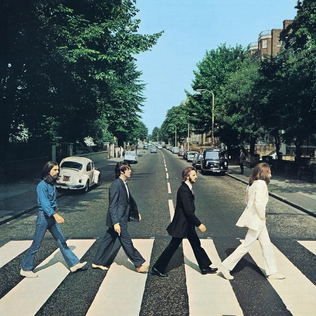
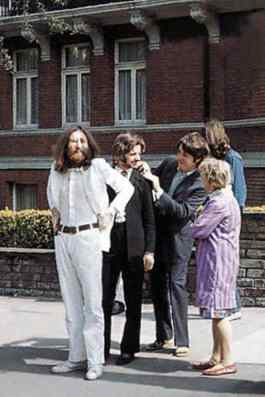
John Lennon loved him and at 23, he found himself art directing the cover of their iconic album, Abbey Road.
What many people fail to realise is the band name was no where on the cover.
And while John had logic behind that decision, many in the industry thought differently.
Especially at their record company, EMI.
In fact, the only reason it ended up happening is that timing was so tight that it was allowed to slip through before anyone else could stop it.
Another example of chaos creating what order can’t.

What a story eh?
And before anyone starts saying I’m wrong …
I’m not saying the decision to remove the bands name from the cover made the album successful. This was The Beatles after all – the biggest, most successful band of all time – so it was always going to sell by the bucketload. However I am saying the decision to remove the bands name from the album cover helped make it iconic … which arguably, helped make it even more successful.
Not to mention make the zebra crossing on Abbey Road one of the busiest in the World.
Filed under: A Bit Of Inspiration, Attitude & Aptitude, Authenticity, Black Lives Matter, Comment, Corporate Evil, Culture, Empathy, Equality, History, Honesty, Love, Loyalty, Perspective, Politics, Racism, Relevance, Resonance, Social Commentary, Social Divide
OK, let’s get the obvious out the way.
Even if 2020 is the most important year, it’s still been a shit year.
But the point being made is a good one.
To be honest, when I first read it, it felt very much like an ad for NIKE.
Taking what we think and forcing us to re-imagine it.
To feel the words rather than functionally jump to conclusions.
And while there may well be a lot of good that comes out of this.
There has been a lot of pain to lead up to this point and then get to this situation.
However as much as many of us probably wish to put all this behind us, it reminds me of something my Dad once told me.
My Dad changed careers quite a lot in his life.
And when I say ‘changed careers’, I mean it.
From the RAF to insurance to a photographer to law.
Fortunately for the family, my Mum was much more stable … hahaha.
But one day I asked my Dad why he did it … why he didn’t just change job, but dramatically and radically changed industry, even if it meant he had to retrain and re-qualify.
And he gave me the best answer I’ve ever heard.
It went like this:
“I love you and your Mum. If I’m going to spend so much time away from you every single day day, I owe it to you to be doing something I love because nothing would be more insulting than being away from the people I want to spend all my time with, doing something I hate”.
I have always taken that to heart.
Fulfilment over contentment.
It’s what has helped me make decisions that others thought were mad.
It’s behind the jobs I’ve taken, the countries I’ve lived in and the projects I’ve embarked on.
And while there were times it opened up challenges that made me question what I was doing, it always was worth it.
The best things always are.
And while I’ve experienced a fraction of the pain others have had to endure in 2020 – both in terms of the impact it has had on them and the duration it has lasted for them – this is the moment where we need to see change through … to get to the other side rather than try to go back to where we were.
Because on the other side of all this shit, is a chance.
A real, once-in-a-lifetime chance to make things right.
Not just in the US, but everywhere.
Where the systemic and systematic prejudice and racism that is embedded and integrated into our whole way of life is changed.
From education to higher government.
Where people of colour are given the equal rights that the rest of us have enjoyed our entire life.
And let’s be honest, if we do that, we still get the easy job.
There’s people out there who have fought for generations for this moment.
To be seen … heard … noticed … valued.
Which is why we have a moral duty to see this through … to keep fighting to the very end … because nothing would be more disrespectful to the people we say we stand with than walking away at the point we have the chance to make sustainable, effective change.
And if you need any other reason – which you shouldn’t, but just in case – there’s the fact that if we force equality – real, actionable, sustainable equality – into our everyday lives, the people of colour community will lift us all higher.
Take us somewhere better. For absolutely everyone.
Which is why we have to choose fulfilment over comfort.
We over me.
To make 2020 the most important year rather than the worst.