
Filed under: America, Attitude & Aptitude, Australia, Childhood, China, Comment, Culture, Daddyhood, Emotion, Empathy, Environment, Family, Home, Jill, Love, My Fatherhood, New Zealand, Otis, Parents, Respect, School
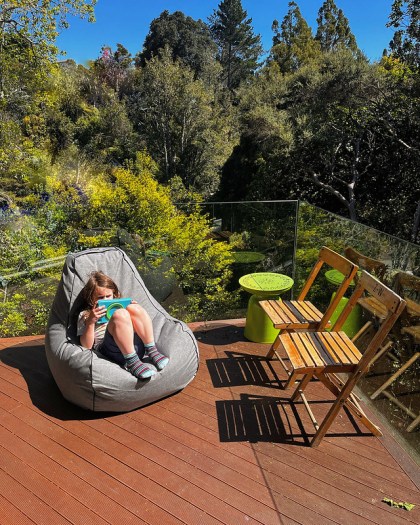
3 different nationalities.
4 different countries [In 4 different continents]
5 different homes.
4 different schools.
Two major long lockdowns.
All of this in just 6 – but soon to be 7 – short years.
And yet despite all that change … all that waving goodbye and learning to say new hellos … he remains a happy, curious, cheeky and compassionate kid.
And while he loved his life in China, America and the UK … he is blossoming in NZ.
Sure, some of that is because he has been able to get back into some sort of routine, meet new friends and play with other kids his own age – at least until Delta struck and he got locked down with his parents for weeks on end – but it’s more than that …
Outdoor life is a way of life here.
Being outside is no longer a conscious choice.
The line between indoors and outdoors is now very slim.
No need to change clothes. No need to wear shoes. Spontaneity is allowed to flow which – let’s be honest – is exactly how a kid should be able to live their life.
I’ve lived in similar environments before … in Australia and America for example … but whether it’s because I’m older or now live in a bloody treehouse or have a kid of my own, I appreciate it so much more.
Watching him be able to run around outside is a real privilege.
Of course, for people born here, that’s a normality … but I have lived in environments where that’s not the case, which is why even seeing him watch his iPad in the sun is something I don’t take for granted.

We cannot discount the importance of being able to play outside, but sadly many governments and councils seem to.
Viewing it as ‘a favour’ rather than a fundamental right.
Playing outside helps kids in so many ways.
Bond … learn … imagine … express … play … explore … compete … respect.
It’s not a ‘waste of time’, it creates a deeper foundation for life.
An ability to think outside of lines and others definitions.
Giving kids an environments where they can be outside is basically an investment in a countries future.
A nation of curious, interested, healthy people.
But not everyone gets this.
Some actively try to stop this.
Often people of immense privilege who either associate outdoor life as something for either the elite or the rough.
Fortunately NZ does not see it this way.
They revel and celebrate it.
They have the best parks I’ve ever seen in my life.
Parks made to enjoy and encourage kids to push their boundaries.
A new discovery of what you’re capable of with every visit.
And while for most kids it’s about developing, for Otis it’s also about grounding.
A place he can feel is his.
A connection to where he lives in a way he’s not had before.
Because while he is young, I do not underestimate what he has been through.
Fuck, there’s people I have worked with who have literally freaked out when asked to move office desks … and yet here’s my kid, who has moved countries, homes and friends and still embraces the possibilities of every situation.
So much of that is down to his brilliant Mum who has helped that change happen in the most comfortable, seamless way … but it still requires a mindset to look at what you’ll gain rather than just what you lose.
And while I know one day I’ll no doubt be dragging him off for another adventure somewhere else on the planet [but don’t worry, it won’t be for ages. Probably] I want you to know that I love you from tip to toe and let you know I’m so, so proud to be your dad.
Thank you Otis, you’re a little legend.
Filed under: A Bit Of Inspiration, Attitude & Aptitude, Communication Strategy, Customer Service, Empathy, Management, Marketing Fail
We need systems.
We need them for all manner of how we live.
From ensuring we get our content on Netflix through to ensuring our food is safe.
Systems drive efficiency and effectiveness and are a competitive weapon for business.
But they can also be suicide.
When ‘human centred design’ isn’t that human.
When you focus more on what the system does rather than who it’s for.
When you set rules that become dictatorial rather than accessible.
And while the post below is funny, it’s a good reminder that if you don’t put the needs of people first – rather than what you want the needs of people to be – then you not only run the risk of having to tell your customer/client/colleague “the computer says no”, you may end up calling them a loser … literally and metaphorically.
Worse, the person telling them that is a bitch. Apparently.
Again, literally and metaphorically.
And then you will have invented a new system.
The customer disservice and ineffective model.

Filed under: A Bit Of Inspiration, Advertising, Agency Culture, Attitude & Aptitude, China, Comment, Confidence, Craft, Creative Brief, Creative Development, Creativity, Distinction, Emotion, Empathy, Entertainment, Environment, Experience, Fulfillment, Happiness, Honesty, Imagination, Innovation, Insight, Legend, Marketing, Technology

I’ve written a lot about experience in the past.
How important it is.
How it can drive brand value and growth.
How it can create distinction and differentiation in crowded categories.
I’ve also talked about how badly so much of it is done.
That it’s more about consistency than excellence.
That it isn’t a new approach, just a new profit centre.
That many aspire to everything average than some things spectacular.
It blows my mind what some agencies and companies think is ‘an experience’.
Especially when you compare it to people who genuinely ‘get it’.
Whether it’s certain luxury brands or my client, SKP-S in Beijing.
Which is why I love the picture at the top of this page.
At the time, the person on the runway was 62 years old.
SIXTY TWO.
This was taken on the first of 3 nights of performing to 68,000 paying people.
So over 200,000 in total.
In South America.
Think about that for a second.
OK, so the person in question is Brian Johnson … lead singer of rock band AC/DC.
But let’s also remember we’re talking about a group of pensioners.
Literally.
Yes, I appreciate there are all-sorts of factors/considerations/contexts/excuses you could use to explain why they can achieve that sort of response when brands – with all their experience models and big budgets – can’t.
But the one thing AC/DC understand is if you want to keep people coming back, you need to focus on creating a seminal moment for your audience not average consistency.
It’s why I always ask ‘experience strategists’ about their life rather than just their work. I want to know what their frame of references are for experience. Because frankly – and I appreciate I’m being a massive snob here – if it doesn’t include festivals, theatre, art, music, retail, museums … then I don’t know if we’re ever going to share the same ambitions.
Because while I appreciate ‘average but consistent’ has value to some organisations, I would rather drink bleach than advocate that as a brand goal.
Not simply because I have an aversion to average.
But because when you do experience right – which means knowing who you are and who your customers are – the profits extrapolate. See, I’m not totally selfish.
Filed under: A Bit Of Inspiration, Attitude & Aptitude, Comment, Corporate Evil, Cunning, Death
A few months ago, I wrote about Philip Morris’ alleged ‘transformation’ from being a manufacturer of cancer sticks to a health company.
Well not only are they continuing with this ambition, they are adopting the Trump/Johnson strategy of acceptance.
What that means is this.
1. Drop the word ‘health’ in every conversation.
2. Use language that positions you as ‘the good guys’.
3. Under no circumstances ever acknowledge any mistake from the past.
4. Publicly question the credibility of anyone who challenges your actions.
5. Act like you only care about average people, never the corporate elite, despite you constantly and continually living and flaunting the sort of life no average individual could enjoy.
And why am I saying all this?
Because of this …

What the absolute fuck.
This is a company who purposefully, willingly and cynically spread false information about the benefits of their product over decades … talking about the dangers of companies who spread false information.
Hell, they even add a ‘warning’ that sounds awfully like the government mandated warning that appears on the front of every cigarette packet.
Seriously, this could only be more ironic if it came from Facebook.
Only a company who literally doesn’t give a shit about morals or honesty or other people’s health would do something like this. But let’s be honest, we shouldn’t be surprised.
Their whole history is littered with manipulation, lies and false information.

From making cigarette products labelled ‘lite’ to give the impression they were ‘better for you’ [they weren’t] to that iconic moment of shame, where the CEO’s of the biggest tobacco companies stood up in from of politicians in the House of Representatives, raised their hand and said their product was not dangerous when they already knew it was and it was killing people.
In fact, in this testimony, not only did the CEO of Philip Morris of the time, William Campbell, proclaim:
“I believe nicotine is not addictive” … which was subsequently repeated by the other executives of the biggest tobacco companies in America … one went on to insist that cigarettes were no more addictive than coffee, tea or Twinkies.
Fortunately, Henry Waxman, a democrat politician who was leading the proceedings, fired back: “The difference between cigarettes and Twinkies is death”.
Pretty hard to come back from a statement like that, even though they tried. Not because they had got so used to lying they thought it was true – they were VERY aware of the deceit they were peddling – it was more they were incredulous to anyone questioning what they said.
So given Philip Morris are so passionate about facts, compare what they say in their ‘brand ‘purpose’ with what they say in public.
Don’t know about you, but it appears they’re not as aligned as they should be … because rather than being about health, it’s more about making their product less death.
‘Less’ death.
But for all the cleverly ambiguity they’ve placed in their writing, the overriding impression I am left with is that they don’t actually understand the meaning of the word truth … which is the only thing I may believe from Philip Morris.
Filed under: Advertising, Agency Culture, Attitude & Aptitude, Authenticity, Brand, Comment, Content, Context, Craft, Creativity, Culture, Differentiation, Distinction, Honesty, Marketing, Netflix, Perspective, Planners
By now, everyone will have heard about Squid Game.
It is – if not already – Netflix’s most watched show.
Ever.
There’s many planners who are writing ‘thought pieces’ on why this happened … but at the heart of it, it’s a greatly entertaining – and incredibly dark – story, with brilliant production values topped off with fantastic characters and acting.
Over the past few weeks, there’s been all manner of news stories coming out about the impact the show has had on broader culture … from sales of white, slip-on Vans – that feature in the show – going up 7800% right through to their instagram going up from 410,000 to 16 million in a matter of weeks.
That said, my favourite ‘proof of impact’ is this insta from one of the stars on the show:
But none of this is the point of this post, the point is related to the picture at the top of this post.
Over the past few weeks, I’ve just been seeing more and more brands – and agencies, specifically TBWA – exploiting the success of Squid Game for their own benefit.
Worse, the vast majority of these brands and agencies have absolutely nothing to do with the show – or Netflix – whatsoever.
Now I shouldn’t be surprised … this sort of thing has been going on for donkey’s years. However, whereas once ‘hijacking’ was a new and exciting way to get ahead of the pack and drive awareness and attention … this approach has now become so expected that any element of ‘surprise’ has gone.
In fact, the overall impact of this act is either seen as desperate or just ignored.
It doesn’t have to be this way.
If people are willing to forgo their laziness for a second, they can look for ways where what they are ‘borrowing’ adds to the culture of the community rather than just stealing from it.
Better yet, they could collaborate with the people who actually created the idea and make something even bigger for culture to enjoy.
But that rarely happens because we live in an industry where speed is seen as being better than substance and stealing is viewed as being more valuable than building … and while there are short-term ‘benefits’ to that approach, all it does is continue to destroy the value of creativity … which is ironic, given all of these approaches are feeding off the power, value and influence of it.
There’s a saying that says ‘genius steals’.
While I know where it came from and what they were trying to say with it … it’s obvious that term is no longer valid.
Lazy pricks, steal.
While finding ways to help our work – and our clients needs – will always be important, if we want to be taken seriously, let’s be the creators, not the parasites..