
Filed under: Advertising, Attitude & Aptitude, Comedians, Communication Strategy, Context, Creativity, Culture, Cunning
Years ago I wrote a post about how Borat was deeply prejudiced and yet – because it was done for humour – it was totally fine to use the worst stereotypes to define and express a culture, heritage or community.
Now of course that’s something comedians have hung onto for years.
The ability to leave no subject on the table.
To let humour challenge myopic beliefs and attitudes.
And, to be honest, I’m a big believer in that – as I am with art – but sometimes you can’t help but feel some people use it as a convenient excuse to purposefully profit from notoriety.
Where instead of adding to the conversation, they just exploit it.
Taking rather than adding.
I say that because I recently saw this:

Yes, I know it does no one any harm.
And I appreciate that London is not the sunniest place in the World.
But it all feels a bit lazy … not to mention confusing given they have called yellow, ‘bumblebee’ when surely they could have named it, ‘LA sun’.
Or something.
But by the same token, I not only remembered it, I wrote about it – so maybe this highlights the reason we need to allow humour to challenge our perceptions and perspectives because maybe the biggest thing that this post has actually revealed is my English fragility, and I’m not even from London!
Wow, I’ve got whiplash from the turnaround of this post.
Filed under: A Bit Of Inspiration, Advertising, Agency Culture, Attitude & Aptitude, Colenso, Colleagues, Comment, Communication Strategy, Creative Development, Creativity, Culture, Cynic, Empathy, Honesty, Marketing, Media, Perspective, Planning, Point Of View, Provocative, Relevance, Resonance, Wieden+Kennedy
This blog has been going for a loooooooong time.
Which means, it’s had its fair share of April Fool posts.
Some have been very good [even though I say it myself] with different industry people picking it up and commenting on it thinking it’s real.
And some being utterly, utterly shite.
But this year I decided not to do one.
Not because I couldn’t be bothered.
Nor because I couldn’t think of what to do.
Not because it was an Easter holiday on April 1.
But because after a while, it just becomes a bit boring.
I say this because a lot of brands don’t seem to get that. Instead, they keep doing the same thing over and over again without realising the audience have moved on.
That might be because of ego. That might be because of a lack of self-awareness. That might be because they don’t even know who the fuck their audience is … but whatever the reason, they keep doing what they do regardless.
And one of those things they keep repeating is ‘hijacking culture’.
By that I mean either during or after a topical event … they hire a van, slap a billboard on the back, put some headline on it that refers to whatever event they are ‘leveraging’ and then drive back and forth so a photographer can snap it in situ and then send it to the press or put it on the socials.
Hey, sometimes it’s really good.
But often, it just feels pretty sad.
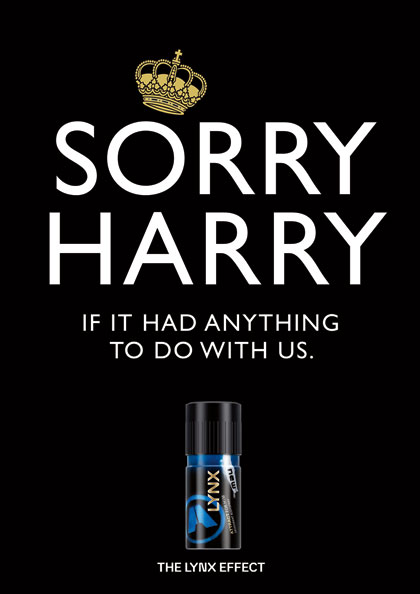
Especially when lots of companies are all trying to do exactly the same thing for the same event at the same time.

Look I get it … it’s a way to get boost attention.
It’s also a way to show your client – or their bosses – you’re ‘on the ball’.
Can’t criticise that … except in many cases, it also seems to have a subliminal admission that they need to borrow from others to make people care about them.
Which is less good.
Yes, I know I’m being a bit of a pedantic asshole here, but here’s the thing … when people expect brands to do this stuff, then you have to accept that you’re no longer ‘hijacking’ anything, you’re simply conforming.
Of course there are ways to do it well.
Wieden were the masters and – arguably – the originators of it.
Which was basically to do stuff that ‘added to the cultural conversation, not just stole from it.
They did it with NIKE for literally decades.
Olympics.
Superbowls.
World Cups.
Winning.
Failing.
Achievements.
Retirements.
Fines.
Spectaculars.
But achieving it wasn’t simply down to great talent, great clients or being quick at doing stuff like this, it was down to 3 things.
Creatives co-run/run the account, not simply make the ads.
They understand the culture around the category, not just the category.
They think in terms of owning the brand voice, not just launching campaigns.
What the combination means is everyone feels there role and purpose is more than just making advertising, but finding how … where … when and who the brand can/should a voice and point of view. It’s more than just being pro-active, it’s a confidence in your preparation.
You know what the brand will say.
You know how the brand will say it.
You know what the culture of the audience want and need.
You’re moving things forward because you’re always moving things forward. Seeing your role as far more than simply fulfilling ‘campaign requirements’ and ‘unexpected opportunities’ but directly and continually driving, shaping and influencing the behaviour and energy of the vision and role of the brand in culture.
Many people will say they do that, few do.
Instead they just churn out stunts or puns that often end up being more for the ego of the people involved than the benefit of the audience it is supposedly for.
Which is the heart of what, in my opinion, separates brands/agencies who get it and those who pretend they do.
Because the wannabes and imposters talk about how they will make the masses love their brand, whereas the real deal know it’s about the brand showing and expressing who they love and who they are for.
Filed under: A Bit Of Inspiration, Advertising, Attitude & Aptitude, Authenticity, Comment, Communication Strategy, Context, Creativity, Culture, Emotion, Empathy, Environment, Marketing, Relevance, Resonance, Respect
Hello. I’m back again.
And I think I’m back for a few weeks now … you must be so happy.
Cue: Evil laugh.
OK, let’s get on with it shall we?
So one of the things I’ve loved about getting healthier, is walking around my neighbourhood.
Going down random streets.
Seeing at new shops.
Just getting a better sense and connection to the place I currently call home.
And on my travels, I came across this.

I have to say, I love it.
People may see it as an old piece of paper stuck on their window, but I don’t see it like that.
I see pride.
Pride in where they come from.
Pride in what Pita created.
Pride in Pita’s craft and skills.
Pride in what Bob – and Charlie – continue to do.
Pride in how they approach their work.
Pride in their community.
Pride in their longevity.
Pride in their role.
I have no idea how long that piece of paper has been up – and given how faded it is, it would suggest a while – but at a time where so many people and companies are ‘bigging themselves up’ based on the most superficial of reasons, it’s lovely to see someone honour their experience in service of their community, rather than adopt the attitude that people should be grateful they exist and acknowledge them.
Given all the talk our industry spouts about communities, fandom and membership … this may be one of the key areas many forget to highlight or recognise. Possibly because in their desperation to look like a ‘Linkedin leader’, they spend their time ‘codifying’ how they think communities operate, rather than recognise the emotional conditions that explain why it does.
Filed under: A Bit Of Inspiration, Advertising, Attitude & Aptitude, Brand, Brand Suicide, Brilliant Marketing Ideas In History, Comment, Communication Strategy, Confidence, Context, Crap Marketing Ideas From History!, Creativity, Culture, Devious Strategy, Differentiation, Effectiveness, Entertainment, Happiness, Innovation, Luxury, Mischief, Packaging, Planning, Professionalism, Relevance, Resonance, Strategy
This is the last post for a week because I’m off again.
I know … I know … it’s getting ridiculous, but consider my jet-lag, your mental health.
Talking of mental health … I’ve not had a drop of alcohol for 38 years.
THIRTY EIGHT.
But despite that, I do find myself buying it on occasion … mainly when those occasions are an extremely rare dinner invite and/or a desire to show gratitude towards someone in particular.
And when that happens, I remind myself how easily influenced I can be.
Because as we saw in 2007, my biggest motivator is the packaging rather than the quality of the product.
Well, I say that, but it has to be a brand I’ve at least heard of – a brand I associate with some sort of quality – but fundamentally, it’s all about the packaging.
Recently I wanted to get something for our old neighbour in LA.
It was his birthday … he’s an amazing human … and he invited me to his dinner. [I was in town, so it wasn’t some totally empty gesture]
So I rushed to a bottle shop and was immediately hit with a wealth of choices and options and so what did I end up choosing?
This.

Yep, a bottle of Veuve in a pseudo orange SMEG fridge.
Frankly it looked ridiculous … hell, it is ridiculous … but it’s also my kind of ridiculous, despite even my low-class tastes thought that for 2 brands that are supposedly ‘premium’, the way they combined looked cheap and tragic.
But unsuprisingly, my inner Dolly ‘it-costs-a-lot-of-money-to-look-this-cheap’ Parton, took over and I handed over my cash and walked out full of smugness and slight humiliation.
Now I don’t know the background to this collab.
I don’t know the process they took to get here,
And while on one level it makes some-sort-of-sense, it also is completely and utterly bonkers … and that’s why I love it.
Because in a world of sensible, it’s nice to see ridiculous win.
Yes, I appreciate Apple’s ‘ceremony of purchase’ packaging strategy is next level … but in terms of what I call, ‘social luxury’, the use of ridiculous packaging – as seen in the fragrance industry – is arguably, the most sensible thing they can do.
For all the processes, models and eco-systems being pushed by so many people right now, it’s interesting how few actively encourage searching for the weird edges. Ironically, they build approaches where the aim is to filter these out before they even have a chance to see what they can do. Which is why as much as the we laugh at the superficiality of fragrance companies and some alcohol brands, they can teach us more about standing out than all these models that seem obsessed with making sure we all ‘fit in’.
So who are the stupid ones now eh?
Filed under: A Bit Of Inspiration, Advertising, Agency Culture, Attitude & Aptitude, Comment, Complicity, Confidence, Context, Creative Development, Creativity, Culture, Differentiation, Distinction, Effectiveness, Innovation, Insight, Linkedin, Marketing, Marketing Fail, Mediocrity, Planners, Planners Making A Complete Tit Of Themselves And Bless, Planning, Relevance, Standards, Strategy, Trust, Wieden+Kennedy
There is a lot of talk about a new term in marketing, called ‘UBR’.
UBR stands for Universal Buying Reason and there’s a lot of people seemingly wetting their pants over it. In essence, UBR is when a brand owns a position within a category that arguably, anyone within that category could have had, but they were first or the most consistent or invested in making it their or were simply, the biggest spenders behind it.
If you’re thinking this is not exactly new, you’d be right … but many people seem to be more obsessed with being associated with new terminologies or methodologies than actually making stuff that pushes brands and business to new places.
That’s why UBR feels like the next terminology trope in a long line of terminology tropes …
Brand Assets.
Brand Eco-Systems.
Global Human Truths.
Overly simplicitic labels that promote conformity under the guise of effectiveness or efficiency.
[And yes, I know Dan Wieden used to talk about Global Human Truths … and as I told him, he was wrong. Because while all Mum’s may love their kids, a Mum in Wuhan shows it in very different ways than a Mum in Washington, and to ignore that nuance is to ignore truth for convenience and complicity. And as anyone worth their salt will tell you, often it’s the nuance that is the difference between doing things for people or about them]
Of course, like all trope trends, there’s some value in what is being said about UBR – after all, its hardly a new concept given countless brands and categories have used this approach for literally decades, from alcohol to jewellery.
But what some of the people pushing UBR are seemingly forgetting – or not understanding – is that even at the most functional level of category marketing, it requires depth and consideration to fully release its potential … and frankly the lack of discussion about that highlights the industries obsession with providing clients with easy answers/solutions rather than encouraging/pushing/provoking them to appreciate the rewards [and shareholder benefit, let alone expectation] of putting in the hard work to identify how they can consistently build their value, role and position.
What scares me most is that some of the people ‘fluffing UBR’ – but thankfully not all – are in jobs where they’re paid to help clients with their business … and yet they talk in incredibly generalistic and simplistic terms about something that has context and complexity.
Where the hell is their objectivity?
Where is the understanding?
Where is the nuance?
It all feels like a desperate play to be seen as an industry thought leader, where the goal is to highjack whatever seems to be getting industry traction and then aligning themselves to it.
What’s worse is we’ve seen how this approach works as more and more people value and aspire speed and status over substance and experience … and I don’t really care that makes me sound old, because it actually has nothing to do with age, and everything to do with valuing what our industry can do when we do it with craft, understanding and ambition.
What sums it all up [for me] is how one of the brands the UBR advocates bang on about is Tesco’s.
I get why, because on face value, Tesco’s is a supermarket like every other supermarket.
But …
All it takes is a quick look at Tesco’s history – from their foundation in 1919 through to the many acts and actions they’ve embraced and led over 100 years, from the ‘computers for schools’ program to challenging EU law to give their customers access to products at the same price as their European cousins and a million things in-between – and they’d see the ‘Every Little Helps’ position is not something ‘anyone’ could say, but something far more specific to them specifically … something they’ve continually reinforced and invested in through retail, customer and cultural innovation as opposed to just the repetition of a category trope.
It’s yet another example of people needing to know their history before they can claim they’re creators of it.
Or – said another way – why clients and the industry at large, need to get back to valuing those who have DONE and DO shit, rather than just talk it … regardless how popular or well-meaning they may be.
[OK, ‘talking shit’ is harsh, but it sounded good in that sentence, so forgive me]
Don’t get me wrong, I’m all for pushing knowledge and possibilities, I’m just not for people putting lipstick on a dead sheep and calling it Ms World.
And don’t get me started on how many of these people are ultimately downplaying someone else’s creative excellence to make it all about them.
Wow, that’s like a rant from 2010. Felt good. Thanks industry trope for waking me up.