
Filed under: A Bit Of Inspiration, Advertising, Attitude & Aptitude, Brand, Brand Suicide, Comment, Communication Strategy, Crap Campaigns In History, Crap Marketing Ideas From History!, Creativity, Culture, Equality, Management, Marketing, Marketing Fail, Women
Years ago I worked on the shampoo brand Sunsilk.
I know. Me.
A bald bloke.
Hahahahahahahaha.
Back then, it was in a two brand fight for dominance with Pantene.
They went back and forth trying to get one over the over.
Apparently the brands had legally agreed how each one could show the ‘shine’ of the hair they washed in TV ads. A slight deviation that allowed each one to build their own distinctive look.
Back when I was on it, albeit for 2 mins, Sunsilk was a big, mature brand.
A powerhouse.
So you can imagine my surprise when I saw this:
What in gods name is that?
What is it?
It’s like the worst Barbie ad I’ve ever seen.
An ad that claims to ‘rethink’ pink but doesn’t really rethink anything.
Oh they may think they are, but the people behind this need to know you can’t just say pink now represents possibilities, future, strength and shiny [gotta get those haircare ad cues in there, even if it makes even less sense to the premise of the ad] … you actually have to make it mean that.
It’s a commitment.
A focus.
Acts beyond advertising.
So sadly, when you make an ad so bubblegum it looks like the bastard love child of the movie, Legally Blonde and a packet of original Hubba Bubba, you’re not really going to convince anyone.
On the positive, they cop out by saying ‘pink is whatever we make it’ and so I would like to tell the people at Unilever and Sunilk they did exactly that, because they have made pink brown.
Shitty brown.
Am I being mean?
Yep.
But then this is a multi-billion dollar company who has profited by putting women across Asia in cultural jail by promoting white skin as the right skin … used COVID to maximise profits for their antiseptic products and continually used stereotypes to promote it’s products … so I don’t have much sympathy for them.
Especially when they’re now trying to connect to young women by saying ‘pink’ is powerful while using all the same tropes, styles and themes that means what they’re actually communicating is ‘pink is the same old girly cliche they’ve been profiting from, for decades’.
There’s some absolutely incredibly talented people at Unilever.
Including some very good friends of mine.
There’s also some brilliant systems and processes within the organisation.
Sadly, there’s also a blinkered reliance on some questionable research methodologies, which results in a lack of self awareness so they end up with work like this.
They have done some brilliant work in the past.
Some truly brilliant.
But – in my opinion – not so much right now. Made worse with the sort of underlying messages that undermine people rather than elevate them.
If it wasn’t for their huge distribution and pricing power, it would be interesting to see what would happen to the brand.
But the thing is I want them to do well.
I want them to make work that changes and positively impacts culture.
They’re a huge spender on advertising.
They have the ability to change how culture feels and how the industry is perceived.
A Unilever that does great advertising is a Unilever that will have positive knock-on effects in a whole host of other areas and industries.
I’d even be willing to help them – for free, for a time – if their starting point was about building change through truth rather than their messed-up, manipulative version of purpose.
However given they made this ad after saying they wanted to stop the stereotypes in their advertising, it appears their view of reality is more blinkered than a racehorse.
Filed under: A Bit Of Inspiration, Advertising, Agency Culture, Attitude & Aptitude, Authenticity, Brand, Brand Suicide, China, Chinese Culture, Comment, Communication Strategy, Confidence, Creative Development, Creativity, Culture, Emotion, Empathy, Insight, Marketing, Nike, olympics, Resonance, Shanghai, Sport, Wieden+Kennedy
I have now had time to get over the Euro finals.
While my Italian/English heritage meant I was going to ‘win’ regardless of the result – and while the result, at least to me, was probably fair – I was gutted for the England team.
Ironically, the disgusting behaviour of the fans after the match – fired up by the equally disgusting behaviour of the British government – kind-of made me happy they lost.
It’s at these moments teams – or brands – can fall away and so what happens next becomes unbelievably important.
It reminded me of 2008 when Chinese hurdler – and gold medal contender – Liu Xiang, broke China’s hearts by injuring himself during the race.
Remember, this was the year the Olympics was held in Beijing and in many ways, it was the governments ‘coming out’ party to the rest of the World. A chance to showcase the nations abilities, talent, skills and sophistication. A declaration a new superpower was here.
While that might have been news to the rest of the World, for the people of China, they had known this for a long time which is why when Liu Xiang faltered through injury, people – like in the UK – started to turn on him.
While he did not face the disgusting and disgraceful racist abuse certain members of the England team have encountered, he did face claims that by pulling out mid-race, he had not tried hard enough, had embarrassed China and sold the people false hope.
Because Liu Xiang was a NIKE athlete, overnight W+K Shanghai created an ad that aimed to reframe the loss for the people across China.
To shift emotions from anger to pride, love, support.
The next morning, this ad ran in most of the papers …

It is still widely acknowledged as one of the pivotal pieces of communication.
Not just by the industry.
Not just by NIKE.
Not even by Liu Xiang.
But by people across China who woke up to that ad the next morning.
Turning anger to sympathy.
Turning abuse to respect.
Turning sport into culture.
I say all this because on the day England finished runners-up in the Euro’s, the English FA released – what I consider – the modern version of our Liu Xiang ad.

I hope it works for England and their players.
But mainly the players.
Because they did bring something home …
Every one of them.
Pride. Unity. Hope.
Until those racist fucks robbed it off them … off the rest of us.
And while the media may like to suggest those responsible are a small minority of hooligans, the reality is it’s not a small minority and hooligans are not some cartoon villain.
In fact the problem is these pricks live amongst all of us. They are invisible because they look, live and work like so many of us. They’re fathers. Sons. Brothers. Uncles.
They’re also racist scum.
Exemplified by their hate towards the 3 England players who missed their penalties.
These 3 brilliant and inspiring men are young.
Hell, Bukayo Saka is 19.
NINETEEN.
At that age I couldn’t even ask out a woman who worked on the till at Asda, West Bridgford … so anyone who gives him shit when he’s playing for the England national football team, in the final of the Euro’s, at the most intense and pressured moment of the entire tournament, with billions watching can just fuck off.
Winning FIFA 2014 on Playstation doesn’t make you a winner, it makes you a fantasist.
And to them I am glad football didn’t come home.
I just wish football could take them far away from it.
Filed under: A Bit Of Inspiration, Advertising, Agency Culture, Attitude & Aptitude, Authenticity, Brand Suicide, Comment, Communication Strategy, Confidence, Corporate Evil, Creative Brief, Creative Development, Creativity, Culture, Differentiation, Distinction, Imagination, Innovation, Insight, Management, Marketing, Marketing Fail, Perspective, Relevance, Resonance, Talent

I still remember buying a movie soundtrack only to discover none of the songs had actually featured in the movie.
When I looked at the cover, I saw “songs inspired by the movie” … in other words, the film company couldn’t get the rights to release the actual music, so they got some two-bit band to write some nondescript music supposedly after watching the film.
It wasn’t as bad as those albums where they got a covers band to sing a well known song – rather than the actual artist – but it was close.
The reason I say this is that I’m seeing a bunch of ‘write-ups’ of ads that seem to adopt the same position.
“Inspired by”.
“Influenced”
“Reinterpreted”.
Now there’s nothing really wrong with this … it’s something that’s been done by all manner of industries for centuries … however while there’s a common belief that ‘genius steals’, the counter to this is ‘lazy borrows’.
I know … I know … I’m being deliberately assholey, but the beauty of our industry is when we allow creatives the freedom to create.
To allow their crazy minds to take us all to crazy intriguing places.
But instead … thanks to budgets, timelines, dictatorial research, corporate fear, layers of management – and countless other things – we don’t.
Which is why we see so many pieces of work that are replications of a film, a meme, a song, a TikTok idea … basically a version of an album of popular songs that haven’t been played by any of the original artists.
Our industry is capable of brilliant things.
But we’ve sold creativity down the river in a bid to make things easier for people who don’t even value the power of creativity.
Nothing smacks of madness as much as that.
Meanwhile, culture leads change of behaviour, attitudes and choices through its endless energy to explore and express.
So while being inspired is one thing, duplicating is another and when certain brands expect people to spend hundreds or thousands on their products, it blows my mind they want to under-invest in the way they actually present themselves in their communication.
Oh they won’t see it that way.
They’ll talk about the celebrity they hired to front the campaign.
Or the music they licensed.
But underneath it all, they’ll they’re taking shortcuts.
They’ll kid themselves it’s working with charts on optimisation or efficiencies … but the reality is they’re trying to work out how long they’ve got before it all falls apart, because the difference between leading and chasing is not about spend, it’s about attitude.
Or said another way …
You either make music or you’re just a cover band.
Filed under: Advertising, Agency Culture, Apathy, Attitude & Aptitude, Authenticity, Brand, Brand Suicide, Colenso, Comment, Communication Strategy, Confidence, Crap Campaigns In History, Crap Marketing Ideas From History!, Creative Brief, Creative Development, Creativity, Differentiation, Distinction, Emotion, Empathy, Equality, Experience, Fake Attitude, Focus Groups, Honesty, Imagination, Innovation, Insight, Management, Marketing, Marketing Fail, Only In Adland, Perspective, Planners, Planning, Point Of View, Relevance, Resonance, Stubborness, Uncommon, Wieden+Kennedy

So many ads today end up just being fancy sales brochures.
A nondescript, stylish image that either has some meaningless line thrust upon it or a literal lift of the proposition from the brief to become the headline.
Clients love it because they think there’s no wastage.
That there’s no ‘thinking’ that the audience has to do to ‘get the message’.
I remember years ago – when I was working on SONY – the client kept referencing Mr Bean.
No, I’m not joking.
They kept saying Mr Bean is understood by all. Loved by all. Communicates a message without saying a word. They were really trying to push this until I pointed out that while that’s the case, no one would spend thousands buying a TV made by Mr Bean.
Then Balls got made and undermined my argument for years. Hahahaha.
And while I hate looking backwards, I can’t help but think the past was far more interesting creatively than where we’re at today.
These days Audi talk about ‘Future is an attitude‘ when once they talked about Vorsprung Durch Technik.

We have Chivas Regal going on about ‘every taste is an experience’ when once they talked about ‘giving Dad an expensive belt‘.

Heineken now ‘open your world‘ when they once ‘refreshed the parts other beers can’t reach‘.
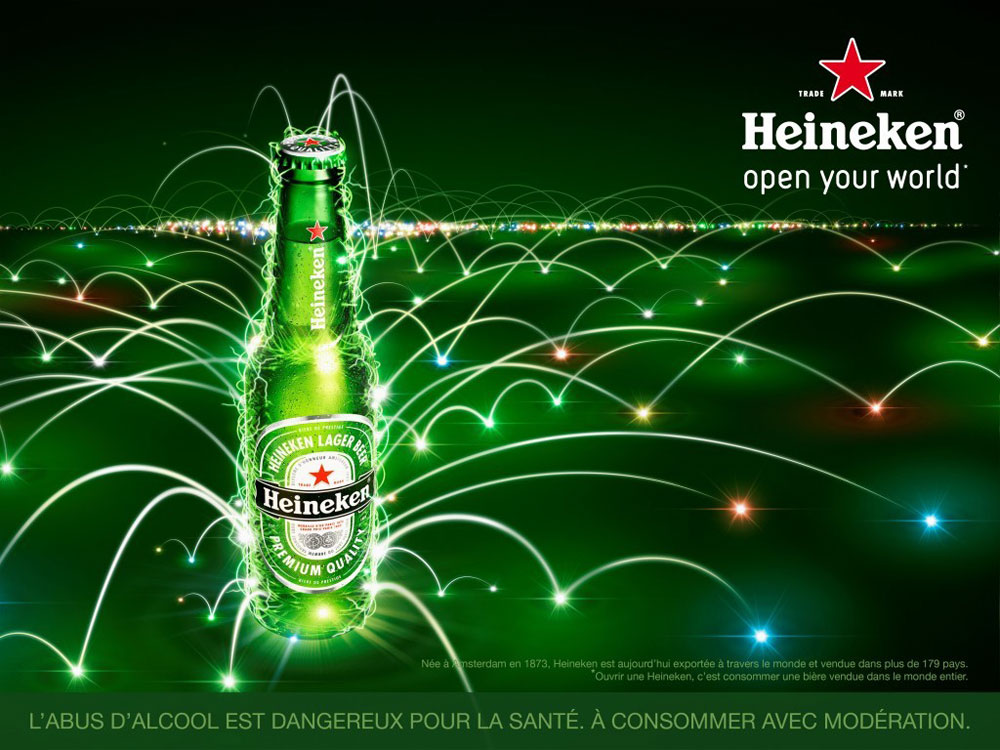
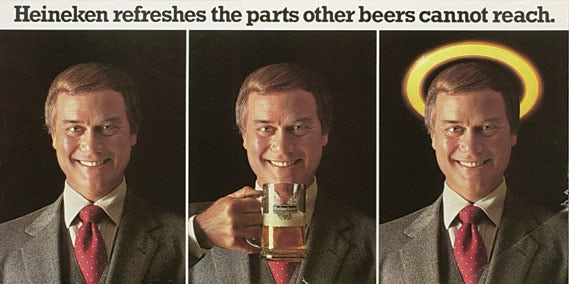
We have countless other brands who were once so powerful with their brand voice who have now become bland.
[Nothing sums it up like this Audi ad for the same car with pretty much the same line]
What really gets me, is we have the talent in the industry to change this.
We have the hunger as well.
But while there are exceptions – and I mean it in terms of agencies who consistently bring the work rather than the odd bit of work getting through – somewhere along the line, we seem to have chosen a path of complicity.
Without doubt the research techniques becoming more and more favoured by companies plays a part in this. As our clients who are more focused on not making a mistake than making an impact. But it cannot be ignored that agencies have a lack of desire to stand up for what they believe is right. Preferring to be complicit rather than respected.
Which may explain why so few of them believe it is worth investing in finding out what is really going on in culture – preferring instead, to either outsource it or just accept the viewpoint of whichever ‘paid for’ 3rd party the client has hired to do the work for them.

What brought this all up was seeing an old Honda ad from the late 70’s/early 80’s.
OK, so Honda have a long history of doing great work – especially from Wieden London – but it’s always been a brand that has run to its own rhythm with its own idiosyncrasies. But even they – these days – are falling into the trap of rubbing off the edges that defines who they are to become like everyone else.
This ad – like so many of the truly great early 80’s ads – came from Chiat/Day.
My god, what an agency they were.
Sadly I say ‘were’ because as much as they still have great people in there and pull off the occasional truly interesting bit of work, when you compare them to what they were like decades ago, there is no comparison.
Brave. Honest. Distinctive. Creative as hell.
Hell, even when they lost, they did it in a way where they would win.
Every single person in adland – especially at C-Suite level – should read this brilliant article by Cameron Day, son of Guy Day … one of the founders of Chiat.
‘How Big Till We Go Bad’ is a fantastic guide on how to build a truly great agency. And then destroy it.
Anyway, I digress.
The Honda ad I saw of theirs was this …

No, your eyes are not deceiving you.
Once upon a time, car manufacturers – or at least some of them – understood equality.
No cliches.
No pandering.
Just treating their audience as adults and equals.
It’s not really that hard is is, but if you compare it to what we see today, it feels we’ve regressed. [Read more about car ad devolution – with a few exceptions – here]
I do not want to look in the past.
I believe my best creative work is ahead of me.
Or at least the potential of it.
To paraphrase Death of a Salesman – or the equally brilliant Nils of Uncommon – we shouldn’t be interested in stories about the past or any crap of that kind because the woods are burning, you understand? There’s a big blaze going on all around.
But the problem is, people have to see the woods are burning and I worry a bunch of the fuckers think it’s a sunset. Then again, it will be … because if we don’t push forwards, it will be the sunset on our industry and that will be the ultimate insult, because the past should never be more exciting and interesting than the future.
Filed under: A Bit Of Inspiration, Advertising, Agency Culture, Attitude & Aptitude, Authenticity, Awards, Brand Suicide, Cannes, Colenso, Comment, Communication Strategy, Confidence, Crap Campaigns In History, Creative Development, Creativity, Culture, Distinction, Embarrassing Moments, Innovation, Insight, Management, Marketing, Marketing Fail, Relevance, Resonance, Technology
Being old, I’ve done more than my fair share of judging awards.
I enjoy it.
Yes it’s a major investment in terms of time, but when you come across an absolutely devastatingly good submission, it’s worth every second.
However it is also fair to say that over the years, there have been some real painful experiences. Either in terms of average papers being seemingly entered into every category in a bid to increase the odds of winning something or papers that have such a strong scent of scam, even Ray Charles can see how suspect they are. [Sorry Mr Charles]
I always laugh when I come across those. Specially at the agencies submitting them … because while they obviously think they are geniuses – or the judges are idiots – the reality is they’re wrong on both counts.
But here’s the thing, people can slag off awards all they like, but they matter.
For Colenso for example, they’re important.
We’re a small agency on the other side of the planet and being able to show our creativity and effectiveness is vitally important to keep demonstrating our validity to attract global clients.
But – and it’s a big but – it only works if its real.
And that only works if all the winners around it are also real.
Now I appreciate that different clients have different needs and budgets.
I appreciate different markets have different cultural traits, behaviours and media.
I absolutely appreciate some entries use a language that is not their native tongue.
And I think that is all brilliant – though I also think none-native English speakers are at an immediate disadvantage and the award organisers should be looking at ways to change that.
However, if you need to write 8456738585463 words to explain your problem or your idea or your insight or your results … you’re not helping yourself.
Nor are you if you are using the pandemic as your strategies main adversary – often followed up with the words, ‘how do we grow in an era of the new normal?’.
Of course I am not doubting the pandemic has caused havoc among categories of business all over the world. It’s definitely happened to me too. But if we don’t explain what the challenge is – how it has affected behaviour or values or distribution or competition or anything other than it ‘made things more difficult’ … then it’s as lazy as the time I judged the Effies in the US when Trump came to power and the opening line of 85% of all submissions was:
How do we bring a nation divided together?
[My fave was when a whisky brand used that as their creative challenge. HAHAHAHA]
I take the judging seriously because I want the awards to be valued.
I want the awards to be valued because I want the industry to be valued.
And I want the industry to be valued because I want clients to win, creativity to win and the people coming up behind me to have a chance of taking us all to better and more interesting places that we’re at right now.
And I believe they can if we don’t fuck up the chance for them.
I get awards are nice to have.
I get they can drive business and payrises.
But if we keep allowing bullshit a chance to shine – and let’s face it, we have time and time again – then all we’re doing is fucking ourselves over.
I’m fine with failure.
In fact I’m very, very comfortable with it.
Especially when it’s because someone has tried to do something audacious for all the right reasons … because even if it doesn’t come off, it’s opened the door to other things we may never have imagined. There’s even real commercial value to that.
But when agencies create, hijack or exploit problems to just serve their own means – then fuck them. Maybe – just maybe – if they did it at a scale that could make a real difference, you’d be prone to encourage it. But when it’s done to achieve just what is needed to let the creators win an award … then frankly, the organisers and judges have a moral obligation to call it out.
Asia gets a bad wrap for this. And over the years that has been deserved, but I can tell you no market is immune. Hell, I’ve even seen some in NZ recently – or one in particular – and what made it worse was it wasn’t even any good.
But as rubbish as that example was, at least it didn’t stoop to the levels we have seen previously.
Let’s remember it’s only 4 years ago an agency WON MAJOR AWARDS for an app they said could help save refugees on boats by tracking them in the sea … only for them to then claim – when later called out – that the app was in beta testing hence the information being sent back to users was not real.
Amazingly ignoring the fact they didn’t say that in any of their entry submissions and if they had, they wouldn’t have been eligible for the awards they entered in the first place.
Creativity can do amazing things.
Advertising can do amazing things.
But we fuck it up when we put the superficial on the podium.
Of course, this is not just an agency problem. Clients are also part of this. Because if they let agencies do what they are great at rather than treating them as a subservient production partner … maybe we’d not just see more interesting work, but even more interesting and valuable brands.