
Filed under: A Bit Of Inspiration, Agency Culture, Attitude & Aptitude, Context, Creativity, Culture, Dad, Daddyhood, Differentiation, Distinction, Diversity, Education, Effectiveness, Emotion, Empathy, Equality, Family, Fatherhood, Government, Happiness, Imagination, Inclusion, Individuality, Insight, Jill, Love, Management, Marketing, My Fatherhood, New Zealand, Otis, Parents, Perspective, Prejudice, Relevance, Resonance, Respect, Social Divide, Standards, Teamwork, Trust
I recently saw this piece of brilliance …

Isn’t it awesome?
Of course some people will think it’s cute … but wrong.
Whereas others may think it’s cute … and smart.
Putting aside the fact the responsibility for clarity of communication is with the communicator, not the recipient – which means the exam board have to accept their role in the answer given – it also highlights how one persons ‘normal’ is another persons ‘lateral thinking’.
I know that sounds a big leap for what is a young kids incorrect/correct answer to an exam question … but at a time where the British PM wants to kill the arts and freedom of expression for kids in schools – in favour of even more logical and rational studies – it’s a sign how early we try to destroy/control/devalue the imaginations of the young.
What I find ironic about the British PM’s stance is that he seems to be of the belief that having people study maths for longer will make everything better.
Putting aside the fact that much of the UK’s global influence – ignoring the violent invasions of other countries – has come from the arts, that’s a big call to make.
Even more so when you consider the financial mess the UK is in right now, has come from the hands of the very people he wants to encourage more of.
As a parent this situation is very difficult.
Of course we want our children to be set up to embrace life. But if they’re all being taught the same thing … in the same way … without consideration of what their own personal talents, interests and abilities are … then are you actually preparing them to thrive or simply survive?
Recently Otis got diagnosed with a learning difficulty.
I say difficulty, but really it’s a complication.
It’s called Dysgraphia.
While this doesn’t affect his ability to learn, it does affect how he does it and what he may be able to do because of it.
We are incredibly grateful the school he goes to – Birkenhead Primary – not only embraced this situation by changing the way he could engage and present his schoolwork. They did it by specifically tailoring their classes and approach to ensure Otis could participate in ways that actively played to his strengths while maintaining the pace of everyone’s learning. And if that wasn’t impressive enough … they were the ones who first noticed there may be an area of challenge for him and were proactive in acting on it.
The impact of this approach on Otis has been enormous.
Not just in areas of his schoolwork that were being impacted because of dysgraphia, but in his overall confidence, enjoyment and willingness to participate.
He has always been a kid who tries hard and wants to do the right thing [so definitely more like Jill than me] … but thanks to his teachers, he now feels he can express himself fully rather than having to become a smaller version of himself in an attempt to find a way to get through certain areas of class that challenged him because of his dysgraphia rather than his ability.
Frankly I doubt this would have happened if we were still in the UK.
Not because the teachers aren’t as good, but because the system doesn’t allow the sort of deviation of approach that Otis’ school created for him.
What’s scary is Sunak’s attitude towards education will only make this situation for kids like Otis, even harder.
Either actively leaving them behind or setting them up for a life of anxiety, guilt and feelings of inadequacy. And yet it doesn’t have to be that way.
So many of these complications aren’t barriers to learning capacity, just accessibility.
A bit of flexibility can unlock the full potential of a child, especially with the power of technology these days.
But the schooling system is increasingly about ‘targets’ rather than learning.
Preparing you for exams rather than life.
Systems rather than needs.
And while I totally accept creating an education system that caters to the masses as well as the edges is incredibly difficult, having a one-dimensional system that ‘succeeds’ by forcing compliance and oppression is not the solution either.
What the British PM needs to understand is making kids study maths for longer isn’t going to solve the UK’s economic woes. But maybe designing an education system that enables teachers to help kids learn how to play to their strengths, is.
Or to paraphase Sir Ken Robinson … see creativity and imagination as a strength, not a weakness.
We’re so lucky Otis’ school values potential rather than parity … but I can’t help but wonder how many other clever kids are out there who have been written off simply because the system would not allow for them to be recognised, embraced and helped.
When will certain governments understand an educated generation is a successful nation?
Probably when they understand school should be about learning not teaching and it’s an investment rather than a cost.
Filed under: A Bit Of Inspiration, Advertising, Attitude & Aptitude, Authenticity, Brand, Content, Craft, Creativity, Culture, Digital, Effectiveness, Emotion, Empathy, Entertainment, Happiness, Honesty, Imagination, Inclusion, Innovation, Insight, Long Copy, Love, Marketing, New Zealand, Perspective, Purpose, Relevance, Research, Resonance, Sentimentality, Truth

As many of you know, I’m quite the emotional guy.
[OK, I get it … that’s an understatement. Let’s leave it there]
But while this can sometimes result in me having an ‘Elton John’ moment [™ Elton John] I have always been a huge believer in the value and importance of empathy.
Part of this is because my Mum always told me to be interested in what others are interested in, but as I got more and more into my planning career, I realised that if you can truly understand the feelings and emotions someone is experiencing, it enables you to make work that others will also feel and resonate with.
A perfect example was this work we did ages ago for Nike in China.
It had already been decided the idea for the global 2012 Olympics Campaign was going to be Greatness. The problem was that when we spoke to kids all over China, they didn’t feel they were ever able to refer to themselves as great.
They felt that was a term saved for the chosen few. The people who the government deemed as having done things that raised the entire nations profile and success.
Of course they didn’t articulate it like this … we got there by spending time with them and slowly pulling away the layers of codes and confusion so we could understand what they wanted to say rather than what was being said.
Or said another way, we wanted to understand rather than get answers.
Now I am not denying it took a while … and I also accept being an Olympic campaign, we had the time and the money to do things right. But the thing is this rigour was worth it … because not only did it turn into an incredible campaign … not only did it become China’s most successful ever campaign … it helped changed attitudes towards what greatness is and allowed millions of kids to feel they could feel valued and valuable.
This is the work.
The reason I say this is because for the past few months, I’ve been working with The University of Auckland’s Creative Thinking Project in exploring new ways to use creativity to engage and deeply resonate with audiences.
Thanks to the work of Sir Richard Faull, Faculty of Medical and Health Sciences at The University of Auckland and Nuala Gregory, a fellow of the National Institute of Creative Arts and Industries – also at The University of Auckland – we have explored and experimented with a whole host of different creative formats to identify which one can create the best conditions for connection.
The findings have been astounding.
While the vast majority of communication spend goes towards television, digital and outdoor advertising … none of these had the same impact on audiences as the power of the poem.
In fact, when poems were used as the content for television, digital and outdoor, the increase in engagement went up on average 13.3%.
THIRTEEN!
OK, I know that may not sound a lot on first impression, but when you consider last year, companies spent SEVEN HUNDRED AND FIVE BILLION DOLLARS GLOBALLY on advertising … if this can improve connection to potential audiences by 13%, then it has huge commercial opportunity.
[And by that, I mean for brands, creativity and the University of Auckland]

Now I suppose on one level, none of this should be a surprise.
Rap is a kind of poetry.
A way to communicate that’s felt as well as heard.
But while we have started to explore this, our focus has been on poetry and the results, as I detailed above, have been fascinating.
Sir Richard believes this may be heavily influenced by the challenges the World has faced over the past few years. Where the feeling of isolation of helplessness has created an yearning for any sort of emotional connection. And while TV may have their manifestos, they often come over as contrived … whereas poems have a fragility to them that enables them to better resonate and connect to audiences.
For example … of the literally thousands of poems tested, this was one that achieved one of the highest scores, despite being from an anonymous author.
Now this mountain I must climb
Feels like the world upon my shoulders
But through the clouds I see love shine
It keeps me warm as life grows colder
While it is deliberately ambiguous, it appeared to connect to audiences as they saw it as capturing the struggles they felt in life. Where there is still an expectation for progress and yet the conditions people find themselves having to deal with are increasingly harsh and difficult.
Other poems that resonated – and follow a similar theme to the previous example, except it is by contemporary poet, Ocean Vuong – include this:
And when your fears subside
And shadows still remain
I know that you can love me
When there’s no one left to blame
So never mind the darkness
We can still find a way
As well as a piece from his work entitled ‘Life’, which has a much darker theme:
Loneliness is my hiding place
Breast feeding my self
What more can I say?
I have swallowed the bitter pill
We are still working on the research but have set up an instagram that lists the poems that have tested particularly well.

I would love it if you could visit the page and let me know how the poems affect you. If they do.
Now I appreciate this leaves me open to all sorts of ridicule.
And I assure you that I am not trying to suggest poems are the future of effective advertising.
This is simply a project to see if there are techniques that allow us to better connect emotionally to audiences without necessarily needing to spend months in the field meeting endless people.
While I am part of this work, it is ultimately the property of Auckland University.
Fortunately, they have said I can promote the work because they would love to have more respondents take part. So if you are interested in discovering more – and helping see where this creative adventure could lead, can I ask you to sign up here.
That said, I would recommend you do it today … because studies have found April 1st is the optimal day to get people to sign up to ‘research’ that is actually just some 80’s song lyrics from Foreigner, Guns n’ Roses and Queen.
Have a great day. I know I will.
Filed under: A Bit Of Inspiration, Attitude & Aptitude, Authenticity, Brand, Comment, Confidence, Context, Craft, Creativity, Culture, Cunning, Devious Strategy, Distinction, Emotion, Empathy, Experience, Family, Love, Loyalty, Membership, Perspective, Relationships, Relevance, Resonance, Respect

Like most things in life, there tends to be 2 sorts of people.
Those who chase the cash.
Those who chase their passion.
Or said another way, the business folks and the creative folks.
But one thing I’ve learned from working with a number of highly successful bands over the last few years is this.
Those who chase cash can be hugely financially successful, but they’ll never achieve the level of creative respect those who chase their passion will receive.
Now you may go, “who cares, they’re rich”.
But here’s the thing …
People who chase their passion can end up being even more financially successful than those who simply chase the cash.
Sure, it doesn’t happen often, but it also happens more than you may imagine. And when it does, that’s when things get really interesting.
I’m working on a project for a band [not Metallica] that is – quite simply – bonkers.
Not just bonkers in terms of what they want to do, but why they want to do it.
And why do they want to do it?
Because they their die-hard fans to be properly rewarded for their die-hard loyalty.
I don’t mean that in terms of getting early access to something they have to pay for – which is the way many companies think loyalty works. I mean rewarding them with something that has real – and long term – economic and emotional value to them.
Obviously I can’t go into specifics … both for the fact I’d be murdered and there’s still a fuck-ton of hurdles to be dealt if we stand any chance of pulling this off … but what I’ve loved seeing is how artists who have built their fortune as a byproduct of their passion [rather than just a focus on the cash] seem to reach a point where they kinda turn into a musical version of Robin Hood.
I should point out this does not mean they suddenly start doing things for free.
Nor do I mean they start giving all their money away.
There may do some of that but by then, they’ve finally learnt the value of their value.
No, what I mean is they put a lot of effort into ensuring their long-term fans feel the respect the artist has for them and all they’ve done for them … and one way they are increasingly doing this is by finding ways to ‘steal’ from the rich, so they can reward the loyal.
Case in point.
Billy Joel.

In 2014 he started a residency at Madison Square Gardens and vowed to keep playing there once a month until his concerts stop selling out.
Well, he’s still playing … and given he allegedly makes US$3-4 million per show, it’s proven to be an incredible relationship.
But this is where it gets fun …
You see Billy Joel no longer allows the first row of the venue to have people sitting in it.
There are 2 main reasons for this.
1. It stops scalpers from making huge money off him.
2. He hated looking down and seeing rich people looking back at him. Not really into the evening, just there because they could afford the seats and could brag about it to their friends.
So instead, every time he plays, he gets his crew to find fans who are sitting in the worst seats in the venue and gets them to bring them down and give them the best seats in the front row. People who are really happy to be there – not for the bragging rights – but for the chance to get the best view of an artists they love, singing the songs they adore.
In essence, he uses the wealth of the uber-rich to pay for the seats for the real fans.
Giving them the night of their life and letting Billy show that money can buy lots of things, but it can’t buy the respect he has for his true fans.
Now before anyone slags this post … or Billy off.
While I appreciate what he’s doing is not perfect … it’s more considerate, respectful and loyal than 95% of companies who talk a great game in terms of their customers/employees being their greatest asset right until the point it actually might result in costing them more than they want to spend.
Which is why I’d rather be loyal to a kinda musical version of Robin Hood than a smiling snake.
And before I go, I just want to leave you with my favourite little film about Metallica.
Unlike the Billy Joel story, this is not about repaying fan loyalty – at least not in the way I’ve just described how Billy Joel has. This is more about the sentimentality the band has for people and places that they believe has had a significant impact on the life of the band.
I’ve written about this before, but whereas that was about their ongoing relationship with Cliff Burton’s father … this is about one of James’ guitars.
That might not sound enticing, but I assure you it is.
Because while this film talks about where this guitar came from … what it represents and how it was crafted to have even greater meaning and significance to James and the band … it’s really a story of loyalty, legacy and love.
Enjoy. They’ve come a loooooooong way since Some Kind Of Monster, ha.
Filed under: America, Attitude & Aptitude, Australia, Childhood, China, Comment, Culture, Daddyhood, Emotion, Empathy, Environment, Family, Home, Jill, Love, My Fatherhood, New Zealand, Otis, Parents, Respect, School
3 different nationalities.
4 different countries [In 4 different continents]
5 different homes.
4 different schools.
Two major long lockdowns.
All of this in just 6 – but soon to be 7 – short years.
And yet despite all that change … all that waving goodbye and learning to say new hellos … he remains a happy, curious, cheeky and compassionate kid.
And while he loved his life in China, America and the UK … he is blossoming in NZ.
Sure, some of that is because he has been able to get back into some sort of routine, meet new friends and play with other kids his own age – at least until Delta struck and he got locked down with his parents for weeks on end – but it’s more than that …
Outdoor life is a way of life here.
Being outside is no longer a conscious choice.
The line between indoors and outdoors is now very slim.
No need to change clothes. No need to wear shoes. Spontaneity is allowed to flow which – let’s be honest – is exactly how a kid should be able to live their life.
I’ve lived in similar environments before … in Australia and America for example … but whether it’s because I’m older or now live in a bloody treehouse or have a kid of my own, I appreciate it so much more.
Watching him be able to run around outside is a real privilege.
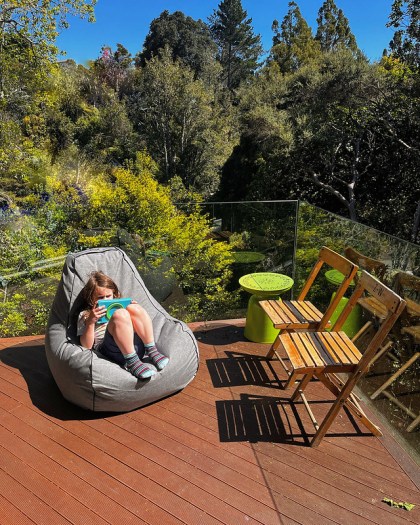
Of course, for people born here, that’s a normality … but I have lived in environments where that’s not the case, which is why even seeing him watch his iPad in the sun is something I don’t take for granted.

We cannot discount the importance of being able to play outside, but sadly many governments and councils seem to.
Viewing it as ‘a favour’ rather than a fundamental right.
Playing outside helps kids in so many ways.
Bond … learn … imagine … express … play … explore … compete … respect.
It’s not a ‘waste of time’, it creates a deeper foundation for life.
An ability to think outside of lines and others definitions.
Giving kids an environments where they can be outside is basically an investment in a countries future.
A nation of curious, interested, healthy people.
But not everyone gets this.
Some actively try to stop this.
Often people of immense privilege who either associate outdoor life as something for either the elite or the rough.
Fortunately NZ does not see it this way.
They revel and celebrate it.
They have the best parks I’ve ever seen in my life.
Parks made to enjoy and encourage kids to push their boundaries.
A new discovery of what you’re capable of with every visit.
And while for most kids it’s about developing, for Otis it’s also about grounding.
A place he can feel is his.
A connection to where he lives in a way he’s not had before.
Because while he is young, I do not underestimate what he has been through.
Fuck, there’s people I have worked with who have literally freaked out when asked to move office desks … and yet here’s my kid, who has moved countries, homes and friends and still embraces the possibilities of every situation.
So much of that is down to his brilliant Mum who has helped that change happen in the most comfortable, seamless way … but it still requires a mindset to look at what you’ll gain rather than just what you lose.
And while I know one day I’ll no doubt be dragging him off for another adventure somewhere else on the planet [but don’t worry, it won’t be for ages. Probably] I want you to know that I love you from tip to toe and let you know I’m so, so proud to be your dad.
Thank you Otis, you’re a little legend.
Filed under: A Bit Of Inspiration, Attitude & Aptitude, Comment, Creativity, Culture, Emotion, Empathy, Love, Resonance
For years people have tried to express what love is.
They’ve used song.
They’ve made films.
They’ve written books.
They’ve made art.
They’ve penned poems.
They’ve even created a day for it to be celebrated.
But none of them have captured it so beautifully and succinctly as a photograph I recently saw.

Love this.
Love it so much.
A moment alone, when you’re surrounded by hundreds.
At a time where creativity is being challenged and questioned by more and more companies, consultancies and corporations, this photo is a great reminder how creativity can solve the problems systems, structures and order can never reach.