
Filed under: A Bit Of Inspiration, Agency Culture, Attitude & Aptitude, Content, Context, Culture, Embarrassing Moments, Management, Only In Adland, Planners Making A Complete Tit Of Themselves And Bless, Presenting, Professionalism, R/GA
So after the rather big news for me and my family on Friday, I thought I’d write a post that gives my new gang at Colenso an idea of what they have got to look forward to.
A few weeks ago, I was messing around on YouTube when – by utter chance – I came across a video of one of my old planning gang from R/GA.
It was unbelievable.
In fact, I had to watch it twice as I couldn’t believe I had been so lucky … I mean, fortunate.
Not only were they young.
Not only were they smartly dressed.
But they were in full-on corporate toady mode.
Fortunately for them, I am a kind, caring and considerate person … so rather than let this piece of video suicide hide in plain sight for any innocent person – or client – to stumble across, I decided to take the selfless path and notify them of what I had found.
Sure, I might have done it with a bit too much glee.
Sure, I might have milked it a little too much.
But it’s the thought that counts.
Or at least I thought it was, until I got their reply …

Oh I can’t tell you how much I loved this reply.
It literally made me spit out the drink I was having at the time.
It’s not just that he thinks I was doing some z-grade CIA check on him in an attempt to get material to humiliate and Ambar as him, it’s the fact that while I haven’t shown the celluloid car crash to anyone else [which even I’m surprised about], he knows that I know it exists.
I believe it’s called, ‘leverage’ … though I think they would refer to it as blackmail.
Filed under: A Bit Of Inspiration, Advertising, Attitude & Aptitude, Audio Visual, Authenticity, Comment, Confidence, Craft, Creativity, Culture, Design, Fulfillment, Honesty, Perspective, Presenting, Relationships

One of the things I find really interesting is how adland has got into the habit of providing clients with multiple options for every bit of work.
Oh I get it.
Apart from the fact there’s always more than one way to answer any brief, we want – or should I say, we need – clients to be happy.
Except it doesn’t always end up that way does it?
We make alternatives that aren’t as good as the idea we think they should buy.
Clients demand diluted versions of the work we don’t really like in the first place.
We end up getting fired because the campaign they pushed us to make didn’t work as well as they wanted.
Who are the bigger idiots?
The people who don’t buy what the experts put forward or the experts that offer alternatives they don’t really believe in?
Which is why every single person should read the story of Paul Rand – the designer who Steve Jobs turned to, to design the logo for his NeXT computer company.
Not just because it’s a brilliant story.
Not just because he didn’t even bother to turn up to the pitch, he just sent a brilliant 100 page book with his idea in it.
But because when Jobs was asked what it was like to work with Rand, he said …
“I asked him if he would come up with a few options, and he said … no, I will solve your problem for you and you will pay me.
You don’t have to use the solution. If you want options go talk to other people.’”
How good is that?
+ I will solve your problem for you.
+ You will pay me for my recommendation, whether you use it or not.
+ If you want options, go talk to other people.
While some may claim that makes Paul Rand arrogant or petulant, I would say it shows someone who knows the value of their experience … their talent and their craft.
More than that, I think it shows someone who really thinks about what idea is the right one for their client and then puts only that one in front of them.
Not countless options.
One.
A single idea that has gone through hundreds of possibilities to get to that single recommendation.
Something that has been created and crafted to answer the brief, rather than simply executed to satisfy the clients taste.
And while the article itself states the NeXT logo might not be a classic … the style, approach and attitude of the presentation certainly is.
Adland should take note.
Read it here.
Filed under: A Bit Of Inspiration, Advertising, Agency Culture, Attitude & Aptitude, Authenticity, Communication Strategy, Confidence, Creative Brief, Creative Development, Creativity, Culture, Emotion, Empathy, Experience, Imagination, Innovation, Insight, Loyalty, Management, Marketing, Meetings, Planners, Point Of View, Positioning, Presenting, Professionalism, Relevance, Resonance

One of the questions I’ve been asked more than any other is how do I tell clients what is wrong with their brand.
The first time this happened, I kept asking for clarification because I couldn’t work out what they were asking.
But over the years, it has become apparent that to some, offering clients honesty and transparency is seen as potential threat to the business rather than creating the foundation to answer what is needed.
For me, giving clients honesty and transparency is a demonstration of how much you want them to win.
How much you want them to win, better.
That doesn’t mean you have to be a dick about it, but it does mean you have to be open about how you see it … and in my experience, if you do it in a way where they understand your reasoning and your ambition for them, then more times than not, it’s welcomed.
That doesn’t mean they will agree with you, but it’s amazing how much respect they’ll have for you … because frankly, they’re surrounded by people who tell them what they want to hear and so someone coming in and saying, “actually, we have a different view on this situation to you” is a breath of fresh air.
Hell, even if they hate what you say, you’d be amazed how many times they’ll remember you. I can’t tell you the amount of times people I once pitched for and lost have come back to me/us at a later date.
But I get it can be daunting, even more so if your bosses are saying. “just do what they want”, which is why the next time you’re in this situation, I encourage you to look at the photo at the top of this post.
That photo is Pablo Escobar.
Columbian drug-king Pablo Escobar.
And yes, that photo is him with his son outside the White House, taken when he was the US Government’s most wanted criminal.
So if you think telling a client how to be more successful requires confidence, imagine what it takes to have a photo with your son outside the building where the President of an entire country wants you dead?
Not so hard now is it?
Have fun …
Filed under: A Bit Of Inspiration, Advertising, America, Attitude & Aptitude, Authenticity, Brand Suicide, China, Corona Virus, Culture, Cunning, Empathy, Equality, Linkedin, Marketing, Marketing Fail, Perspective, Planners Making A Complete Tit Of Themselves And Bless, Point Of View, Prejudice, Presenting, Professionalism, Relevance, Resonance, Social Commentary, Social Divide, Social Media
So a few weeks ago, I saw a tweet that asked about ‘most awkward’ presentation.
Given I’d just read a terribly superficial [and out-of-touch] document they’d written on China, it reminded me of something that happened with me and McKinsey in China a few years ago.
So I wrote this:

As soon as I posted it, I knew it had hit a nerve as my phone was continually buzzing – but whereas it normally stops after about 4 seconds, this carried on. In fact it got more intense. So intense in fact that within 48 hours, it had achieved this:
22,000 likes.
5,500 retweets
300+ comments
In addition to that, I got contacted by people in the US, Mexico and China who said I had set off a vibrant debate in their respective countries via their respective versions of Linkedin, Instagram and Twitter.
Hell, I even got contacted by Consulting Humour [which is apparently ‘a thing’] who wanted to post it.
MADNESS.
But what’s even more mad is that almost everyone who commented was nice to me.
Even the people who disagreed with what I’d written.
And yet, despite all that, I found it overwhelming … like being in a car that’s on the edge of going out of control.
It got so uncomfortable that I had to delete my Twitter for a few hours so I could catch my breath.
But what was obvious was a lot of people have a lot of issues with McKinsey and consultancies as a whole.

The main issue seemingly being they get paid a fortune for their advice but don’t have to take any responsibility for what they recommend.
This was the message a huge range of people working in a huge range of industries said … from small businesses to multinationals to entrepreneurs to ex-McKinsey consultants.
Now I am under no illusion that McKinsey won’t give a shit about what I said – and I don’t blame them – but I do think they should be a bit nervous that an innocuous tweet could create such a shitstorm of commentary and engagement.
However on the off-chance that last sentence encourages the McKinsey lawyers to come after me, I should point a few things:
1. The talk I referred to in the tweet was not a presentation claiming advertising was better than consultancy. It wasn’t even about advertising … more about how cultural innovation can achieve more distinctive brand growth and business optimisation. I think.
2. And while it looks like I pissing on the value of consultants, I wasn’t. I accept, in the right situation, they offer incredible benefits to business … however, when they have no skin in the game – or are offering analysis on cultural behaviour without ever actually interacting in culture – then the effect of their advice can be called into question.
3. But most of all, while I was a cheeky shit in the presentation I gave in Shanghai all those years ago … I definitely said it with a twinkle I the eye and the audience knew that … rather than looking at me thinking I was purely an antagonistic bastard.
Emphasis on ‘purely’.

So while this viral situation was an interesting adventure, I learnt something even more valuable than ‘consultancies’ are the silver bullet to influencer status.
I’m not talking about the grudging respect I might have gained for social media influencers.
Nor the fact I am worried so many people aspire to be one, without maybe realising the mental anguish they will face and the pressure they will place on themselves to perform even better.
No, it’s this …
There are so many people out there who face abuse, judgement and prejudice just for being who they are.
Not just in social media, but in every aspect of their lives.
I can’t imagine having to deal with that level of scrutiny … hell, I couldn’t even deal with 2 days of it and my experience was good.
This not only highlights their strength, but also my privilege.
Of course I knew I had that – but this situation helped me understand it in a way I could feel rather than just understand.
I honestly think it would be worth every white, middle class person to experience … especially the Karen’s of this World, who have the audacity to claim being in their comfortable homes to protect them from catching a deadly virus is equivalent to slavery.
You think I’m making that last bit up don’t you?
I know, it sounds utterly insane to think that could be true.
But in America, insane is often normal.
Filed under: A Bit Of Inspiration, Advertising, Agency Culture, Apple, Attitude & Aptitude, Audio Visual, Comment, Content, Context, Craft, Creative Brief, Creativity, Culture, Design, Emotion, Experience, Imagination, Innocence, Innovation, Insight, Marketing, Music, Planning, Presenting, Professionalism, Relevance, Resonance, Standards, The Beatles, The Kennedys, The Kennedys Shanghai, Unexpected Relevance, Wieden+Kennedy
One of the things I love about this industry is our way of re-writing rules.
I don’t mean that in terms of post-rationalisation.
I don’t mean that in terms of rebellion.
I mean it in terms of letting creativity take us to new places.
That said, I think a lot of people forget this.
Clients and colleagues.
Specifically the one’s who encourage work to go where others have gone before.
Or where the brand has previously been.
Or just killing ideas before they’ve had a chance to start to evolve.
Of course I appreciate what we do has a lot of implications on our clients business.
That to get it wrong has serious ramifications.
But – and it’s a big but – doing the same thing over and over again doesn’t move you forward.
The opposite in fact.
They know this.
We know this.
And yet I hear words like ‘optimisation’ far more than I do ‘creativity’ these days.
Now I get it, you want to get every bit of value from something that you can, but our obsession with models and processes just limits our ability to invent and move forward.
Please don’t think I’m discounting the value of experience.
There’s a lot to be said for it.
But basing the future purely on what has happened in the past – specifically your individual past – is not experience, it’s blinkered.

Case in point.
Mouldy Whopper.
Here was a campaign that was attempting to do something differently. But rather than be curious about how it would be received, industry people – the same folks who are supposed to be pushing for creativity – were violently writing it off from the beginning. And when I pointed out that no one really knew what the campaign was trying to achieve – I copped it too.
Hell, I didn’t even like it very much, but I appreciated they were doing something different and evidence showed it was getting people to talk about preservatives in food – which was a positive for BK – so at the very least there were something positive in that. But then a senior industry person challenged me – said it was only people in the bubble of adland doing that – so when I proved he was wrong, he just disappeared. Happy to throw out personal opinion but not happy to be shown it was just his personal opinion. And that was my issue, we didn’t know how it would go. We had thoughts, we had opinions but we didn’t give it the time to see how it played out and apparently, it did pretty well by a whole range of metrics.
Of course, the great irony is that when you do have a brand that believes creativity can move things forward in unexpected ways, then you get accused of your job being easy.
I can’t tell you the amount of times people said to me, “it can’t be hard working on NIKE, they love being creative”.
Of course, the people who say this have never worked on NIKE and tend to be the first to criticise anything they think is ‘too creative’.
My god, when Da Da Ding came out, the wave of, “I don’t get it”, “it’s indulgent” was amazing.
But not as amazing as the fact that a lot of the abuse came from white men not based in India.
But I digress.
I love creativity.
I use that word specifically as I see it as being much bigger than advertising.
At least in terms of where the inspiration can come from and how it can be applied.
I am in awe when I see ideas taking shape. Things I never imagined coming together in the aim of changing something rather than just communicating it.
One of my greatest joys was running The Kennedys, because I saw that in possible its purest form.
From making takeaway coffee cups into dog frisbees to re=programming Street Fighter to represent the lessons they’d learnt over the previous year … was epic.
Sure, sometimes it was scary, frustrating and painful.
Sure, there were arguments, walk-outs and moods.
But as I wrote before, great work leaves scars and while that doesn’t mean it can’t be an exciting journey to be going on, it will have many twists and turns.
Or it will if you are pushing things enough.
And that’s what this post is about, because recently I read a story about John Kosh.
John was the creative director of Apple.
Not the tech company, but The Beatles.
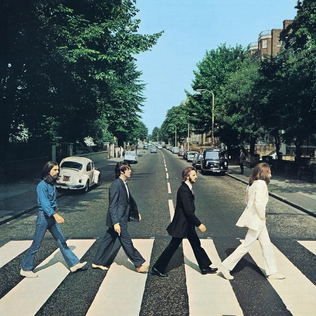
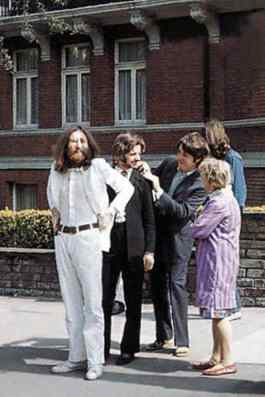
John Lennon loved him and at 23, he found himself art directing the cover of their iconic album, Abbey Road.
What many people fail to realise is the band name was no where on the cover.
And while John had logic behind that decision, many in the industry thought differently.
Especially at their record company, EMI.
In fact, the only reason it ended up happening is that timing was so tight that it was allowed to slip through before anyone else could stop it.
Another example of chaos creating what order can’t.

What a story eh?
And before anyone starts saying I’m wrong …
I’m not saying the decision to remove the bands name from the cover made the album successful. This was The Beatles after all – the biggest, most successful band of all time – so it was always going to sell by the bucketload. However I am saying the decision to remove the bands name from the album cover helped make it iconic … which arguably, helped make it even more successful.
Not to mention make the zebra crossing on Abbey Road one of the busiest in the World.