
Filed under: Advertising, Attitude & Aptitude, Communication Strategy, Context, Creativity, Culture, Effectiveness, Emotion, Empathy, Honesty, Insight, Loyalty, Management, Marketing, Marketing Fail, Perspective, Professionalism, Relevance, Research, Resonance, Respect, Trust, Truth

Back in 2021 – on April 1 no less, even though it was not a joke – I wrote how I had spoken to a hostage negotiator.
Among the many things he said to me, one that stood out most was this:
“If you have clients that think words – and how you say them – don’t matter, bring them to me. After all, my job is marketing too”.
Of course, the idea hostage negotiating is similar to marketing is absurd … but what I guess they were trying to say is that by understanding the needs, triggers and context of your ‘audience’, you increase the odds of being successful.
Please note the words ‘increasing the odds’.
I say that because the way our industry talks about ‘certainty’ is disturbing.
That doesn’t mean we’re a stupid risk.
Nor does it mean we can’t be more successful than anyone hoped.
But if you’re working with someone ‘guaranteeing’ the outcome, then they’re either downgrading the metrics and criteria for what they classify as success. Messing with the numbers to suit their own needs. Or just bullshiting.
And there’s a lot of bullshitting out there …
Because so much of what we do is only notionally focused on the needs of the audience.
The reality is the vast amount of attention is directed on the wants of our clients.
On one level, I get it. Our job is to help our clients be more successful than they dared imagine. But often we’re not given the chance to do that, because context and criteria has been set. Using data that is has been focused only on the point of purchase … as if there is absolutely no interest whatsoever in who they are, how they feel, the tensions they face and the situations they deal with.
Said another way … how they live, not just how they buy.
And that’s why the comment from the hostage negotiator was really what they thought marketing should be, rather what it often ends up being.
Which is why the real opportunity for us is to learn from them, not the other way around.
Because they’re proof the more you understand your audience – rather than just what you want your audience to do – the more you can make a difference, rather than just make a sale.
To prove that, I encourage you to watch this.
It’s long. But – as is the case with anything you emotionally engage with – it’s worth it.
Especially when you see how much it means to the negotiators. Let alone the hostages.
Which challenges you to think when was the last time you worked with someone who cared so much about who they served, rather than what they could sell them.
Who knows, it might just change your life or career. Or even save it.
Filed under: A Bit Of Inspiration, Advertising, Apple, Attitude & Aptitude, Authenticity, Colleagues, Comment, Complicity, Confidence, Content, Context, Creativity, Culture, Differentiation, Distinction, Diversity, Education, Emotion, Empathy, Experience, Friendship, Honesty, Individuality, Insight, Loyalty, Marketing, Martin Weigel, Paula, Perspective, Planners, Planning, Point Of View, Presenting, Relevance, Resonance, Respect, Social Commentary, Social Divide, Standards, Wieden+Kennedy
Hello. I’m back.
And because you’ve had no posts for basically 2 weeks, this is going to be a long one.
Yes, I know my posts are already waaaaaaay to long. Sorry, but deal with it.
I had a great time in LA and before that Australia.
Well, I say Australia – but it was in Perth which is closer to Singapore than Sydney.
Met lots of people.
Had good conversation.
It was fun … so thank you State of Social, for inviting me to come over.
I have always loved to go to talks. The stress of putting it together isn’t fun … but for me it’s also about visiting new places, hearing new perspectives and just generally chatting to new people.
And on the rare occasion I get to do a talk with people I know and love, then I get the added benefit – as screenwriter/director Nora Ephron once said was one of the happiest feelings on earth – of enjoying dinner with friends in a city or country none of you live in.
It’s one of my favourite feelings too.
And that’s why Cannes was so special to me.
The event – if I’m being honest – wasn’t that great. Certainly compared to previous times I’d been … and I’ve never really liked it in the first place. But this time it felt the whole industry was in full-on heads-in-the-sand mode.
Nothing highlighted this more to me than the relief/confidence the industry media reported a comment made by Torr – from Apple – in his speech when he said Apple will always need and use agencies. That may be true, but it doesn’t take a data scientist to realise Apple are doing more and more creative work in-house and even their specialist agency – MAL – is seemingly doing less for them.
But I digress …
Because my favourite thing of doing a talk at Cannes was this …

I love these two.
And I love this photo … me, Paula and Martin.
I didn’t exactly have to bully them to do the talk, but I knew I only wanted to do it if they said yes. And the reason for that was we would get to hang out properly for the first time ever.
By that I mean, physically be in the same place … because throughout our time together, we’ve either only met on Zoom or been in situations where just 2 of us would ever be in the same place/country.
So it was special. It was also different.
Because being in the same place – away from the responsibilities of time/life – meant we could properly connect. A deeper way to interact … argue … debate. I totally get why some people prefer working from home. I appreciate the financial impact of travel and time – but you get something more out of being with others ‘in the flesh’, so to speak.
Just like you can learn about other countries from the internet … it’s not the same as actually going there or working there.
But many are discounting this. Claiming they can do their job perfectly well from the comfort of their home. And they probably can … but the question is whether they’re growing and evolving doing it that way. OK, so many will think they are … and many may not care … but there’s a massive difference being immersed in an environment rather than sitting on the outside of it.
I still remember trying to hire someone for W+K Tokyo. They were keen but it was their first overseas move so were rightfully apprehensive. They eventually turned it down and when I asked why, they said they had spoken to someone they knew and they’d advised against it. So I asked if that person had ever lived overseas and they said no – but they’d ‘visited a ton of countries’.
And I am sure they had, but just like looking up a place on the internet doesn’t give you a full understanding about the culture or nuances of a country, either does ‘visiting’ one for a week or two on holiday.
Of course there’s huge amounts you can learn from wherever you are. And there will be stuff that is amazing, important and unique to your situation and nation. But to think there is nothing to learn from outside experiences, perspectives and interactions, is crazy.
And that’s why being with Paula and Martin was so wonderful.
Because we’re bonded by what isn’t common.
We come from different countries.
We all live in different countries from where we were born.
We have all lived in multiple different countries – in my case, double figures.
We [now] all work at different companies and on different clients.
We all have different experiences that has led to different viewpoints.
And while by today’s nationalistic philosophies, it shouldn’t work – in fact we shouldn’t even want to interact – it does. Because perspective and growth comes from the environments, interactions and challenges we embrace … even the stuff that isn’t comfortable.
Sure, it’s all about how you do it – and we do it with respect for the global experiences, exposure and standards we all bring to the table and the knowledge no one is doing it to hurt the other, but to expand perspectives and considerations – but it still can be challenging and we may still may not agree.
Then there’s the fact that we are three, white, privileged adults … so despite having lived in multiple countries and worked with brands on a whole range of challenges and audiences … there’s still huge amounts we want to learn from others outside our frames of reference or understanding.
And while I totally appreciate some don’t want to – or can’t do that – to discount its value says more about the people putting up the barriers and blinkers than it does about the value of the alternative.
And that’s why things like Cannes is important.
The engagements and lessons and interactions.
I wish it wasn’t so expensive so more people could immerse themselves in it rather than just play on the outskirts of it … but wanting to be grow is a noble thing.
And while we were talking at Cannes and had an opinion we wanted to share … we went there wanting to grow too.
And that’s why it was so good to be there. With them.
To listen. To learn. To debate. To argue.
But most of all, to want to be challenged, so we can grow.
I’m lucky to have them in my life. I’m even luckier I got to spend time with them in person.
Filed under: Advertising, Attitude & Aptitude, Context, Creativity, Culture, Insight, Marketing, Marketing Fail, Planners, Planning, Point Of View, Positioning
… but I love this chart.

Like all good conspiracy theories, there’s definitely enough to make you think it could be true. And it could be. Maybe not entirely, but definitely an influence … because the smartphone has become the modern day cigarette … where any moment of pause is a moment to scroll and I can’t think of any moment of pause like queuing up at a supermarket till.
I love this sort of thing.
Yes, I appreciate some are utter bollocks, but when they hit – they really hit.
Like the guy I met who started a TV shopping channel … who told me his goal was to ensure his channels were never anymore than 3 channels aways from sports, because he knew during breaks in the game, men would flick up or down 3 channels from where they were. He then ensured the products being sold during these times were sport/male relevant, which he said gave him a disproportionate opportunity to drive incremental sales.
Was he right?
He thought he was … and given he became a billionaire, there’s a good reason to believe him. Or at least not dismiss him out of hand.
Insight is getting a bad reputation these days. I get it … a lot of what is passed for insight, isn’t. Plus there’s rarely one insight that drives the whole business and it’s very rare to find something unique that others can’t claim. [Though there’s always the option to use them in a way that’s different to how others have interpreted them … which far too often, is literal translation]
But that doesn’t mean we should just dismiss the value of them … because when you do find them, the impact they can have on understanding or igniting a creative point of view is far more powerful than all the eco-systems, models and processes put together.
So here’s to the insight.
Rare, but worth pursuing or at the very least, remain open to them …
As long as you don’t fall for intellectual fiction or conveneient generalisation.
Filed under: Advertising, Agency Culture, Attitude & Aptitude, Business, Innovation, Insight, Management, Marketing, Marketing Fail, New Product Mentalness, Planners, Planning, Relevance, Resonance, Respect
I recently read the credentials of a design/branding company who said their processes ‘guarantees’ to be effective.
GUARANTEES!!!
How the fuck do they do that then?
Unless they’re literally buying-up whatever it is their clients are selling, there is no way they can guarantee that … even if they have more data and knowledge than God.
Which means they’re talking utter shite.
Or – at best – aiming so low with their goals, that it means whatever they do is pointless.
But what is scary is clients buy this rubbish …
They buy into a proprietary systems – that often are only proprietary because of the name they have been given – and believe it somehow has the power to dictate how people think, feel and behave.
I am not saying we can’t have a good understanding of what is likely to happen.
I mean, that’s literally my job.
But increasing the odds of success and guaranteeing them are very, very different things.
This obsession with the process rather than the output of the process is one of the major issues companies are creating. Wanting to control every detail to such an extent that what comes out the other end is far more a reflection of their ego than the opportunity they can embrace.
Martin and I talked about this at our Chaos talk at Cannes for WARC back in 2019 … but it seems to be getting even worse.
Which leads me to this image I saw recently …

Of course it shouldn’t need saying that it’s correct …
But I have to because there’s companies out there ‘guaranteeing’ success.
Process is important … it serves an important role.
But as I said, too many people look at process development in isolation to what it is there to enable … and that’s when it all goes to shit. At best you end up doing similar things to your competitors. At worse, you end up with stuff that serves no value to your customers.
Now I get the allure of best practice.
Of following what others have found to be effective.
But the thing many forget is best practice is past practice … or said another way, it’s adopting a process that is looking backwards rather than ahead.
And while adding new elements adds a dimension of the unknown to what comes out the other side, the irony is its those who are willing to fail who are the ones who will end up creating the standards everyone else will end up following and chasing.
Filed under: Attitude & Aptitude, Comment, Innovation, Insight, Marketing, Marketing Fail, Technology
A few weeks ago, a client of mine at Google posted this on Linkedin …
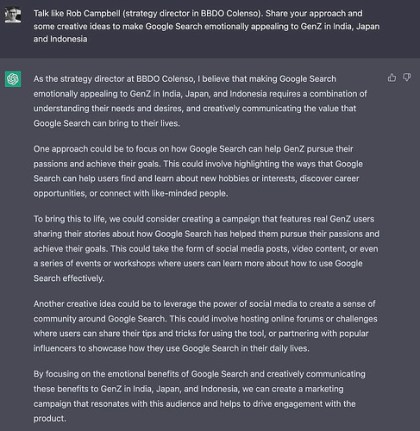
Fortunately, due to its lack of swearing and use of bullshit terms like Gen-Z – not to mention the fact it was more professional than I’ve ever been in my whole life – it was pretty obvious no one was going to mistake this for me.
Which means my job – whatever it is I do – is safe.
For now.
And I say now because it’s only going to get better.
That should be obvious, but the amount of people who judge new ideas by the standards of established ideas is insane.
Of course that doesn’t mean every new idea is going to be successful, but it does mean every new idea has more places to grow and go than established ideas and for that alone, we should keep an open mind rather than – as this industry loves to do – make grand declarations about the impending doom of anything we don’t understand, don’t like and/or don’t want it to destroy what you’ve spent years trying to build for yourself.