
Filed under: Advertising, Attitude & Aptitude, Communication Strategy, Creative Development, Creativity, Marketing, Marketing Fail
2nd month of 2024 already.
Sure, this blog only restarted a couple of weeks ago, but still …
So there is a lot written about brand. And marketing. And brand marketing.
And a bunch of it is written by people who haven’t done much of it.
Certainly not to the level their ‘expertise’ can legitimately claim.
I appreciate this makes me sound a bitter bastard … but it’s bothering me.
It’s bothering me because it undermines standards.
It bothers me because it undermines the people who are doing it, but not shouting about it.
It bothers me because it teaches the wrong lessons – and wrong approach – to people who want to enter the industry.
But most of all, it bothers me because it undermines everything we do.
Everything.
Our work.
Our approach.
Our value to business.
Don’t get me wrong, it’s absolutely fine to have ideas and theories. We need those. But that doesn’t mean you can suddenly claim to have the answers to situations you’ve never even dealt with. Or – for that matter – to suggest your credibility is in the fact you have worked with major clients on major projects when, at best, you were a bit part player in them.
I don’t understand our reluctance to challenge this because it’s affects us all.
Someone who has been in the industry a few years may – if lucky – have worked on some big name clients, but it is unlikely they have led those big name clients. And yet, look on Linkedin and you see that being pushed left, right and centre.
Look, I get the ‘fake it till you make it’ attitude, but it shouldn’t come at the cost of others in their quest to feed their ego and yet I am seeing so much of that.
I’m writing this because of something I recently read from Mike Cessario, founder of Liquid Death. This …

In just 3 short paragraphs, he explained the role, approach and importance of building a brand in ways that is far more articulate and valuable than so many of these Linkedin self-appointed gurus could do in 3 years of status updates.
Better yet, he’s actually done it.
At the highest level.
We’re falling into the trap that strategy is about soundbites and newsletters.
Updates and popularity.
Worse, too many think its about words, not change.
And while I’m here for the theories and the new ideas … if you don’t make something from it, you don’t have a right to claim to be an expert about it. Because strategy only counts if change and creation is born from it.
Anyone can judge. Anyone can criticise. But until you’ve actually led it or made it, then you’re not that far different from a used car salesperson.
This industry is capable of brilliant things.
It has some incredibly talented, brilliant people.
They come from all walks of life, work in all parts of the world, work on all sorts of work.
And most have a very small social presence.
But what connects them all is they’ve done stuff rather than just talk about stuff … so if we are to get back to where we need – and deserve – to be, then we need to value real life experience rather than ‘strategy rizz’ because otherwise, we’re part of the problem rather than helping lead the solution.
So if you’re looking for guidance and lessons, listen to people like Northern Planner rather than someone who talks about how many people read their newsletter.
Because – to paraphrase Lee Hill – popularity is vanity, experience is sanity.
Filed under: A Bit Of Inspiration, Advertising, Apathy, Attitude & Aptitude, Australia, Brand, Brand Suicide, Comment, Communication Strategy, Creative Brief, Creative Development, Creativity, Culture, Distinction, Effectiveness, Embarrassing Moments, Emotion, Empathy, Fake Attitude, Government, Insight, Internet, Management, Marketing, Marketing Fail, Mediocrity, Nike, Planners, Point Of View
OK, I’m back.
Again.
And this time, I’m not going to be going away for …. hmmmmm, actually let’s not go there.
Let’s move on shall we?
So before I start, there’s 2 things to say.
1. Some may have seen this before, because I accidentally put the wrong publish date on it.
2. This is a week of long and – for me – serious posts. So don’t say I didn’t warn you.
The good news is that on Friday, you’ll be rewarded for it, with some news that benefits you as much as it does me.
Kinda.
Maybe.
OK, so one thing that drives me nuts is when brands talk in totally different voices to different audiences.
But there’s something that gets to me more, and that’s when the brand in question has tried to position themselves as some sort of ‘brand of the people’.
Case in point, Reddit …

I really like Reddit.
I think their ‘front-page of the internet’ is a brilliant place to play.
And then I saw this …
‘Where Engagement Meets Results’.
What the fuck is that about?
Oh I know what some will say …
“They’re trying to reach business people who discount Reddit as a commercially valuable platform”.
And maybe they are. But the irony is the easiest way to discount Reddit as a commercially valuable platform is having clients on there who only can communicate in the corporate monotone of the meaningless mission statement.
How insincere is a brand who speaks to their customers one way and business another?
How crazy is it that some think business people are a different species to ‘normal’ people?
How badly will Reddit’s audience react to work from companies who only speak business?
Now some may think I’m going over-the-top … they will remind me that we all ‘change’ our tone and personality dependent on who we are talking to.
And that’s true … to an extent.
But this isn’t a tonal change, this is character.
I read that and it’s a brand I don’t recognise …
Feels more like they should be called Beigeit rather than Reddit.

The ability to adapt your voice to different audiences shouldn’t mean changing who you are.
People who play golf have a dramatically different view to sport than those who play football … but Nike still do it in a way where you know and feel it’s them. Just like CTO’s in major corporations has different requirements to those who want a laptop for home … but you never feel Apple changes who they are to communicate with them.
Brands who fundamentally change their personality in a bid to engage different audiences literally don’t know who they are. Worse, their customers may start to question that too.
Reddit are amazing.
Their audience is diverse, engaged and productive.
And while I appreciate some in business may not understand that, if you have to alter who you are, do you want them anyway?
Years ago I was doing work for Triple J … a government funded, youth radio station in Australia.
Unlike other ‘government funded’ media, Triple J was someone with real credibility, driven by championing and breaking new artists, discussing topics commercial radio wouldn’t touch with a barge pole and absolutely no advertising.
So when they came to us asking for help, we knew straight away that whatever we did had to ensure their current audience didn’t feel Triple J was selling out by advertising for more listeners.
While you may think this meant we went niche, we did the opposite.
Built off an idea we called, ‘enemy of the average’ … we went into mainstream media with messages that challenged audiences about the mediocrity they were engaging with.
Radio.
Newspapers.
Cinema.
Magazines.
Nightclubs.
Television.
Wherever mainstream audiences were, we were there too.
And while many hated our work [it was even discussed in Australian Parliament] it not only attracted the largest audience increase in Triple J’s history, it reinvigorated their existing audience because they saw the brand they love stay true to who they are, despite wanting what they didn’t have.
I get we’re in different times.
I appreciate the idea of any risk is unpalatable for so many.
But nothing is as dangerous as changing who you are to attract people who aren’t your audience.
The brand voice is more than how you talk. Or look. It’s how you look at the world … and if you’re consistent with that, then you can express yourself in a million different ways and always be yourself.
But too many brands, despite what they say, don’t want to be distinct.
They see it as having the potential to alienate an audience.
To which I say this …
While you may think being something to anyone means you can engage more people, the fact is, the most power to build the value of your brand is when you are everything to someone.
Filed under: Advertising, Apathy, Attitude & Aptitude, Brand Suicide, Cannes, Colleagues, Communication Strategy, Content, Context, Creative Development, Creativity, Culture, Effectiveness, Egovertising, Experience, Fake Attitude, Management, Marketing, Marketing Fail, Perspective, Point Of View, Professionalism, Relationships, Resonance, Respect, Standards, Toxic Positivity | Tags: om
Obviously I have a soft spot for Google.
From cynic to Colenso, they’ve been a constant in my professional as well as personal life.
They are intimately involved in so much of what I do every single day and I appreciate the possibilities they have enabled me to embrace because of them existing.
I know … that sounds unbelievably gushing doesn’t it.
That doesn’t mean there’s not stuff that drives me nuts …
From the way some of their products work [Google Slides, I’m looking at you] through to the passive behaviour they are increasingly showing in the face of challenges that their smarts/money/tech could fundamentally change for the benefit of millions – if not billions – of people. However even with all that, it pales into comparison to this:
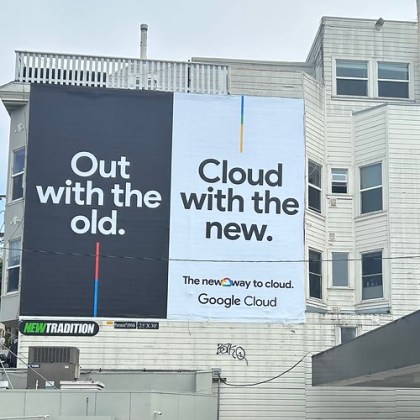
What. The. Hell?
Not only is it an absolutely terrible attempt to make a terrible pun, I still don’t know what ‘the new way to cloud’ is. Or means. Or why I should give a second of attention to it.
For a company so full of smart people, how can this happen?
Seriously, this sort of work does the absolute opposite of what Google want.
It makes people question how smart the company is.
It makes people ask if Google know how to talk to people.
It makes people wonder if Google know how to make tech that understands our needs.
It makes people ask if this is the sort of organisation we should trust to shape our future.
Sure, it’s just a random billboard … but for a brand that once represented humanities hope for ensuring technology enabled and empowered a better, brighter, more equal future for all, this work feels more like a politician pretending to smile while they’re busy oppressing us.
I know this isn’t the case, but bloody hell, it’s rubbish.
Which leads me to this.

I don’t know who is behind it. I don’t know if it’s an agency or an internal group. But I have to believe this was made because senior people mandated it or influenced it. Either directly, or indirectly. Which serves as a really good reminder about the dangers of corporate structures.
As Martin, Paula and I said in our Cannes talk, toxic positivity is ruining brands and people.
The idea that ‘team’ is now interpreted as blind complicity and conformity is insane.
But it’s happening. We all see it or have experienced it.
Worse, there’s an underlying attitude that the only way to get ahead is manage up. What I mean is that rather than do the right thing for your audience, you do the right thing by your boss. Doesn’t matter if it makes no sense. Doesn’t matter if it actively confuses the people it is actually designed to communicate to. As long as it hits the ‘cues’ your boss likes, you’re good.
As I wrote recently, toxic positivity is leading to the systematic destruction of knowledge and experience. Great ideas and people are literally being moved out of organisations to be replaced by conformists and pleasers.
Yes, company culture is important.
It has an incredible power to achieve great things.
But here’s the thing too many companies just don’t seem to get.
If you’re mandating it, you don’t have it.
Because real company culture is born from the people within the company. Yes, the people at the top shape and influence it – often through beliefs and a way to look at the world – but the moment you try to dictate or define it, you lose it.
But here’s the thing …
Even when a company gives you something to believe in, they know the real key is to give every employee the power to feel they can be themselves. That they trust them to want to make things better, rather than break things apart.
Which is why they encourage debate.
They value different opinions and ideas.
Because as long as it’s not in a self-serving, divisive manner … it’s almost the ultimate demonstration you want to help make things better.
There are a lot of companies who get this.
There’s sadly far more who don’t.
And everyone loses because of it. Because if companies stopped thinking of company culture in-terms of efficiency and optimisation – and more about standards and quality control – we would all get to better places faster.
Or at the very least, less ads that say everything by saying absolutely nothing.
Filed under: Advertising, Attitude & Aptitude, Communication Strategy, Context, Creativity, Culture, Effectiveness, Emotion, Empathy, Honesty, Insight, Loyalty, Management, Marketing, Marketing Fail, Perspective, Professionalism, Relevance, Research, Resonance, Respect, Trust, Truth

Back in 2021 – on April 1 no less, even though it was not a joke – I wrote how I had spoken to a hostage negotiator.
Among the many things he said to me, one that stood out most was this:
“If you have clients that think words – and how you say them – don’t matter, bring them to me. After all, my job is marketing too”.
Of course, the idea hostage negotiating is similar to marketing is absurd … but what I guess they were trying to say is that by understanding the needs, triggers and context of your ‘audience’, you increase the odds of being successful.
Please note the words ‘increasing the odds’.
I say that because the way our industry talks about ‘certainty’ is disturbing.
That doesn’t mean we’re a stupid risk.
Nor does it mean we can’t be more successful than anyone hoped.
But if you’re working with someone ‘guaranteeing’ the outcome, then they’re either downgrading the metrics and criteria for what they classify as success. Messing with the numbers to suit their own needs. Or just bullshiting.
And there’s a lot of bullshitting out there …
Because so much of what we do is only notionally focused on the needs of the audience.
The reality is the vast amount of attention is directed on the wants of our clients.
On one level, I get it. Our job is to help our clients be more successful than they dared imagine. But often we’re not given the chance to do that, because context and criteria has been set. Using data that is has been focused only on the point of purchase … as if there is absolutely no interest whatsoever in who they are, how they feel, the tensions they face and the situations they deal with.
Said another way … how they live, not just how they buy.
And that’s why the comment from the hostage negotiator was really what they thought marketing should be, rather what it often ends up being.
Which is why the real opportunity for us is to learn from them, not the other way around.
Because they’re proof the more you understand your audience – rather than just what you want your audience to do – the more you can make a difference, rather than just make a sale.
To prove that, I encourage you to watch this.
It’s long. But – as is the case with anything you emotionally engage with – it’s worth it.
Especially when you see how much it means to the negotiators. Let alone the hostages.
Which challenges you to think when was the last time you worked with someone who cared so much about who they served, rather than what they could sell them.
Who knows, it might just change your life or career. Or even save it.
Filed under: A Bit Of Inspiration, Advertising, Attitude & Aptitude, Comment, Communication Strategy, Content, Context, Creative Development, Creativity, Culture, Effectiveness, Marketing, Marketing Fail, New Zealand, Nike
There’s been a lot written and said about brand assets over the years.
A lot of claims and over-promises.
Hell, careers have been made from being a cheerleader of it … even though it has also been responsible for a whole lot of terrible advertising.
Contrived, complicit and confused advertising.
That doesn’t mean it doesn’t have a value – or a role – but as I wrote here, the thing rarely talked about is that brand assets don’t happen by themselves. You can’t buy them off the shelf or make them happen by simply repeating their use ad-nauseum.
No, the only way to turn an attribute into an asset is through creativity.
It’s creativity that gives it meaning.
It’s creativity that gives it a purpose and role.
It’s creativity that imbues it with financial value.
I appreciate that might not fit the narrative of certain people, but that’s the reality of the situation … or it is if you want to do it properly. Unfortunately, it appears more and more people don’t. Preferring to outsource their responsibility – which, let’s not forget, they are paid to do – to generalistic and simplistic solutions that are focused on recognition, not value.
Nothing brought this home more than this ad I saw for a new Nike store in Auckland.
Look at this …
What the fuck? Seriously, what the fuck is that?
While they have used a number of NIKE’s ‘brand assets’ – namely the font and swoosh – it’s pretty obvious whoever put this together has no understanding or appreciation of what they represent or how to use them.
Mind you, it also seems they also have no understanding or appreciation of sport, art direction or design.
It’s like they’ve just taken a few pieces and shoved them wherever they like – like a terrible jigsaw puzzle that doesn’t show the picture they need to create.
Which highlights another thing rarely talked about brand assets …
Just because you’ve earned them, doesn’t mean you can’t lose them.
Treat them with distain and you’ll find all that hard work will be for nothing.
Moving from a brand asset to an attribute to a warning sign to stay the fuck away.
Brand assets are made and built over time.
They need nurturing, crafting and supporting.
They’re not something that once earned, can be used any way you choose.
It’s why the people who use them need to understand them.
What they represent.
The context they play in.
Their creative meaning and expression.
How to actually fucking use them in the right way.
Without any of that you don’t just fail to unlock their inherent value and power, you’re killing their credibility and the brand they’re tied to.
That doesn’t mean you can evolve them. Or expand them. Or play with them in different ways. Nike – of all brands – is very good at doing that. But that only happens because generally they’re embraced by people who have a deep understanding of what they stand for and represent … rather than random ‘colours and logos’ that they treat as a range of stickers they believe they can put wherever they want and whenever they choose.
It’s why I get so frustrated with how certain people talk about them. Acting they’re like ‘parts’ that can be replaced, exchanged, adapted or used however someone chooses … which ultimately demonstrates many of the people who talk like this don’t actually understand what a brand is, what it takes to build one or the difference between post-rationalising and creating.