
Filed under: A Bit Of Inspiration, Advertising, Agency Culture, Attitude & Aptitude, Brand, Brand Suicide, Comment, Confidence, Creativity, Culture, Differentiation, Distinction, Diversity, Innovation, Insight, Loyalty, Management, Marketing, Marketing Fail, Perspective, Planners, Point Of View, Resonance, Respect, Rick Rubin, RulesOfRubin
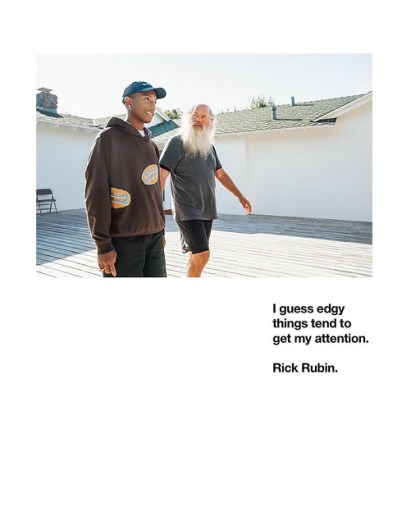
So this is the end of the week so this is the final Rules of Rubin.
To be honest, I’ve got at least another 3 weeks worth of posts I could do, but I want to write about some other stuff.
Yes, less valuable, less relevant, less interesting stuff.
Hey, this blog hasn’t got to where it is by writing stuff that is good. That’s why where this blog is, is at the bottom of everything.
But in all seriousness, maybe I’ll write more about the lessons from Rick later – I’ve certainly enjoyed it – but if you are interested, below is the list of quotes I’ve used and if you click here, you can read my write-ups on all of them.


However this last one is one of the most important.
One of the things I’ve never understood are brands consistently playing to the middle.
I get their thinking.
It’s a mass audience.
It’s a relatively safe audience.
It increases the odds of scalable success rather than risk.
But the thing is, playing to the middle is just the illusion of safety.
Apart from the fact lots and lots of brands are all playing there, all you’re actually doing is – at best – staying where you are, but more likely going backwards.
You might not notice it at first.
You may think everything is fine and dandy and slap yourself on the back for being so brilliant and successful.
But what starts off slow eventually turns in the blink of an eye as the brands or people who play and push to the edge take away all the safety you thought you had.
And what’s worse is because you’re high and dry and left far behind, your legacy and capabilities are impacted.
You’re tainted with being part of the past rather than the present, but even worse than that, your operational capabilities have been built around optimising rather than advancing so the best you can achieve is to play catch up.
This is a nightmare situation, based on one simple reality.
When you are playing catch up, your starting point is where everyone else is. But the problem is that by the time you get there, everyone is even further ahead and you’re back where you started.
A bit like Kyle in this episode of South Park
Of course it doesn’t have to be that way.
Some get that the only way to truly catch up is to leap frog current standards to set the next standard, but few companies have the courage to do that, let alone the money.
Oh they’ll suggest they can.
They’ll make all the right noises.
They’ll invest in some new technology, research or corporate ‘tagline’
They’ll even hire the odd new person from a new discipline with new ideas [though in many cases, they’ll then get moved on with the excuse ‘they weren’t the right cultural fit’] … but the reality is they’ll remain in this endless cycle of catch up.
I’ve seen it.
Hell, I’ve worked in some companies that have practiced it.
Because for all the desire to not get left behind, nothing feels as good as feeling in control.
Even if that’s just an illusion.
Because doing this means their position is protected.
It means they don’t have to look at their entire business model.
But more importantly, it means they don’t have to take a long hard look at their contribution for being in this situation.
So while I totally get why choosing to stand still may sound like the wisest option for so many, the problem with it is that it ignores one pretty vital consideration.
Culture never stops moving.
If you don’t want to get left behind, always play to the edge.
Filed under: A Bit Of Inspiration, Advertising, Attitude & Aptitude, Authenticity, Comment, Confidence, Creative Brief, Creative Development, Creativity, Culture, Design, Emotion, Empathy, Experience, Imagination, Innovation, Insight, Management, Marketing, Perspective, Point Of View, Relationships, Relevance, Resonance, Respect, Rick Rubin, RulesOfRubin

When I read that Rubin quote, it reinforced why I hate when companies devalue creativity.
Focused on working down to a price rather than up to a quality ..
An expense, rather than an investment.
Even though they then expect it to work it’s socks off for them.
And while it would be easy to throw all this blame at the organisations who hide behind their procurement departments, the reality is – as I mentioned in an earlier post – the ad industry are equally complicit in this downturn.
Look, I get it … we’re fighting for our lives.
But selling the value of creativity down the river in favour of process and hourly rates seems to be an act of self sabotage. An act that has ended up handing power to a group of people who ignore context and quality and just evaluate on the comparison of unit prices. Who then demand agencies to accept work based on a price/output ratio not on quality/value.
And what this means is talent – real talent – gets pushed out for being too expensive.
Or too demanding.
Or too stubborn.
Adland has always had an issue with ‘experience’, but this approach is also affecting the new and the different.
The people with different backgrounds, new ways of doing things, looking at the world in unique ways.
And all because the price/output ratio the agency agreed to, won’t allow for any exploring.
Any anything.
Instead, they need to execute exactly what is wanted, efficiently. precisely and repeatedly.
And what is wanted?
Well, whatever the producer has determined can be done in the time/budget allowed … using previous work as the blueprint even though [1] the context is different [2] they don’t know whether that previous work, worked and [3] reducing creative minds to simply executional monkeys is the quickest way to destroy confidence, character and creativity.
Because what everyone seems to be forgetting is what it takes to make great work.
It’s not just about putting a brief in front of someone and – voila – it’s done.
Creativity is born from years of experiences, adventures, wins and losses, stories and songs, failures and fuck-ups.
Where every step of the journey has played a role in crafting that thing that will make so many people feel, think and do so much.
Ignoring that … devaluing that … not catering for that … doesn’t just mean you’re working against your own best interests, it means you’ve have failed to realise what you’re really paying an agency for.
It’s not simply to make an ad, it’s so they can hire the people who have the most interesting ways of looking at the world because of the experiences, ideas and imagination from the life you never had.
Filed under: A Bit Of Inspiration, Advertising, Agency Culture, Attitude & Aptitude, Authenticity, Comment, Communication Strategy, Confidence, Creative Brief, Creative Development, Creativity, Culture, Emotion, Empathy, Management, Marketing, Marketing Fail, Point Of View, Relationships, Relevance, Resonance, Rick Rubin, RulesOfRubin

Great work. It’s a term used by so many but – let’s be honest – there’s not huge amounts of it about.
Of course there’s some … work that literally takes your breath away … but in the main, it’s all a bit beige and blah.
But what’s interesting is who people are blaming for this situation.
Often it’s the ad agencies who cop all the abuse.
Claims of being … out of touch, selfish and arrogant, more focused on what they want than their client needs.
But frankly, all this feels a bit too convenient because the people and organisations shouting the abuse the loudest happen to be the people and organisations who are directly competing for the same budgets.
Hmmmmn, I wonder if that undermines their credibility a little?
Throw in they’re often more focused on optimising than progressing and make work that either says whatever the client wants to say – regardless of how tone deaf that may be in culture – or just talk at people with buzzwords and data points that have no value, resonance or humanity towards the audience they are trying to engage … then you start to realise this is more a shitty strategy, than a future of marketing play.
Don’t get me wrong, I think agencies have to take a significant amount of the blame for the situation they find themselves in …
Too many have sold creativity down the river.
Charge for the process they undertake rather than work.
Seek to beliked by clients rather than respected.
Focus on creating generalised answers not unique problems.
Underpay, undervalue and under-appeal to the best of the best – existing or new.
… but even then, it’s only some of the blame, not all.
And the reason for this is great work is a team sport.
Everyone plays a part.
Not everyone – to use a football analogy – will be the striker, but they’re all necessary to score the goal.
But too often, we’re in situations where it’s not played that way.
Where too many wanting the authority but none of the responsibility.
Taking the credit but rejecting the blame.
Handing out dour instruction but expecting amazing results. Even though they don’t even know what amazing is, because either they’re context is small or they simply think everything they do is great so it doesn’t matter what they say.
Hence they’re the ones who criticise the agency for not delivering.
They’re the one’s questioning their commitment and passion.
They’re the ones running to data and management consultants to subject society to communication that in cultural landfill, not cultural stimulus.
And that’s why Rick’s quote is so good.
Because it acknowledges the inclusive responsibility to making something great.
From literally how you deliver the brief – let alone the actual brief – to how you support, encourage and give feedback to the people you want to do the best work of their life to help you have the best time of your life.
Because the reality is, if you’re not excited about doing something great, why the fuck do you think anyone else will be?
Filed under: A Bit Of Inspiration, Advertising, Agency Culture, Attitude & Aptitude, Authenticity, Colenso, Comment, Communication Strategy, Confidence, Creative Development, Creativity, Culture, Differentiation, Emotion, Empathy, HHCL, Innovation, Insight, Love, Loyalty, Management, Marketing, Metallica, New Zealand, Perspective, Planners, Planning, Point Of View, Relevance, Resonance, Respect, Technology, Uncommon, Uncorporated, Wieden+Kennedy

So this is it.
First day at school. Again.
In another new country. Again.
It’s always a weird feeling starting a new job. A mixture of excitement and nerves.
Excitement for the possibilities that lie ahead and nerves that you don’t really know what the hell actually lies ahead.
Most of this is because you are not you when you begin a new job.
You’re in this weird place where you want to throw yourself in the mix as quickly as possible – both to start feeling settled and to show your value to your new colleagues – while at the same time, knowing you have to learn a whole new set of people, protocols and situations while navigating the judging eyes that are going to follow you around for weeks.
But I have to say I am particularly excited about this.
I’ve loved Colenso from afar for a long time.
And as I wrote a while back, I almost joined them 6 years ago and always regretted it didn’t work out [simply because my head was not in the right place after Mum died] … so to be given this chance again is something else.
But the main thing is how they have acted towards me before I joined.
Lots of companies talk a good game when they’re trying to hire you and then – the moment it’s all signed and sealed – turn into demanding, inconsiderate pricks.
While it has only happened to me once, it fucks with your mind.
You doubt your judgement.
You question your decisions.
It’s pretty debilitating.
And yet, while it has been almost 8 months since we agreed to get married, Colenso have been amazing in how they have dealt with me.
One of the big things is how steadfast they’ve been not involving me in stuff till I’m here.
Of course they checked in … but they never gave me work to do, because they didn’t want our first experience working together to be one where I’m the only person on Zoom and 13 hours behind the rest of the team.
And while I would not have minded, I totally get why they wanted that to be the way.
That said, I did want to use the time to get to know the team and I basically had to beg to get that to happen.
Of course it’s not the best way to build any sort of understanding, rapport and relationship with people – so rather than talk about work, we tended to chat about what’s happening in our lives and how we feel about it – which took away any formality and allowed us to start revealing the different sides of each other.
And while I can’t wait to get to know them properly from here on in, I’m happy we have got to a stage where they feel comfortable enough to already call me a range of ‘choice’ names … which means I’ve just saved a week on my typical timings, ha.
While the past 13 months have been a very special time for me both personally [spending so much time with my wonderful family in our new home] and professionally [working with amazing people doing work I never dreamed I would be a part of] I am utterly thrilled to be starting here today.
Don’t get me wrong, I know it won’t all be rainbows and unicorns.
I’m old enough to know there will be plenty of times full of pain, drama, arguing and asshole challenges … but when you work for a place that only has its eye on the work they create, it means everything works out in the end.
For all the tension, scars, arguments and bloody hard fucking work it takes for creativity to be at its sharpest and most dangerous – at least a lot of the time, but not all of the time – once you’ve got it there and let it out into the world, it’s amazing how all the tension, scars and arguing fade away.
Better yet, it’s replaced with excitement, energy and possibility.
OK, and nerves, but even that is in an excited way.
Now I accept this might all sound like bullshit, but it isn’t
I lived it at HHCL, Cynic and Wieden.
It’s why it’s the founding principal behind Uncorporated.
It’s why places like Uncommon, are attracting the biggest names rather than chasing them.
And it’s why a small agency on the other side of the World has consistently played against the very best in the World.
The key word here is consistently.
Not one offs.
Not once upon a time, a long time ago.
I mean doing it day in and day out.
Finding new ways to do old things.
Looking for opportunities where creativity can change outcomes.
Embracing technology to expand the possibilities of creativity rather than just efficiency.
Staying on the path even when you could take short-cuts or potentially crash and burn.
Because in an industry that is increasingly defining success outside of the work they make and the cultural impact it creates, it’s those who let the creativity do the talking who create and attract the most interesting futures.
Not just for themselves. But for clients and culture alike.
So thank you to everyone who helped me get to this place in my career.
Thank you to everyone who has helped me actually get to New Zealand.
And thank you to Colenso for your stupidity in giving me this opportunity.
I will be eternally grateful, even if my new planning gang won’t be.
Right, time for the oldest ‘new boy’ to go cause some chaos.
Have a great day, I know I will.
Filed under: Advertising, Agency Culture, Apathy, Attitude & Aptitude, Authenticity, Brand, Brand Suicide, Colenso, Comment, Communication Strategy, Confidence, Crap Campaigns In History, Crap Marketing Ideas From History!, Creative Brief, Creative Development, Creativity, Differentiation, Distinction, Emotion, Empathy, Equality, Experience, Fake Attitude, Focus Groups, Honesty, Imagination, Innovation, Insight, Management, Marketing, Marketing Fail, Only In Adland, Perspective, Planners, Planning, Point Of View, Relevance, Resonance, Stubborness, Uncommon, Wieden+Kennedy
So many ads today end up just being fancy sales brochures.
A nondescript, stylish image that either has some meaningless line thrust upon it or a literal lift of the proposition from the brief to become the headline.
Clients love it because they think there’s no wastage.
That there’s no ‘thinking’ that the audience has to do to ‘get the message’.
I remember years ago – when I was working on SONY – the client kept referencing Mr Bean.
No, I’m not joking.
They kept saying Mr Bean is understood by all. Loved by all. Communicates a message without saying a word. They were really trying to push this until I pointed out that while that’s the case, no one would spend thousands buying a TV made by Mr Bean.
Then Balls got made and undermined my argument for years. Hahahaha.
And while I hate looking backwards, I can’t help but think the past was far more interesting creatively than where we’re at today.
These days Audi talk about ‘Future is an attitude‘ when once they talked about Vorsprung Durch Technik.
We have Chivas Regal going on about ‘every taste is an experience’ when once they talked about ‘giving Dad an expensive belt‘.
Heineken now ‘open your world‘ when they once ‘refreshed the parts other beers can’t reach‘.
We have countless other brands who were once so powerful with their brand voice who have now become bland.
[Nothing sums it up like this Audi ad for the same car with pretty much the same line]
What really gets me, is we have the talent in the industry to change this.
We have the hunger as well.
But while there are exceptions – and I mean it in terms of agencies who consistently bring the work rather than the odd bit of work getting through – somewhere along the line, we seem to have chosen a path of complicity.
Without doubt the research techniques becoming more and more favoured by companies plays a part in this. As our clients who are more focused on not making a mistake than making an impact. But it cannot be ignored that agencies have a lack of desire to stand up for what they believe is right. Preferring to be complicit rather than respected.
Which may explain why so few of them believe it is worth investing in finding out what is really going on in culture – preferring instead, to either outsource it or just accept the viewpoint of whichever ‘paid for’ 3rd party the client has hired to do the work for them.
What brought this all up was seeing an old Honda ad from the late 70’s/early 80’s.
OK, so Honda have a long history of doing great work – especially from Wieden London – but it’s always been a brand that has run to its own rhythm with its own idiosyncrasies. But even they – these days – are falling into the trap of rubbing off the edges that defines who they are to become like everyone else.
This ad – like so many of the truly great early 80’s ads – came from Chiat/Day.
My god, what an agency they were.
Sadly I say ‘were’ because as much as they still have great people in there and pull off the occasional truly interesting bit of work, when you compare them to what they were like decades ago, there is no comparison.
Brave. Honest. Distinctive. Creative as hell.
Hell, even when they lost, they did it in a way where they would win.
Every single person in adland – especially at C-Suite level – should read this brilliant article by Cameron Day, son of Guy Day … one of the founders of Chiat.
‘How Big Till We Go Bad’ is a fantastic guide on how to build a truly great agency. And then destroy it.
Anyway, I digress.
The Honda ad I saw of theirs was this …
No, your eyes are not deceiving you.
Once upon a time, car manufacturers – or at least some of them – understood equality.
No cliches.
No pandering.
Just treating their audience as adults and equals.
It’s not really that hard is is, but if you compare it to what we see today, it feels we’ve regressed. [Read more about car ad devolution – with a few exceptions – here]
I do not want to look in the past.
I believe my best creative work is ahead of me.
Or at least the potential of it.
To paraphrase Death of a Salesman – or the equally brilliant Nils of Uncommon – we shouldn’t be interested in stories about the past or any crap of that kind because the woods are burning, you understand? There’s a big blaze going on all around.
But the problem is, people have to see the woods are burning and I worry a bunch of the fuckers think it’s a sunset. Then again, it will be … because if we don’t push forwards, it will be the sunset on our industry and that will be the ultimate insult, because the past should never be more exciting and interesting than the future.