
Filed under: A Bit Of Inspiration, Advertising, Attitude & Aptitude, Authenticity, Brand, Brand Suicide, Comment, Confidence, Creative Development, Creativity, Culture, Honesty, Management, Relationships, Sport

There’s a well-known phrase that says. ‘it’s easier to get to the top than to stay there’.
I couldn’t agree with it more.
That’s not to say getting to the top is easy, but staying there requires a very different mentality.
However, while it should mean you’re always pushing forward … looking for ways to push and provoke possibilities … understanding where culture is heading rather than where you wish it was … defining the future rather than just following it … a lot of companies do it in a very different way.
Abusing their scale.
Buying market share.
Pricing competitors out.
Focused on size not change.
But what makes this ‘optimise the position’ approach even more fascinating is that a lot of these organisations who are like this, were not like that in the beginning.
In fact, they were the polar opposite.
Founded on changing something in their industry they felt was wrong.
They wanted to create change by offering a real alternative.
Something that drove them and defined them.
Where over time, they became distinctive and definitive.
And then … the more comfortable they became, the less they could see what they were turning into.
Silencing the alternate voices that used to fuel their drive.
Replacing the misfits with the people who look just like them.
Seeing a point of view as alienating rather than a beacon for those they once served.
Looking at cost rather than value.
Optimisation over innovation.
But this isn’t just in terms of operational behaviour.
It also affects the people within the operation.
Playing politics more than performance.
Protecting their position rather than growing those around them.
Following the process rather than focusing on what they want to do … create … change.
It’s a question I love to bring up with clients.
Especially when we’re talking about brand and positioning work.
The good ones are open to the uncomfortableness of the conversation.
I’m not saying they like it.
I once asked it to the founder of a rather well-known, global sports brand and he DEFINITELY didn’t like it … but based on the hard, honest, passionate and open debate it stirred – let alone the shifts it later encouraged – it was definitely worth it.
As for those organisations who are too far gone?
Well, they tend to shut down that conversation very, very quickly.
Then try to position you as bad for daring to ask it.
That everything is perfect with them and you should respect them and embrace them.
Of course, asking that question is the ultimate sign of respect.
You’re putting yourself on the line because you do like them. You do want them to do well.
You have recognised something may be misbalanced and you want to help them get that back.
Which may explain why the vast majority of companies I’ve asked this question have been open to it.
That doesn’t mean it has always led to different actions or behaviours, but it has been something they’re willing to debate. And while some may consider this approach ‘career suicide’, the great irony is it has had a huge and positive impact on the majority of my client relationships … because they know I’ll always give them the truth and I know they will always give it the time.
So while I still believe it is harder to stay at the top than to get there … if it means you’ve turned into the beast you were created to slay, then ‘the top’ is really rock bottom.
Filed under: Agency Culture, Attitude & Aptitude, Comment, Corporate Evil, Corporate Gaslighting, Culture, Management, Meetings, Perspective, Relationships, Respect, Taboo Categories
As you know, I love the band Queen.
Yes, spare me the insults, I’ve heard them all before.
Anyway, I was recently reading an interview with Roger Taylor about his 50 years in the band and there was a response to one question that caught my eye. It was this:

The bit that specifically stood out was when he says:
“But when you’re young, you’d better be arrogant and have big dreams, because it’s not going to happen by accident”.
I found that sentence interesting for a number of reasons.
One is that Queen were always criticised by the music press as being ‘too ambitious’.
As if they had a a masterplan for World domination that they were executing bit by bit.
Now they definitely wanted to be huge – Roger says that in the interview – but apart from the fact, pretty much every band wants to be successful to a degree, these accusations neatly side step some key things.
First is, there isn’t a masterplan.
A guarantee of success.
Yes, there’s some elements that increase the odds of it, but nothing certain.
Second, if you were aiming for World domination, writing songs like Bohemian Rhapsody would literally not be part of the plan.
Of course, ironically this helped them get there, but even their record company didn’t want to release that song because it was so against the approach the music industry tended to follow.
If you want to talk about a band that was designed for World domination, you can throw that far more at melodic mainstream masters, Abba, more than Queen.
But even if Queen did have some fictional blueprint to guarantee the future success, all the barbs thrown at them ignore some of the critical elements they would have needed to stand any chance of achieving it.
Talent.
Songs.
Luck.
Whether you like Queen or not, you’d be hard pressed to say they didn’t have that.
You might not like the songs. You may not like their musicianship. You might not like their performances.
But you have to admit they had that.
Which leads to the point of this post.
Underpinning those critical attributes the band hand …
Underpinning the ambition to be a hugely successful rock band …
Underpinning the “when you’d better have big dreams” attitude. …
… is something we don’t seem to want to talk about any more.
Graft.
Putting in the effort. The commitment. Trying and learning.
Don’t get me wrong, I am not suggesting people should put themselves in a position where their mental health is impacted.
And I absolutely accept companies have exploited people’s ambition to serve their own purposes.
But treating ‘graft’ as if it is the enemy is wrong.
A quick look at Corporate Gaslighting tells you that where mental health is concerned, it’s not simply about the volume of work you are expected to do, but what the work is and how the people around you, treat you and it.
Yet that contextual part is rarely talked about …
Many companies talk about mental health through the singular lens of volume … and while a more cynical person could suggest that is so they can remove all other elements of the job – like training etc – to ensure every second available is spent on paid work, I would never suggest such a thing.

Which is why I’m bothered the word ‘graft’ has been seemingly removed from our lexicon.
Tainted when the reality is, it’s important.
Because graft is about learning, exploring, growing.
It’s personal. An act designed to help you improve rather than just make you do more.
That’s very different to the term agencies and companies seem perfectly OK with …
Hustle.
Hustle is far more damaging in my mind.
Hustle is about speed. Additional workloads. Never stopping.
Hustle is the opposite of graft.
An activity designed to fulfil the needs of others [read: managers], not yours.
I think in our quest to deal with mental health, companies have got everything the wrong way around.
Mental health is not about relinquishing ambition.
Mental health is not about abdicating hunger.
Mental health is about feeling you are growing, encouraged, supported and heard rather than just continually giving your energy, taking orders, listening to demands, being offered zero flexibility and being expected to do whatever is asked in increasingly shorter timeframes.
I passionately believe people don’t mind grafting.
I passionately believe people don’t mind working hard for something they care about.
I passionately believe people don’t even mind if their graft doesn’t always result in the perfect outcome. Disappointment maybe but not devastation … at least not if it’s something they still found fulfilling.
What they are sick of is having their progress defined by how much they hustle.
What they are sick of is having their career measured in energy rather than value.
What they are sick of is having their development dictated by workload not training.
What they are sick of is having their needs ignored in favour endless client demands.
If we want our industry to offers dynamic careers rather than repetitive jobs, we better understand people need to feel they can progress and grow through other means than mindless mental, physical and emotional exhaustion.
Roger Taylor is right things don’t happen by accident.
You rarely get to great without pushing yourself.
Athletes don’t just wake up and can run personal bests.
Chefs don’t just wake up and can cook the finest cuisine.
Drummers don’t just wake up and write a number one song.
But by the same token …
Athletes don’t run personal bests writing endless presentations no one reads. Chefs don’t cook the finest cuisine just because they work 12 hour shifts everyday and weekend. And drummers don’t just wake up and write a number one songs because they wait for hours on end for their boss to come out the office ‘just in case’ they need them to do something before they go home.
Yes, progress takes hard fucking work, but when you’re doing it in ways – and with people – who share your goal, rather than just want to exploit it, it has a very different impact on you and your wellbeing.
I believe this is possible to do in this industry. I believe we have people who want to work fucking hard to grow and develop. I even believe progress does not have to come with the devastating cost it has in the past.
Some sacrifices, maybe. But not mental destruction.
However, as long as we continue signing contracts that allow our people to be at the whim of clients regardless of what they need … and then promote people based on volume of work rather than quality of it, then all we’re doing is fucking everybody over.
[There’s going to be a post in a few weeks about career plans and how companies make a big deal of them but few actually live up to them. In other words, they sell the illusion of structure but it’s generally made of sand. And then they wonder why employees are disillusioned]
So while I believe one thing we should do is place mental health protection guideline in all contracts – as clients rightfully do with diversity demands – I think another major step is having adland kill the hustle and start valuing the graft.
_________________________________________________________________________
* Unless you’re from a rich family and can have whatever you want without effort.
Or you’re white …
Where you still have to work but you have a bunch of immediate advantages.
And if you’re a white male, you have hit the jackpot in terms of getting a leg-up.
Filed under: A Bit Of Inspiration, Attitude & Aptitude, Colenso, Comment, Creativity, Culture, New Zealand
A few months ago, the disgustingly talented Nils Leonard of Uncommon, posted this on his twitter …

Maybe it’s because I’m old, but it stopped me in my tracks.
Of course, the reality is death is coming for all of us the moment we are born, but when you hit my age – it has a more profound impact.
But what’s interesting is that as much as turning 50 brought up a bunch of issues I never knew I had – driven by the fact my dad was only 60 when he died – it’s also given me more energy to chase after the things I’m interested in.
To be honest, I’ve never needed help with going after the interesting, but when you hit my age you come to the realisation the things you find exciting and intriguing can’t be put on a list to check out later, you have to act now because you may run out of time to do them later.
Of course the shit about all this is that the more you go into something new, the more exciting and intriguing things you find – so the concept of ‘running out of time’ is an unnerving inevitability. But it’s also something else. Inspiring.
While I have always prided myself on doing interesting stuff with interesting people, the last 9 months have been some of the most inspiring times I’ve ever had.
From what I’ve helped create to who I’ve helped create it with to what I have learned … I’ve thrown myself into anything that sounded beautifully bonkers and the result is that I feel like I’ve had a 10 years of experiences crammed into less than a year.
And while the pandemic helped make that happen … as did being made redundant from R/GA … so did turning 50 years of age.
That feeling that death is coming so I’d better live more.
Focus on the interesting not the banal.
Creativity not the endless talk of how to do it.
It’s a big part of why we are in New Zealand. At Colenso.
While it would have been easy to stay in England after 25 years away – and I totally acknowledge will be back eventually – the idea of being in an interesting and stimulating environment we had never lived before was pretty hard to resist.
Not just because it was Colenso …
Not just because it was closer to Jill’s Mum …
But because we have always evaluated our life by what we’ve done, not what we have and this allows us to add a shit-ton more weird and interesting experience to our lives.
Which isn’t bad when you’ve turned 50.
So thank you death.
You may be an asshole, but you’re one hell of a motivator.
Filed under: A Bit Of Inspiration, Advertising, Agency Culture, Attitude & Aptitude, Brand, Brand Suicide, Comment, Confidence, Creativity, Culture, Differentiation, Distinction, Diversity, Innovation, Insight, Loyalty, Management, Marketing, Marketing Fail, Perspective, Planners, Point Of View, Resonance, Respect, Rick Rubin, RulesOfRubin
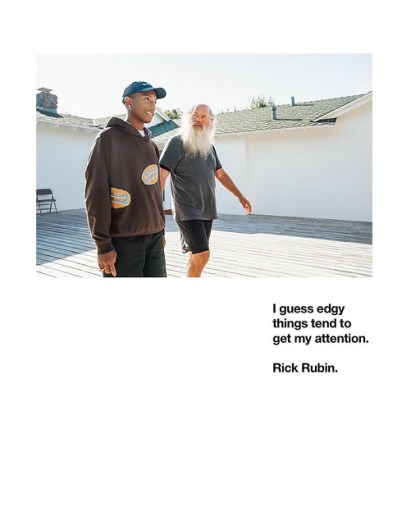
So this is the end of the week so this is the final Rules of Rubin.
To be honest, I’ve got at least another 3 weeks worth of posts I could do, but I want to write about some other stuff.
Yes, less valuable, less relevant, less interesting stuff.
Hey, this blog hasn’t got to where it is by writing stuff that is good. That’s why where this blog is, is at the bottom of everything.
But in all seriousness, maybe I’ll write more about the lessons from Rick later – I’ve certainly enjoyed it – but if you are interested, below is the list of quotes I’ve used and if you click here, you can read my write-ups on all of them.


However this last one is one of the most important.
One of the things I’ve never understood are brands consistently playing to the middle.
I get their thinking.
It’s a mass audience.
It’s a relatively safe audience.
It increases the odds of scalable success rather than risk.
But the thing is, playing to the middle is just the illusion of safety.
Apart from the fact lots and lots of brands are all playing there, all you’re actually doing is – at best – staying where you are, but more likely going backwards.
You might not notice it at first.
You may think everything is fine and dandy and slap yourself on the back for being so brilliant and successful.
But what starts off slow eventually turns in the blink of an eye as the brands or people who play and push to the edge take away all the safety you thought you had.
And what’s worse is because you’re high and dry and left far behind, your legacy and capabilities are impacted.
You’re tainted with being part of the past rather than the present, but even worse than that, your operational capabilities have been built around optimising rather than advancing so the best you can achieve is to play catch up.
This is a nightmare situation, based on one simple reality.
When you are playing catch up, your starting point is where everyone else is. But the problem is that by the time you get there, everyone is even further ahead and you’re back where you started.
A bit like Kyle in this episode of South Park
Of course it doesn’t have to be that way.
Some get that the only way to truly catch up is to leap frog current standards to set the next standard, but few companies have the courage to do that, let alone the money.
Oh they’ll suggest they can.
They’ll make all the right noises.
They’ll invest in some new technology, research or corporate ‘tagline’
They’ll even hire the odd new person from a new discipline with new ideas [though in many cases, they’ll then get moved on with the excuse ‘they weren’t the right cultural fit’] … but the reality is they’ll remain in this endless cycle of catch up.
I’ve seen it.
Hell, I’ve worked in some companies that have practiced it.
Because for all the desire to not get left behind, nothing feels as good as feeling in control.
Even if that’s just an illusion.
Because doing this means their position is protected.
It means they don’t have to look at their entire business model.
But more importantly, it means they don’t have to take a long hard look at their contribution for being in this situation.
So while I totally get why choosing to stand still may sound like the wisest option for so many, the problem with it is that it ignores one pretty vital consideration.
Culture never stops moving.
If you don’t want to get left behind, always play to the edge.
Filed under: Advertising, Agency Culture, Attitude & Aptitude, Authenticity, Brand Suicide, Colenso, Comment, Consultants, Context, Creative Brief, Creative Development, Creativity, Culture, Differentiation, Distinction, Emotion, Empathy, Experience, Happiness, Honesty, Innovation, Insight, Management, Marketing, Marketing Fail, Metallica, Perspective, Planners, Planning, Point Of View, Politics, Premium, Professionalism, Relationships, Relevance, Resonance, Respect, Rick Rubin, RulesOfRubin, Standards, Uncommon, WeigelCampbell, Wieden+Kennedy
So I know I said last week was the last of the Rules By Rubin … but then I did also say there may be some more in the future.
Well consider this the future.
Shit isn’t it?
Don’t worry, it’s just for today and tomorrow then we go back to normal.
So just as shit. Sorry.
Anyway this is about the state of the creative industry.
Whereas once, it was filled with companies all wanting to create wonderful things to put into the world – regardless of their individual discipline or expertise – the emergence of consultancies has led to the industry now falling into 2 groups
Those who can’t help finding ways to put creativity out into the world in interesting ways and those who seemingly do all they can to never put anything out whatsoever.
While I sort-of understand the theory why agencies would like the idea of being like a consultancy, what I’ve found especially bizarre is that in doing that, they’re seemingly happy to dismiss making any actual creativity at all.
At first I was really confused how they thought they’d stay in business.
I mean, there are as many competitors as there are in adland.
Their entire model is designed around making actual creative work.
The lack of C-Suite engagement is more individual than entire industry.
Then I thought maybe I was completely wrong.
That they did want to make work.
After all, why else would their excellent strategists continually write 100 page decks filled with charts, ecosystems, frameworks and playbooks to every single client meeting?
Surely that is a sign of a company actually wanting to make something.
But then on closer inspection, I saw a lot of those decks had no creativity mentioned in them whatsoever.
And the conversation around audience was simplistic, generalist and utterly contrived.
In essence, they talked a hell of a lot but actually said very little.
“What the hell was going on?” I would ask myself.
And then on a cold night one Wednesday, I worked it out.
Those planners aren’t writing strategic decks, they’re creating remuneration landfill.
Thank fuck for the others.
The ones who know who they are.
The ones who push rather than pander.
The ones who create opportunities not wait for them.
The ones who run to the edge rather than run on the spot.
The ones who finish interesting things to start making more interesting things.