
Filed under: A Bit Of Inspiration, Advertising, Agency Culture, Attitude & Aptitude, Audio Visual, Authenticity, Comment, Communication Strategy, Confidence, Content, Context, Creative Development, Creativity, Culture, Differentiation, Emotion, Empathy, Experience, Honesty, Insight, Management, Marketing, Perspective, Planners, Planning, Point Of View, Presenting, Relevance, Resonance, Stubborness
For reasons I am unsure of, I have been asked to do a lot of presentations over the last few weeks.
From the board of directors of the World’s most notorious video game company to Silicon Valley VC’s to the social platform Trump is petrified of and a whole host in-between … I’ve been asked for my POV on all manner of things.
The role of technology in sexual education.
How technology can evolve how we tell stories.
Why the best way to be wanted is to be banned.
How experience design is increasingly built on efficiency not emotion.
How to create the environment where the best creative is allowed to be born.
It’s been so much fun …
Not just because it made me think about things or that I got to meet a bunch of amazing people, but because I could do the presentation entirely as I felt I wanted to.
It’s not that I have felt I couldn’t do what I believe was right, but over the last few years, there’s been a few people who have tried to convey a ‘this is how you should say things’ attitude.
Now don’t get me wrong, it takes an army to make an argument and you should always be open to other people’s thoughts and suggestions … but if you’re made responsible for giving the presentation, then you should get the final call on how you express it.
Having people more obsessed with how you’re saying things rather than what is being said is pretty depressing, but not as depressing when you realise colleagues can be more of an obstacle to great work than your clients.
When that starts happening, you start questioning things.
Often yourself.
Are you good enough?
Are you worthy enough?
And then, before you know it, you’re chipped into complicity by the constant stream of criticism … leaving you with no confidence, no self-belief and not much hope for where you’re heading.
I wrote about this a short while ago which is why I want to just reiterate, when you do the presentation you want, the feeling is infectious.
Not just to you, but to who the audience is.
Here’s some examples of the pages I’ve presented in the last few weeks …
And here’s the thing, they all went down very well.
Sure, some of them made the audience gulp.
But they also loved it because they knew I was saying was to try and help them win better rather than just kick them in the head.
And that’s the key.
Show you really give a shit about them.
However, while some seem to think you do this by pandering to the audience, I believe it is by giving them utter transparency and honesty.
Let’s face it, if you’re willing to do that to a client at a formal presentation – albeit doing it in a way where they understand why you’re doing it – then most of the time they’re going to respect you, even if they don’t agree with you.
I’ve had so many clients come to me/us who initially didn’t.
Because as my old, brilliant head of NIKE marketing said to me once,
“Middle management want to be told they’re right. But senior management want to know how to be better”.
Filed under: A Bit Of Inspiration, Advertising, Agency Culture, Attitude & Aptitude, Brand, China, Comment, Communication Strategy, Confidence, Consultants, Creativity, Culture, Devious Strategy, Differentiation, Diversity, Empathy, Honesty, Imagination, Innovation, Insight, Management, Marketing, Marketing Fail, Martin Weigel, Perspective, Planners, Planners Making A Complete Tit Of Themselves And Bless, Planning, Relationships, Relevance, Resonance, Social Media, Standards, Technology, Unplanned, WeigelCampbell

A few weeks ago, the lovely/stupid folks at WARC asked me to be part of a conversation to discuss whether strategists were well equipped to embrace the opportunity that clients valued brand strategy more than any other discipline.
If you’re a WARC member, you can watch the whole discussion here, but all the panelists were asked to give a 5 minute introductory talk about their perspective on the issue.
I used no slides, but if I had, I’d have used the image at the top of this page that comes from a presentation I recently gave to Rockstar Games. Not because it’s arresting, but because if no one paid any attention to what I said, they’d still get a good idea about where I stand on things.
But for those who want to know a bit more detail, this is what I said.
_____________________________________________________________________________
“We are in an interesting situation.
We have more flavours and capabilities in strategy than ever before.
We have more opportunities to learn the craft of strategy than ever before.
And – according to reports – we have more demand from clients for strategy than ever before.
That all sounds fucking fantastic for the strategy discipline, except we continue to see …
+ Strategic thinking being given away or discounted.
+ Tighter and tighter deadlines for strategy to be concluded.
+ The abdication of strategic thought to ‘whatever the data or platform owners say’.
+ More value placed on the process of strategy than the outcome of it.
+ A reduction in strategic training and development from agencies and companies alike.
+ Huge swathes of strategists being made redundant every single day.
+ A continued reluctance to hire people of colour or people born outside of capital cities
[and when we do, we tell them they’ll only be valued if they act exactly like the incumbents]
+ And from my view, less distinctive, disruptive and long-term strategy than we’ve seen before.
So when I compare the claims ‘the strategy future is rosie’ with the reality going down all around us, something doesn’t add up.
Which leads me to think there are 3 possibilities.
1. The strategy clients want is less about strategy and more about repackaging what they’ve already decided or simply don’t want to have to deal with.
2. The strategy companies/agencies want is less about strategy and more about doing whatever will keep the client relationship happy.
3. The strategy strategists do is less about taking lateral leaps forward and more literal shuffles towards the justification of whatever our clients want to have justified.
OK, I’m being a prick … but only partially.
Somewhere along the line we all seem to have forgotten what strategy is and what it is supposed to do.
To quote my planning husband, Mr Weigel, strategy should …
+ Make things happen
+ Move things forward
+ Create new possibilities
+ Create greater value for the audience and the business.
Or said another way, strategy is about movement, momentum and direction. Where the day after a strategy is engaged, the behaviour of the company or brand is fundamentally different to the day before. A distinctive, sustainable difference designed to deliver breakthrough results born from identifying a real business problem, nuanced understanding of the audience [rather than convenient generalisations] and commercial intimacy … by that I mean knowing who the company actually is, how they operate and how they need to in these modern times.
Prof Lawrence Freedman, the author of A History of Strategy … said it best:
“Strategy is about revolution. Anything else is just tactics.”
And we’re seeing a lot of tactics these days.
And while eco-systems, frameworks, brand onions, data, D2C, UX, creative briefs, ads and comms are all parts of the strategic journey, they’re rarely THE strategy.
Nor is creating endless sub-thinking for every decision, implication or possibility because, at best – they can paralyse the potential of the strategy and end up just creating incremental change rather than fundamental or – at worse – just cause mass fucking confusion.
And don’t get me started on optimisation or user journeys or white-label solutions or writing endless decks that go nowhere … because they’re often more about keeping things the same than moving things forward.
This discipline has been my life. I believe in it and I’m employed because of it. It can create incredible opportunity and value and has some incredible talent working in it and – more excitedly – wanting to work in it. But the reality is for all the people who have strategy in their title, few are setting the stage for brilliantly creative, commercially advantageous, progressive revolution … most of us are simply executing a small part of someone else’s thinking and then going off thinking we’re hot shit.
What this means is as a discipline, we’re in danger of becoming like a contestant on Love Island, initially interesting to meet but ultimately blunt, disposable and forgettable.
And while there’s many reasons for this – some beyond our control – we are contributing to it by acting like our own worst enemy. Doing things like arguing about which ‘flavour of strategy’ is the right ‘flavour of strategy’ for the modern age.
Apart from the fact most of the ‘new flavours’ are just re-badged versions of old strategic rigour – albeit with some more consideration and expression in it – this is just an argument of ego that’s distracting us from the real issue …
We can be so much more than we think we are.
We need to be so much more than we think we are.
But to realise this we need to stop thinking of strategy as if it’s engineering or simply the act of being able to think strategically … and get back to objective, distinctive and focused revolution.
I’ll leave you with one more quote from Prof Freedman:
“Strategy is getting more from a situation than the starting balance of power suggests”.
If we’re not doing that, then we’re not just kidding ourselves … but also our entire discipline and our clients trust.
And while they’re many reasons for it – as I have already mentioned – we’re all kidding ourselves a lot these days.
As with everything, what happens next is up to us. But I hope it results in us being strategically dangerous because when we’re in full flight, that’s when we’ll show how much value we can add to commerce, culture and creativity”.
Filed under: A Bit Of Inspiration, Advertising, Agency Culture, Attitude & Aptitude, Authenticity, Brand, Brand Suicide, Comment, Communication Strategy, Confidence, Content, Context, Crap Campaigns In History, Creative Development, Creativity, Culture, Differentiation, Egovertising, Empathy, History, London, Management, Marketing, Marketing Fail, Perspective, Point Of View, Positioning, Prejudice, Purpose, Relevance, Resonance, Social Divide

Let me start by saying I have a lot of respect for Charles and Maurice Saatchi.
What they did … the legacy they created … is, even now, amazing.
Their agency was responsible for so many of the ads that went on to define my childhood – both in good and bad ways – however, as I got older and entered the industry, I started to understand just how audacious they were in terms of what they thought the ad industry could be. And do.
Back then, their mantra was ‘Nothing Is Impossible’.
And they certainly lived up to it.
But while this led to some truly incredible work, it also led to the brothers ultimate downfall when they tried – amazingly and brilliantly – to buy Midland Bank.
There have been many reasons written about why their plan didn’t work out … and what happened subsequently … but I have to say, I’d imagine working for them at the time – with their sheer confidence, swagger and ambition – would have felt pretty intoxicating.
However this post isn’t about that, it’s about what happens when, in your quest to keep moving forward, you lose your values or self awareness and end up being a caricature of what you once were.
I’ve seen it happen.
I once worked with an advertising great who ended up believing everything they did was great, simply because they did it.
It didn’t take long before they were phoning in their work.
Not caring about what was going on around them.
Saying whatever they wanted because they believed whatever they said was wanted.
It was pretty tragic and I remember a very horrible conversation between us, where I said he had become the beast he had been obsessed with slaying.
It didn’t go well for me.
And, within a year, it didn’t go well for him … when his deluded arrogance took a step too far and his actions and behaviors couldn’t be ignored any longer.
Nowadays I occasionally see him spouting racist shit about immigration and foreign workers, which I find even more shocking given he spent so many years living across the World, not to mention – if rumours are to be believed – doing unspeakable things with certain people when he was in Asia.
But this isn’t a post about an old, short-lived, delusional colleague – nor it is to suggest the Saatchi brothers are anything like my old, delusional colleague … however this is about the moment [at least for me] when the Saatchi brothers revealed they may have not grown with the times, but were lost in old times.
This.

It was early Jan, 1990.
Saatchi was – I believe – the biggest agency in the World.
And the World was changing.
The party of the 80’s was over and everyone was trying to work out what the next decade had in store. One thing that had already started to happen was the fall of communism.
Protests had been happening throughout 1989 and they continued to gain momentum when, in November of that year, The Berlin Wall – a symbol of Communist/Western ideals – fell.
And it was on that wall Saatchi had placed that ad.
Not on the Western side, but the Eastern.
It wasn’t up for long, but they paid to have it there.
A way of showing their mantra.
An act of deliberate provocation for shock value.
An attempt to keep the spirit of 80’s excess alive.
A claim it was welcoming East German’s to independence and choice.
But the problem was, it wasn’t the 80’s anymore and so it came off as an act of commercial vulgarity. An act of cynical shamelessness to try and capture the headlines. And suddenly, the agency that could do no wrong suddenly went from being audacious to trying too hard.
Or said another way, Saatchi’s were trying to hold on to the past rather than lead the future.
Can you imagine an agency doing that now?
Don’t get me wrong, there’s still plenty of them out there that have a complete lack of self awareness … not to mention another bunch whose entire business model appears to be ‘doing things first’ … regardless of its value to culture, creativity or commerce … however I doubt even those guys would think doing this would be a good idea today.
Or at least I hope not.
And that’s why I believe a positioning is not as good as a point of view.
Because positioning’s are set in stone.
They don’t move with the times … they stand firm, shouting their same tune regardless of what is going on. But a point of view is different. There’s flex in that. It lets you express what you believe, but how you express it is shaped by what is going on around it.
There’s longevity in a point of view.
There’s resonance in a point of view.
There’s less need to shock, because you always speak what others are trying to say.
Saatchi’s continue to do great work.
Saatchi’s continues to be filled with great people.
But I’ll always wonder what they could have been if they’d not crossed the line from audacious to caricature.
You can read the story of the Berlin Wall ad, here.
Filed under: A Bit Of Inspiration, Advertising, Attitude & Aptitude, Comment, Content, Craft, Creativity, Culture, Differentiation, Emotion, Empathy, Home, Insight, Marketing, Relevance, Resonance

To people outside of the UK, the title of this post might sound like a diss to NIKE.
But it’s not.
It’s part of a well known tagline by UK hardware giants, B&Q.
Originally the whole expression was ‘Don’t just do it, B&Q it’ however it’s recently had an evolution … which is my excuse for talking about their new ad campaign.
A campaign by – in my opinion – the best agency in the UK right now and one of the best in the World.
Uncommon.
I’ve written about how much I love them – and Nils in particular – and this campaign is another reason for that.
DIY often gets promoted by ‘salt of the earth men and women’ making, fixing or changing stuff.
Or ‘cheeky chappy’, blue-collar cliches … having a giggle as they saw some wood.
It’s all very practical, rational and very before/after.
But Uncommon have done something different.
For a start they are trying to bring more people into the DIY world rather than just appeal to the people already there. It’s smart, because with COVID, we’re having to rely more and more on our own abilities than those of a specialist.
But they’ve done something more than that.
They’ve tapped into the emotions of what DIY does for us.
Not in the terms of a new shelf or a better shed … but in terms of crafting the place we live and turning it into our home.
A place that reflects us not just shelters us.
The quirks, the tweaks, the creativity, the failures.
The stuff we will always remember when we see it.
The stuff that makes it OURS.
The stuff we built … literally and figuretavely.
And it’s this premise that Uncommon tapped into with the thought, “you don’t buy a life, you build one”.
It’s always been true, but in these times where we try to outsource everything for a generic perfection, it is even more pertinent.
Doesn’t matter what you make.
Doesn’t matter how good you are.
All that matters is you make something that makes it yours.
I love everything about this campaign.
The idea. The craft. The writing.
I love that they’ve evolved the line from ‘Don’t just do it’ to ‘You can do it’.
It’s the right thing to do.
Not just because it is more inclusive, emotional and personal … but because it has a positive, encouraging energy to it. Something that conveys confidence for whatever you’re going to do rather than judgement and doubt.
But one thing I like in particular is the poster campaign.
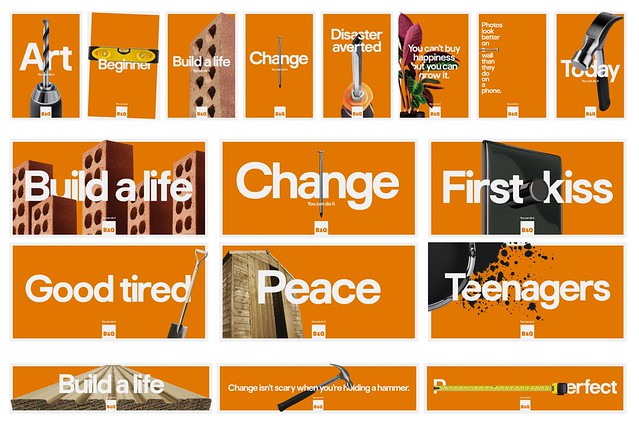
As I wrote previously, Uncommon are seemingly single-handedly bringing the beauty and value of posters back into the ad world.
The work they’ve done for B&Q is a perfect example of that.
Simple. Clear. And each expressing a different attribute of the brand idea.
No bought in stock shots with some throwaway, meaningless copy dropped on it …, oh no … they’re all individually and beautiful art directed to within an inch of their life.
This is what advertising can be. Should be.
This is how we build the industry again.
This is how we turn it into a home people want to live in again.
Filed under: A Bit Of Inspiration, Advertising, Attitude & Aptitude, Brilliant Marketing Ideas In History, Comment, Communication Strategy, Corporate Evil, Crap Marketing Ideas From History!, Creativity, Culture, Loyalty, Marketing, Marketing Fail, Membership
Loyalty.
One of the most overused, misunderstood words ever used.
At least in marketing.
Too often companies/agencies think the word – or, the modern version of it, ‘membership’ – gives them the right to churn out all manner of contrived marketing under the guise of it being for the benefit of their members … when we all know it’s just a badly disguised attempt to get people to spend more money with them.
It’s so transparent you could put it in your garden and call it a greenhouse.
But recently I saw an example of a brand that understands what being a member should mean. How it should feel.
Because contrary to what many companies seem to believe, membership is as much about give as it is take.
I’ve heard far too many people narrow it down to ‘transactional value’.
What a company gives you is in proportion to what their audience gives them.
Data for discounts.
Purchases for discounts.
Information for access to stuff. And discounts.
Mechanical. Contrived. Commercial. Soulless.
And while I get the commercial value in this approach and acknowledge some do it very well … apart from the fact it’s now condition of entry for any commercial organisation, that’s not what real membership is about, just the illusion of it. And often, this illusion isn’t even for the audience, but for the marketing department of the brand and their agency.
Having a card that gives you discounts or questionable points that – if you’re lucky – can be used for some supposed benefit or other, may increase the amount of times you transact with a brand, but it doesn’t mean the audience give a shit about them.
And maybe companies don’t care about that, they just want your money.
But they should.
Because if people are transacting purely for convenience or routine, you may find they’re susceptible to going to someone who shows they understand who they really are, not just how much money they have to spend.
Nothing highlights what real membership is like, like sport.
Yes they expect stuff from their team.
Yes they can be vocal when things go wrong.
But …
Members can deal with loss.
Members can deal with pain.
Members can even deal with scandal.
All they really want is to feel their presence counts.
That they’re seen. That they’re valued. That they’re respected.
That both parties are putting in equal amounts of graft for the common goal.
Not so the club can flog them more of their stuff, but so they can feel they play an acknowledged and accepted role in making the team better, more distinctive and more special.
And while there’s a bunch of programmes that do this – and some do involve giving discounts and access to products before they hit the market – the most powerful are where teams target members hearts, not just their wallets.
Doing stuff they value, not what they want you to value.
Stuff they didn’t have to do, but still did.
Stuff that means they went out of their way rather than expecting their members to always go out of theirs.
It doesn’t even have to be a grand gesture, it just needs to be a gesture that proves you get how important it is to them, rather than just say you do.
But here’s the best bit … when you do that properly, you find those members will want to buy more of your stuff anyway.
No need for any contrived ‘membership’ marketing.
No need to claim you are as loyal to them as they are to you.
No need to push ‘signing up’ every time they spend any amount of cash.
Because ‘transactional value’ is a byproduct of the emotional relationship you have together, not the cause.
You’d have thought brands would have got this by now, especially as the approach so many currently favour is not that different to when the internet first started and people would get inundated with ‘e-newsletters’ from brands, simply because they once handed over their email address because they were interested in a single thing they said.
I often wonder if the brands that follow this approach think Argos has the best membership program in the Universe, simply because people keep stealing pens from their stores.
If you are one of those wondering this, let me help you.
They don’t. People just steal their pens from them. Because they can.
Me included.
And yes, I appreciate someone could say that’s ‘transactional value’ but actually it’s just shitty free advertising from a shitty free pen. It’s the same approach Virgin Atlantic had with their Upper Class salt and pepper sets that literally had ‘stolen from Virgin Atlantic’ printed on the bottom of them.
Because it was free advertising. Literally included in their cost of operations.
Look, having programs in place that drives sales value is a smart thing to do.
But doing the same as everyone else and claiming people have some sort of deeper connection with you because of it, is ridiculous.
Transactional value is the opposite of what membership is really about.
Because membership isn’t just about what you have, but how it makes you feel.
Or said another way, who it makes you feel you are … who you are a part of.
And with that, have a look at this …