
Filed under: A Bit Of Inspiration, Advertising, Attitude & Aptitude, Comment, Content, Craft, Creativity, Culture, Differentiation, Emotion, Empathy, Home, Insight, Marketing, Relevance, Resonance

To people outside of the UK, the title of this post might sound like a diss to NIKE.
But it’s not.
It’s part of a well known tagline by UK hardware giants, B&Q.
Originally the whole expression was ‘Don’t just do it, B&Q it’ however it’s recently had an evolution … which is my excuse for talking about their new ad campaign.
A campaign by – in my opinion – the best agency in the UK right now and one of the best in the World.
Uncommon.
I’ve written about how much I love them – and Nils in particular – and this campaign is another reason for that.
DIY often gets promoted by ‘salt of the earth men and women’ making, fixing or changing stuff.
Or ‘cheeky chappy’, blue-collar cliches … having a giggle as they saw some wood.
It’s all very practical, rational and very before/after.
But Uncommon have done something different.
For a start they are trying to bring more people into the DIY world rather than just appeal to the people already there. It’s smart, because with COVID, we’re having to rely more and more on our own abilities than those of a specialist.
But they’ve done something more than that.
They’ve tapped into the emotions of what DIY does for us.
Not in the terms of a new shelf or a better shed … but in terms of crafting the place we live and turning it into our home.
A place that reflects us not just shelters us.
The quirks, the tweaks, the creativity, the failures.
The stuff we will always remember when we see it.
The stuff that makes it OURS.
The stuff we built … literally and figuretavely.
And it’s this premise that Uncommon tapped into with the thought, “you don’t buy a life, you build one”.
It’s always been true, but in these times where we try to outsource everything for a generic perfection, it is even more pertinent.
Doesn’t matter what you make.
Doesn’t matter how good you are.
All that matters is you make something that makes it yours.
I love everything about this campaign.
The idea. The craft. The writing.
I love that they’ve evolved the line from ‘Don’t just do it’ to ‘You can do it’.
It’s the right thing to do.
Not just because it is more inclusive, emotional and personal … but because it has a positive, encouraging energy to it. Something that conveys confidence for whatever you’re going to do rather than judgement and doubt.
But one thing I like in particular is the poster campaign.
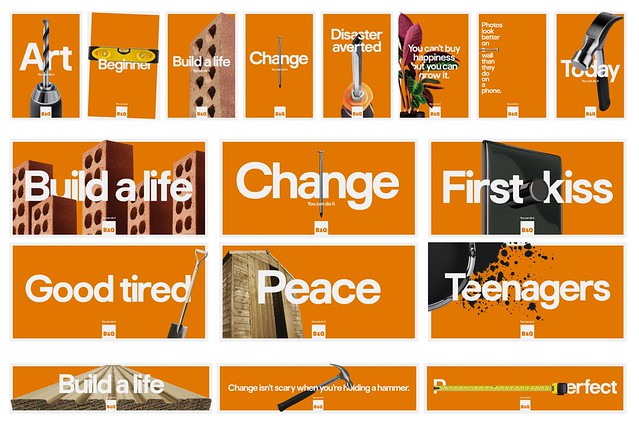
As I wrote previously, Uncommon are seemingly single-handedly bringing the beauty and value of posters back into the ad world.
The work they’ve done for B&Q is a perfect example of that.
Simple. Clear. And each expressing a different attribute of the brand idea.
No bought in stock shots with some throwaway, meaningless copy dropped on it …, oh no … they’re all individually and beautiful art directed to within an inch of their life.
This is what advertising can be. Should be.
This is how we build the industry again.
This is how we turn it into a home people want to live in again.
Filed under: A Bit Of Inspiration, Advertising, Agency Culture, America, Attitude & Aptitude, Audio Visual, Authenticity, Business, Comment, Confidence, Content, Context, Craft, Creative Development, Creativity, Culture, Diversity, Empathy, Entertainment, Equality, Experience, Film, Finance, Friendship, Happiness, History, Loyalty, Management, Music, Relevance, Resonance

Yes, this post really is about the movie The Blues Brothers.
The one where paroled convict Jake — and his blood brother Elwood – set out on a mission from God to save the Catholic orphanage in which they were raised, from foreclosure.
Where to achieve their goal, they not only have to reunite their R&B band and organise a concert so they can try to earn the $5,000 needed to pay the orphanage’s tax bill … but also have to navigate around a homicidal mystery woman, a bunch of Neo-Nazis, an entire police department hellbent on stopping them and a Country & Western band.
And yes, I am really saying we should be like them.
However this is not because I am advocating violence against authority [ahem], or even a return to the true definition of rhythm and blues [versus the sanitised version being flogged by record companies left, right and centre] but because of how Dan Aykroyd – the writer and actor of the movie – ensured the creative value of the artists appearing in the film was rewarded rather than exploited.
Music has a long history of exploiting artists.
Where their talent is used to fund the lifestyles of everyone other than themselves.
It’s been going on for decades and affected everyone – including those who got to ‘the top’ like The Beatles and Elvis Presley [there’s also a great book on how badly Bros got ripped off, which is worth checking out] … however no group of musicians has been as badly affected as black artists.
From not being paid to not being played … black artists has consistently been exploited and abused by white music industry leaders, from record companies to MTV.
To give you an idea of it, here’s a clip of David Bowie challenging MTV about their lack of black artists on the channel …
Bowie, as usual, was right.
Recently I watched a documentary where legendary musician, Herbie Hancock, talked about his iconic Rockit video and how they purposefully created something that didn’t really show his face to ensure MTV would play it in heavy rotation.
THIS IS NOT A LONG TIME AGO!!!
And while you may think the music business is now dominated with black artists, the reality is they are still getting screwed by organisations who want to profit from their talent.
Which leads me back to the Blues Brothers.
You see this movie was dominated by African American musicians – and while many studios would try and underpay them by saying the worldwide exposure they’d gain is commercially valuable to them, Dan Aykroyd did something else.

That’s right, he let them keep their publishing rights.
Which means every time a song or the movie was played, the artists behind the music would get paid.
Not the studio.
Not the writer.
Not the networks.
But the artists.
What’s sick is that 40 years later, this act by Dan Aykroyd and John Belushi is still rare.
Since then, we have consistently seen people of colour have their creativity exploited and profited from by others.
Whether that is through acts of cultural appropriation to corporate intimidation to down right theft.
Frankly, nothing highlights this more than the plight of Dapper Dan and his store in Harlem during the 80’s and 90’s. Here was an individual who created fashion that changed and impacted culture on an almost unprecedented scale … and yet he faced a constant barrage of abuse, exploitation and theft from organisations who appreciated his talent but just didn’t want to pay for it or acknowledge it.
Given black culture is the driving force of almost all youth culture around the World, it is disgusting how little of the money it helps generate ends up in the pockets of the black community … which is why I suggest another way companies can demonstrate their diversity and inclusion ambitions is to follow the approach of the Blues Brothers.
Included.
Represented.
Acknowledged.
Respected.
Paid.
Enabled.
Empowered.
Filed under: A Bit Of Inspiration, Attitude & Aptitude, Cars, Comment, Craft, Creativity, Culture, Fulfillment, Insight, Management, Resonance, Service, Standards, Technology
So I have an Audi.
I know … I know … what a wanker.
Well as we all know, German cars are well known for their quality of engineering, but recently I saw something that showed me it’s not just engineering where they pay attention to detail.
Have a look at this …

Can you see?
It’s the colour of the screws.
Where most cars have 4 yellow screws in each corner of the rear number plate, Audi have used 2 – one black, one yellow – placed in the middle of the number plate and designed to make sure they perfectly match with the area they’re screwing into.
Black to match the colour of the letter of the registration number.
Yellow to match the background of the rear registration number.
It’s an incredibly small thing, but if they care about that, you can be sure they care about every detail in the car.
Which helps reinforce why German manufacturing is so highly revered.
Or said another way, why craft is proved by the small things, not just the big.
Filed under: A Bit Of Inspiration, Advertising, Attitude & Aptitude, Audio Visual, Authenticity, Comment, Confidence, Craft, Creativity, Culture, Design, Fulfillment, Honesty, Perspective, Presenting, Relationships

One of the things I find really interesting is how adland has got into the habit of providing clients with multiple options for every bit of work.
Oh I get it.
Apart from the fact there’s always more than one way to answer any brief, we want – or should I say, we need – clients to be happy.
Except it doesn’t always end up that way does it?
We make alternatives that aren’t as good as the idea we think they should buy.
Clients demand diluted versions of the work we don’t really like in the first place.
We end up getting fired because the campaign they pushed us to make didn’t work as well as they wanted.
Who are the bigger idiots?
The people who don’t buy what the experts put forward or the experts that offer alternatives they don’t really believe in?
Which is why every single person should read the story of Paul Rand – the designer who Steve Jobs turned to, to design the logo for his NeXT computer company.
Not just because it’s a brilliant story.
Not just because he didn’t even bother to turn up to the pitch, he just sent a brilliant 100 page book with his idea in it.
But because when Jobs was asked what it was like to work with Rand, he said …
“I asked him if he would come up with a few options, and he said … no, I will solve your problem for you and you will pay me.
You don’t have to use the solution. If you want options go talk to other people.’”
How good is that?
+ I will solve your problem for you.
+ You will pay me for my recommendation, whether you use it or not.
+ If you want options, go talk to other people.
While some may claim that makes Paul Rand arrogant or petulant, I would say it shows someone who knows the value of their experience … their talent and their craft.
More than that, I think it shows someone who really thinks about what idea is the right one for their client and then puts only that one in front of them.
Not countless options.
One.
A single idea that has gone through hundreds of possibilities to get to that single recommendation.
Something that has been created and crafted to answer the brief, rather than simply executed to satisfy the clients taste.
And while the article itself states the NeXT logo might not be a classic … the style, approach and attitude of the presentation certainly is.
Adland should take note.
Read it here.
Filed under: A Bit Of Inspiration, Advertising, Agency Culture, Attitude & Aptitude, Authenticity, Brand, Brand Suicide, Comment, Communication Strategy, Confidence, Content, Context, Crap Campaigns In History, Creative Development, Creativity, Culture, Differentiation, Egovertising, Empathy, History, London, Management, Marketing, Marketing Fail, Perspective, Point Of View, Positioning, Prejudice, Purpose, Relevance, Resonance, Social Divide
Let me start by saying I have a lot of respect for Charles and Maurice Saatchi.
What they did … the legacy they created … is, even now, amazing.
Their agency was responsible for so many of the ads that went on to define my childhood – both in good and bad ways – however, as I got older and entered the industry, I started to understand just how audacious they were in terms of what they thought the ad industry could be. And do.
Back then, their mantra was ‘Nothing Is Impossible’.
And they certainly lived up to it.
But while this led to some truly incredible work, it also led to the brothers ultimate downfall when they tried – amazingly and brilliantly – to buy Midland Bank.
There have been many reasons written about why their plan didn’t work out … and what happened subsequently … but I have to say, I’d imagine working for them at the time – with their sheer confidence, swagger and ambition – would have felt pretty intoxicating.
However this post isn’t about that, it’s about what happens when, in your quest to keep moving forward, you lose your values or self awareness and end up being a caricature of what you once were.
I’ve seen it happen.
I once worked with an advertising great who ended up believing everything they did was great, simply because they did it.
It didn’t take long before they were phoning in their work.
Not caring about what was going on around them.
Saying whatever they wanted because they believed whatever they said was wanted.
It was pretty tragic and I remember a very horrible conversation between us, where I said he had become the beast he had been obsessed with slaying.
It didn’t go well for me.
And, within a year, it didn’t go well for him … when his deluded arrogance took a step too far and his actions and behaviors couldn’t be ignored any longer.
Nowadays I occasionally see him spouting racist shit about immigration and foreign workers, which I find even more shocking given he spent so many years living across the World, not to mention – if rumours are to be believed – doing unspeakable things with certain people when he was in Asia.
But this isn’t a post about an old, short-lived, delusional colleague – nor it is to suggest the Saatchi brothers are anything like my old, delusional colleague … however this is about the moment [at least for me] when the Saatchi brothers revealed they may have not grown with the times, but were lost in old times.
This.
It was early Jan, 1990.
Saatchi was – I believe – the biggest agency in the World.
And the World was changing.
The party of the 80’s was over and everyone was trying to work out what the next decade had in store. One thing that had already started to happen was the fall of communism.
Protests had been happening throughout 1989 and they continued to gain momentum when, in November of that year, The Berlin Wall – a symbol of Communist/Western ideals – fell.
And it was on that wall Saatchi had placed that ad.
Not on the Western side, but the Eastern.
It wasn’t up for long, but they paid to have it there.
A way of showing their mantra.
An act of deliberate provocation for shock value.
An attempt to keep the spirit of 80’s excess alive.
A claim it was welcoming East German’s to independence and choice.
But the problem was, it wasn’t the 80’s anymore and so it came off as an act of commercial vulgarity. An act of cynical shamelessness to try and capture the headlines. And suddenly, the agency that could do no wrong suddenly went from being audacious to trying too hard.
Or said another way, Saatchi’s were trying to hold on to the past rather than lead the future.
Can you imagine an agency doing that now?
Don’t get me wrong, there’s still plenty of them out there that have a complete lack of self awareness … not to mention another bunch whose entire business model appears to be ‘doing things first’ … regardless of its value to culture, creativity or commerce … however I doubt even those guys would think doing this would be a good idea today.
Or at least I hope not.
And that’s why I believe a positioning is not as good as a point of view.
Because positioning’s are set in stone.
They don’t move with the times … they stand firm, shouting their same tune regardless of what is going on. But a point of view is different. There’s flex in that. It lets you express what you believe, but how you express it is shaped by what is going on around it.
There’s longevity in a point of view.
There’s resonance in a point of view.
There’s less need to shock, because you always speak what others are trying to say.
Saatchi’s continue to do great work.
Saatchi’s continues to be filled with great people.
But I’ll always wonder what they could have been if they’d not crossed the line from audacious to caricature.
You can read the story of the Berlin Wall ad, here.