
Filed under: A Bit Of Inspiration, Apathy, Attitude & Aptitude, Authenticity, Brand Suicide, Business, Comment, Complicity, Confidence, Consultants, Context, Corporate Evil, Corporate Gaslighting, Creative Development, Creativity, Culture, Fake Attitude, Imposter Syndrome, Leadership, Management, Marketing, Marketing Fail, Mediocrity, Prejudice, Professionalism, Relationships, Relevance, Resonance, Respect, Succession, Toxic Positivity, Trust, Truth

I appreciate that at my age, the title of this post may suggest I’m going to whine about companies overlooking people of a certain age for younger, cheaper, hungrier individuals.
I’m not. I get it.
Not only that, while age and knowledge have some level of interconnectedness … I’ve met countless young people who are bloody brilliant [not relative to their age, just bloody brilliant] as well as plenty of people with ‘experience’ who, frankly, aren’t.
What I’m talking about is the blinkered confidence some companies place in their people simply because they’re their people.
On one hand I suppose I should celebrate it, given its not that long ago that companies overlooked internal capability for the external shiny and new.
And while this post does not reflect any of the clients I specifically work with directly, I am seeing and hearing more and more companies go to this other extreme and worse … enabling a level of arrogance in their people that results in any objectivity they face – regardless of the knowledge and expertise of the person delivering it, let alone the desire to help make things more successful – as a threat.
Complicity is the name of the game these days.
Blind acceptance that whatever the person ‘in charge’ says, is right.
A belief internal employees are better informed about every topic than people who are experts in specific topics … so companies can feel great about themselves.
Of course, the issue with this approach is that when things go wrong – or don’t go right enough – everyone else gets the blame. Not just by the person in charge [which you almost expect] but by the company they work for, despite the fact the only reason they gave this employee the project is because they knew a bit more about a subject than senior management, so they saw them as [1] an expert in the field and [2] a cheaper option that bringing in external expertise.
Now you’d think the fear of this outcome would ensure people would stand up for what they believe is right.
Not because they’re arrogant, but because they know their experience and knowledge can disproportionally benefit the end result.
And some do. At least the really good ones …
But even they are under increasing pressure to go along with the whims and wants of certain people/companies … because the whole industry is seeing more and more work being handed to people and companies who simply say yes to whatever is wanted.
Or said another way, convenience and fawning is more valued then expertise, knowledge and standards.
Now of course, it’s human nature to believe we can do more than we actually can.
We all like to think we are ‘special’.
We all like to be acknowledged as important.
We’ve all heard the ‘fake it till you make it’ philosophy.
But the truly special are the ones who know that however good they are, having people around them who are better than them – in different fields – can make them even more effective.
It’s why the World’s best athletes have coaches.
It’s why the World’s best musicians have producers.
It’s why my brilliant ex-NIKE/FFI client, Simon Pestridge, said: “middle management want to be told they’re right. Senior management want to know how they can be better”.

The reason I say all this is that I recently reached out to one of the best organisational psychologists in the World. They work with the CEO’s of some of the most respected and successful companies in the World including Apple, NIKE, Ferrari and Electronic Arts to name a few.
This is what they said when I talked to them about what I was seeing:
_________________________________________________________________________________________________________________
“I call them professional imposters and the reason so many succeed in corporations is because they target other imposters. It becomes a co-dependent relationship where they ensure their ego, status or promotion opportunities won’t be challenged.”
_________________________________________________________________________________________________________________
To be honest, I was not shocked by their view, I was more shocked by the acknowledgment.
Of course, I probably shouldn’t be. It’s hardly a new phenomenon and we also had one of the most successful shows in TV history shine a light on it …
Succession was a celebration of the role of co-dependence and complicity within organisations.
As I wrote recently, Tom was the epitome of it.
But this post is about Tom before he ‘won’ [even though he is still a pawn to the real power] … this is about Tom when he just wanted to please to win favour. Where he thought nothing of being vicious and vindictive to those beneath him because he knew that didn’t just please the people above him, it let him feel he was above everyone around him.
And so Tom eventually gets promoted beyond his capability …
Where the illusion of power and external fawning is more important to him than pay checks.
Where his belief is he is superior to all, regardless of knowledge or experience.
Where his understanding of situations is the only understanding of a situation.
Yeah, it’s bleak. It’s fucking bleak. Because while Tom was fiction, Trump got to be President of America. And what makes it worse is we all see it. Hell, we’ve probably all been exposed to it. And yet it goes on.
If companies truly want to be great, then they’ve got to kill and stop rewarding toxic positivity … because value will be revealed when they allow more people to say no to them and they say yes to more people.
Filed under: A Bit Of Inspiration, Attitude & Aptitude, Comment, Content, Context, Emotion, Empathy, Mum & Dad, Nottingham, Nottingham Forest
First of all happy birthday to Queen drummer, Roger Taylor.
He turns 74 today – which used to sound ancient, but now I’m 53, sounds terrifyingly close.
Hopefully when I’m his age I am also living my best life … though what that is, is evolving in ways I’m trying to work out – haha.
But this post is about my hometown, Nottingham.
I went there a month ago on my way to Cannes and I have to say it was a very emotional trip.
Part of this is because it was the first time I’d been there on my own since my Mum died.
Part of this is because it was the week after a terrible incident in the city where 3 innocent people were killed.
And part of this was because of a personal situation and challenge that I was – and still am – trying to work through.
In my few days there, I went on a bit of a history journey … visiting places that meant so much to me as a kid.
From shopping in Victoria City … visiting Rock City … passing my old schools … picking up some food from the local Asda, where my parents would shop every Friday evening … going to the crematorium to see the memorial for my parents … paying homage to the Nottingham Forest football stadium … right through to popping in and seeing my childhood home, that resulted in me bursting into tears in front of the new owner as it was much more impactful than I had dared imagine.
Yeah, it was one big sentimental and emotional journey.
But amongst all the memories, there was something that popped up that I wasn’t expecting.
Something I thought had died and I’d recently written about.
This.
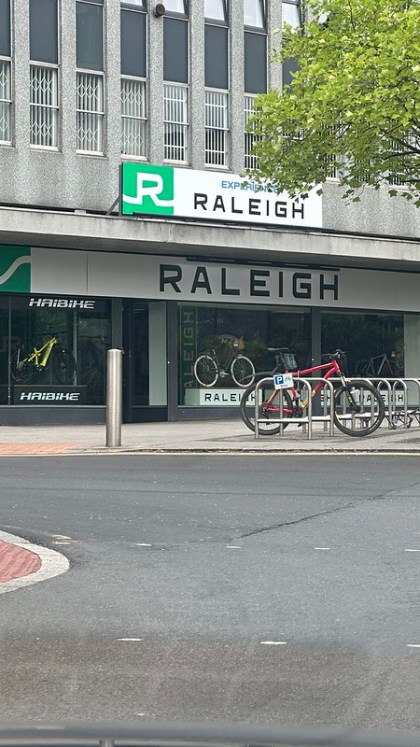
Yep, Raleigh Bikes were back.
Better yet, they were on Maid Marion Way … a thoroughfare of the city that meant everyone would see them.
OK, they aren’t what they used to be – they’re owned by a Dutch company for a start – but they exist and are still based in Nottingham.
As I wrote in my post about Raleigh last month … seeing this brand that defined and promoted my city to the World, die was incredibly tough.
When you’re a kid you look for signs you’re living in a place that is full of promise and hope … a place that let’s you feel you have a bright future … and in my earliest days, with Raleigh making globally known bikes and Nottingham Forest being Kings of Europe, I did. But then, when Forest fell away and Raleigh died, it shook me to my core.
I appreciate that’s the sort of melodrama only a young kid can have, but I wasn’t too wrong to be fair … so seeing the brand alive in my city – especially after a week that saw the whole county in mourning for the needless death of so many – gave hope.
A sense that even in the darkest times, we can move forward.
Given how fucked the UK is right now, that’s worth its weight in gold.
And I’m happy. Because while I don’t live in Nottingham, I’ll always belong there.
Filed under: A Bit Of Inspiration, Advertising, Agency Culture, Attitude & Aptitude, Brand, Brand Suicide, Business, Comment, Communication Strategy, Creative Development, Creativity, Culture, Effectiveness, Management, Marketing, Marketing Fail
A few weeks ago, I saw this …

… and I have to be honest, it’s had me thinking a lot.
Because while I acknowledge you can’t take things for granted, when you get lost in the weeds, you lose sight of what you’re working towards and how you do it.
And a lot of people are doing both of those things.
Nothing sums this up more to me than the issue of attribution.
The quest to minimise risk – or ‘optimise value’ – has resulted in brands forgetting that the easiest way to get attribution is to do something interesting.
But instead – reinforced by industry ‘guru’s – we have ended up with a continual production line of commercially responsible alternatives.
Be a one colour brand.
Place brand assets higher than a brand idea.
And – worse of all – have watermarks in your ads.

While colour and brand assets have a role – albeit not a primary role as so many people seem to suggest – if you feel the only way your brand will be remembered in your commercial is to place your logo all the way through it, then you either don’t know how people work or how advertising does.
Or said another way, you’re admitting your brand and your product are forgettable.
Seriously … why would you do that?
Why would you spend millions on something that positions you as uninteresting.
Worse, why would you spend millions on something that positions you as uninteresting and make sure people know it’s you by ramming your logo down their throat?
But somewhere, someone is measuring the ‘impact’ of this approach and finding a way to demonstrate its effectiveness to clients. Letting everyone feel pleased with themselves. Their choices. Their actions. Creating a precedent others will follow in the blind belief they’re being smarter … more optimised … more effective than all their competitors. All the time consciously and deliberately ignoring the critical fact that it’s undermining them rather than liberating them.
Which leads back to that tweet at the top of the page.
Because while knowing how things are going is important, nothing reveals how lost you are than measuring everything but valuing nothing.
Filed under: A Bit Of Inspiration, Attitude & Aptitude, Authenticity, Comment, Communication Strategy, Food, Innovation

Years ago I wrote about how standards are driven – and protected – by stubbornness.
Well recently I heard a great story about the man who started the sauce company, Si Racha, who embraces this value.
David Tran arrived in America in 1979 after fleeing Vietnam after the communist takeover.
He found himself living in LA with nothing but his passion for spicy food.
The Vietnamese are one of the most magical and industrial cultures on the planet so David decided to turn his love into an outlet and started making hot sauce in a bucket and selling it from his van.
The name Si Racha came from a Thai surf town where he liked the sauce.
[You thought that was the name of the sauce rather than the brand didn’t you?]
Anyway, David didn’t care about branding or advertising … he just focused on making the best sauce possible. And it worked, because word of it spread like wildfire and suddenly people were buying it in their droves and putting it on everything they ate.

Over time, David started partnering with local Asian restaurants & grocery stores … and more and more people got to experience it.
One day someone said his product was “too spicy” and suggested he adds a tomato base to sweeten it. His friends agreed, saying it would pair better with chicken. But this is where David’s stubbornness started to come through.
“Hot sauce must be hot… We don’t make mayonnaise here.”
Over time Si Racha has become a cult phenomenon.
Famous chefs talked about their love of it.
Obama talked about his love of it.
And in many ways, the sauce became a symbol of both the diversity in America and the opportunity of America … because here was an immigrant who pursued his dream despite all odds and succeeded.
Today, Sriracha sells over 20 million bottles per year, generates over $150 million in annual revenue and has made Tran a very rich man.
But rather than just produce more and more of the sauce to make more and more money, it’s production is strictly managed.
David is adamant on quality, so because Jalapenos have a short window for being at their optimum ripeness, he has created a production cycle where a year’s supply is executed in just 10 weeks.
Tran owns 100% of his company – which he named after the ship that brought him to the US.
He still works at his factory in Irwindale, California and he still wears the same blue shirt and hat every day.
But what I love most is his attitude towards why he so conscientiously and strictly makes his product …
“I don’t make hot sauce for money. I make money for hot sauce.”
We could all do with more David Tran’s.
Filed under: A Bit Of Inspiration, Apple, Attitude & Aptitude, Authenticity, Comment, Confidence, Management, Mercedes
The photo above is old.
I didn’t even take it. And yet, when I was sent it, I immediately felt nostalgic and sentimental.
Not because of the car – even though it’s a very nice car – but because of the person who owned it.
You see this was Steve Jobs car.
A Merc.
Sure, an AMG Merc … but still a Merc.
And the reason it has no number plate is because he apparently changed it for another AMG Merc every 3-6 months.
Whether he did that for security or not wanting to commit, I don’t know … but I’m pretty sure it wasn’t because he was financially flexing.
What’s interesting to me is that the extremely wealthy people I’ve met, don’t do that.
Sure they have nice things.
Sure they have things we could never get.
But it’s rarely for show … which is why I’ve found it so amusing to hear people – especially ‘trend spotters’ – go on about ‘quiet luxury’ as if it was a new thing.
Better yet, they only ‘discovered’ it because of Succession, so it’s not even something they had considered before then.
But seeing Jobs car just parked in a carpark ignited a feeling of conflict within me.
Given his influence and impact on the world, it seems banal to witness his car parked in an everyday carpark.
An outdoor carpark.
Parked perfectly within the lines!
A reminder he was human.
An incredibly brilliant and rich human … but a human all the same.
Where for all his achievements, there were moments his day was like so many of us.
Traffic.
Petrol.
Jams.
Parking.
Commute.
It’s also a reminder that for all his tempestuous, demanding, stubborn characteristics … Jobs was always about the work, not the ego.
Because that carpark is the old Apple carpark.
As the co-founder of the most influential technology company in the World, he could have demanded anything.
Helicopters.
Police escorts.
A chauffeur.
Or at least a car park space under some shade.
But no. Or at least I have been told he didn’t.
That he has been gone 12 years is incredible.
I suppose that’s the mark of someone that made a mark.
You don’t just miss them, you don’t recognise time.
________________________________________________________________________
Update: This post has kind of lost its energy given someone has sent me this.
Bloody hell Steve … why????.