
Filed under: Advertising, Agency Culture, Attitude & Aptitude, Brand Suicide, Communication Strategy, Crap Marketing Ideas From History!, Creativity, Culture, Embarrassing Moments, Management, Marketing, Marketing Fail, Music

First of all, this is the last post for a week.
I’m away next week for a talk – I know, I know – and not back till Thursday evening so you can go into the weekend with an extra big smile on your face. Assholes.
Anyway, back to the post.
Over the years, this industry has shown an alarming lack of judgement in how it presents itself.
However, of all the terrible ideas, the absolute worst has to be when they decide to show how ‘fun’ they are through the art of song.
There’s been so many examples.
Sapient Nitro – remember them? – started it with something I can’t remember.
Then Mindshare Amsterdam got in the act saying they ‘work hard for your money’.
Not to be left out … Leo Burnett Sydney did – I think – a Sister Sledge song for a pitch.
Then Ogilvy Athens wrote a ‘ballad’ dedicated to David Ogilvy.
And then – one of my car-crash favourites – the Singapore Media Development Authority did a rap that, rumour has it, almost stopped Eminem wanting to continue his career. Maybe.
Despite having written a few times about these symphonies of shit, the reason there are so few links is because over the years, the guilty parties realised it made them look like a bunch of lunatic impersonator ‘entertainers’ appearing on a revival of Stars in Their Eyes.
Which is why I’m so happy that someone has decided to revive the trend with an epic re-write of Elton John’s ‘I’m Still Standing’ … filmed where the original video was shot. Cannes.
Better yet … at Cannes while I believe the festival was on.
Now, to be fair, it is way, way better than the other films mentioned and shown in this post.
That doesn’t mean much given they were worse than the worst musical duo on Britain’s Got Talent musical duo in history, but beggars can’t be choosers.
But I still can’t grasp why anyone would do this.
Don’t get me wrong, you don’t have to take yourself seriously while still taking what you do seriously … but to decide you have to ‘show’ you’re fun outside the context of how you’d actually interact with a client seems crazy. Almost as crazy as thinking this shows you’re ‘fun’.
And remember, this is coming from me … who did iPod Singing and wear birkenstocks!!!
So with that, let me send you off to your weekend with this rendition of I’m Still Standing … which still you might think is a joke but I can assure you isn’t as bad as sitting in the Majestic during the festival and watching people pour 2 grand bottles of champagne down their throat while publicly banging on about the economic crisis facing them and their clients.
Happy weekend.
Filed under: Attitude & Aptitude, Brand, Brand Suicide, Complicity, Context, Corporate Evil, Creativity, Culture, Innovation, Management, Marketing, Marketing Fail, Teamwork, Technology

I always laughed when people blamed Microsoft Powerpoint for bad presentations.
The idea that this program was purely responsible for you choosing to write 15,000 pointless words on a page in small font.
Sure, it had limitations … sure, it could encourage a certain ‘look’ for what you wanted to present … but fundamentally, that was on you, not it.
Don’t get me wrong, for a tech company … I’m shocked at how bad their user experience is.
If you think their classic platforms are bad, you should see the utter shit show that is a parents account on X-Box.
Or Microsoft Teams.
Oh my god, how can a company that can so carefully and considerately design an X-Box controller for those with disability make such a shit show of everything else.
I literally don’t understand it. Honestly.
Teams is the most user un-intutitive experience I’ve ever had.
Things don’t make sense. Things are unnecessarily complex. Things are hidden.
And yet, instead of fixing this – it seems their focus is to land-grab the video collaboration market, regardless if people like working with it or not.
You can’t go a week without being told Teams now offers a new feature.
Some – as you can see from the photo above – are relatively big things.
Most, aren’t.
A range of tools/functions that seem to only cater to the most niche or nerdy of Teams users.
It all feels like Samsung phones.
When you start one up, you see a bunch of apps that seem to serve no purpose whatsoever other than to be able to say you can do something with it that no one will ever want to do something with.
Ego rather than value.
And here lies the problem with Microsoft …
They claim all they do is about aiding collaboration, but in practice, it appears they have no understanding of how teams – or humans for that matter – actually work together.
For all the efficiency they claim they want us to be able to operate at, they are – arguably – making us more inefficient, either by making things more difficult than it should – or needs – to be, or trying to push us to answers without any capacity for giving the situation some thought to make things better.
And maybe that’s the next gen of their business model.
A desire to make efficiency about quantity than quality … a way to help their corporate clients keep their staff costs lower by not allowing any one individual to rise while also giving them more opportunities to sell tools, like their new AI model which will be incorporated in many of their products.
Yeah … I know, I sound like a conspiracy nutcase and I don’t really believe this is the reason, which means it’s something far worse.
They make for what they wish we did rather than who we actually are.
Or said another way, innovators of control, rather than efficiency.
Filed under: A Bit Of Inspiration, Apathy, Attitude & Aptitude, Authenticity, Brand Suicide, Business, Comment, Complicity, Confidence, Consultants, Context, Corporate Evil, Corporate Gaslighting, Creative Development, Creativity, Culture, Fake Attitude, Imposter Syndrome, Leadership, Management, Marketing, Marketing Fail, Mediocrity, Prejudice, Professionalism, Relationships, Relevance, Resonance, Respect, Succession, Toxic Positivity, Trust, Truth

I appreciate that at my age, the title of this post may suggest I’m going to whine about companies overlooking people of a certain age for younger, cheaper, hungrier individuals.
I’m not. I get it.
Not only that, while age and knowledge have some level of interconnectedness … I’ve met countless young people who are bloody brilliant [not relative to their age, just bloody brilliant] as well as plenty of people with ‘experience’ who, frankly, aren’t.
What I’m talking about is the blinkered confidence some companies place in their people simply because they’re their people.
On one hand I suppose I should celebrate it, given its not that long ago that companies overlooked internal capability for the external shiny and new.
And while this post does not reflect any of the clients I specifically work with directly, I am seeing and hearing more and more companies go to this other extreme and worse … enabling a level of arrogance in their people that results in any objectivity they face – regardless of the knowledge and expertise of the person delivering it, let alone the desire to help make things more successful – as a threat.
Complicity is the name of the game these days.
Blind acceptance that whatever the person ‘in charge’ says, is right.
A belief internal employees are better informed about every topic than people who are experts in specific topics … so companies can feel great about themselves.
Of course, the issue with this approach is that when things go wrong – or don’t go right enough – everyone else gets the blame. Not just by the person in charge [which you almost expect] but by the company they work for, despite the fact the only reason they gave this employee the project is because they knew a bit more about a subject than senior management, so they saw them as [1] an expert in the field and [2] a cheaper option that bringing in external expertise.
Now you’d think the fear of this outcome would ensure people would stand up for what they believe is right.
Not because they’re arrogant, but because they know their experience and knowledge can disproportionally benefit the end result.
And some do. At least the really good ones …
But even they are under increasing pressure to go along with the whims and wants of certain people/companies … because the whole industry is seeing more and more work being handed to people and companies who simply say yes to whatever is wanted.
Or said another way, convenience and fawning is more valued then expertise, knowledge and standards.
Now of course, it’s human nature to believe we can do more than we actually can.
We all like to think we are ‘special’.
We all like to be acknowledged as important.
We’ve all heard the ‘fake it till you make it’ philosophy.
But the truly special are the ones who know that however good they are, having people around them who are better than them – in different fields – can make them even more effective.
It’s why the World’s best athletes have coaches.
It’s why the World’s best musicians have producers.
It’s why my brilliant ex-NIKE/FFI client, Simon Pestridge, said: “middle management want to be told they’re right. Senior management want to know how they can be better”.

The reason I say all this is that I recently reached out to one of the best organisational psychologists in the World. They work with the CEO’s of some of the most respected and successful companies in the World including Apple, NIKE, Ferrari and Electronic Arts to name a few.
This is what they said when I talked to them about what I was seeing:
_________________________________________________________________________________________________________________
“I call them professional imposters and the reason so many succeed in corporations is because they target other imposters. It becomes a co-dependent relationship where they ensure their ego, status or promotion opportunities won’t be challenged.”
_________________________________________________________________________________________________________________
To be honest, I was not shocked by their view, I was more shocked by the acknowledgment.
Of course, I probably shouldn’t be. It’s hardly a new phenomenon and we also had one of the most successful shows in TV history shine a light on it …
Succession was a celebration of the role of co-dependence and complicity within organisations.
As I wrote recently, Tom was the epitome of it.
But this post is about Tom before he ‘won’ [even though he is still a pawn to the real power] … this is about Tom when he just wanted to please to win favour. Where he thought nothing of being vicious and vindictive to those beneath him because he knew that didn’t just please the people above him, it let him feel he was above everyone around him.
And so Tom eventually gets promoted beyond his capability …
Where the illusion of power and external fawning is more important to him than pay checks.
Where his belief is he is superior to all, regardless of knowledge or experience.
Where his understanding of situations is the only understanding of a situation.
Yeah, it’s bleak. It’s fucking bleak. Because while Tom was fiction, Trump got to be President of America. And what makes it worse is we all see it. Hell, we’ve probably all been exposed to it. And yet it goes on.
If companies truly want to be great, then they’ve got to kill and stop rewarding toxic positivity … because value will be revealed when they allow more people to say no to them and they say yes to more people.
Filed under: A Bit Of Inspiration, Advertising, Agency Culture, Apathy, Attitude & Aptitude, Brand Suicide, Consultants, Context, Creative Development, Creativity, Culture, Marketing, Marketing Fail
Once upon a time, there was an ad for John West – a canned food company – that said:
“It’s the fish that John West rejects that makes John West the best”.
And at our recent talk at Cannes, I quoted this from the brilliant Janis Joplin.

And yet, when I look at my industry – an industry that is quick to call out the failings of clients – we’re not really living up to that.
Now of course I appreciate we are in economically challenging times.
And I also appreciate money makes the World go round.
But the decline of our industries power and influence was going on long before this and one of the reasons was because we chased money more than standards.
Or said another way, we sold the value of creativity and cultural understanding for the illusion of importance and association.
On one hand I get it …
As an industry, we have always been paid a fraction of what some others have got, despite – arguably – doing a lot more, or at the very least, the same amount.
But our desire to be seen as a ‘corporate insider’ has destroyed our value as a ‘corporate outsider’.
Where we have the clarity to see where society is going and what they’re valuing. Where we have the objectivity to understand what are the real issues, not what companies wish them to be. Where we have the creativity to know how to connect to people in ways they may actually give a shit about.
But more and more, we are walking away from this.
Complicity is valued more than questions.
Acquiescence is valued more than a point of view.
Toxic positivity is valued more than honesty and transparency.
Now don’t get me wrong, there’s a reason for all this …
Some of our own making, some of clients making.
But for all our talk of believing in creativity … how many really are demonstrating it?
What makes it worse is the creative talent out there is arguably better than at any point in our history.
And that’s why this is not some ‘rose-tinted-looking-backwards’ bullshit – especially as there was a whole host of shit that went on back then – this is a ‘what the hell do we value’ rant.
Once upon a time I was having a bit of a hard time at work.
A lot of it was because of the issues I’ve just written.
I went home and told Jill what was going on and what I was being told when I asked questions … to which she said something that has stuck with me.
“There’s always a reason why they’re not going to do something”.
She was right.
She still is.
Despite being in the incredibly fortunate position to work with highly successful creative people who reside outside of this industry, I still love this industry.
More than that, I still believe in what this industry can do and create.
Hell, it has given me a life that is beyond anything I could have ever imagined for myself.
In fact, almost everything that is in my life is because of what
But right now it seems we’re better at talking good things than doing good things.
And so when things get worse – not just for us, but those who use/dictate to us – we better not complain about who is eating our lunch, because quite frankly, we are doing it, and have been doing it, to ourselves.
Making decisions of convenience not of standards and excitement.
A circle jerk of blinkered and blind complicity.
The good news not everyone is like this.
The even better news is it’s not too late for us all to change.
But the muscle memory may be too old for some to remember. Or worse, care.
Don’t let the financial crisis be another excuse for apathy. That didn’t get us in this mess.
We did.
We all did.
Filed under: A Bit Of Inspiration, Advertising, Agency Culture, Apple, Attitude & Aptitude, Brand, Brand Suicide, Communication Strategy, Creative Development, Creativity, Culture, Differentiation, Distinction, Technology, Wieden+Kennedy
Apple.
One of the best brands in the world.
From product to marketing … everything they do is considered, consistent and distinctive.
A brand voice forged over years, with a clear understanding of who they are.
But what’s interesting is what they used to be …

Or this …

Or worse of all, this …
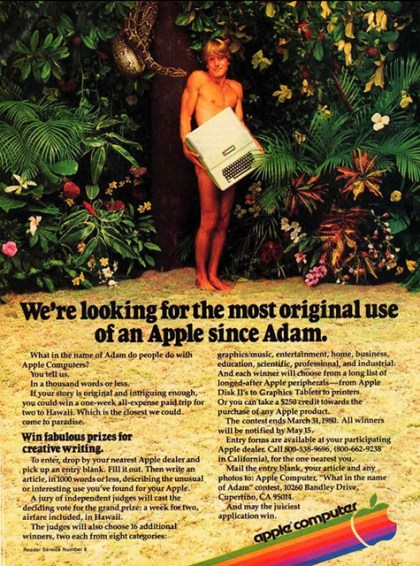
I know they’re from a time where long copy wasn’t viewed with the same distain as a global pandemic but look at them?
And what’s with their obsession with mythical figures?
It’s ugly, it’s cluttered, it’s got no clear point of view and it’s talking around the product not at it.
And then, there’s a point in their advertising evolution that you feel they took a clear step towards where they are today with work like this …

And this …

Still a lot of copy. Arguably more.
But it just feels more contemporary …
From being product benefit focused to the choice of font to the voice … which talks to adults like an adult rather than the disinterested, casual, general audience tone they had used before.
It’s so strikingly different that you feel this was the moment Apple understood who they were and who they were for.
It’s also an obviously deliberate act … because there’s no way you would get here from the – let’s be honest – horrible historical figure focused campaigns they’d run before.
Which leads to the point of this post.
A while back I got to hear the wonderful Nils of Uncommon talk.
One of the things he said that particularly resonated with me was brands who say they need to ‘work up’ to the creativity you think they need.
In essence, it’s just their polite way of saying ‘no’ to the work you want them to do.
But the funny thing is that in the main, there’s no valid reason for them to say that, other than them being fearful of change or commitment.
There’s a lot of that at the moment.
Work in an endless loop … seemingly because the people who have the right to sign off on something are scared that the moment they do, they will be judged.
So what happens is the entire industry are caught in arrested development.
And what do agencies do?
Well, in a bid to get anything made, they agree to anything – justifying it as “being a bit better than what they did before” – so we end up with bland and boring campaigns that, bizarrely, keep everyone happy as the agency got to make something and the client doesn’t have to worry of offending anybody.
Said another way, everybody loses with this strategy.
Brand.
Advertising.
Customers.
Industry.
Which is why Nils challenges brands on what they need to do the work they could do.
It’s a test of their truth and ambition.
And he’s right to do that …
Because brands don’t get to where they want through time, but deliberate acts and choices.
Even then it won’t happen overnight … but continually and consistently playing to where you want to be is far smarter than playing to where you hope to be taken.
Because to paraphrase Dan Wieden said … you don’t become the brand you can be by discovering the power of advertising … you do it when you discover the power of your own voice.