
Filed under: Advertising, Agency Culture, Attitude & Aptitude, Brand, Business, Communication Strategy, Confidence, Craft, Creative Development, Creativity, Culture, Effectiveness, Egovertising, Marketing, Marketing Fail, Perspective, Planners, Planning, Strategy

Not too long ago, Campaign – in the UK – asked me for my point of view on Byron Sharp and the obsession with brand assets etc.
Specifically, they wanted to know if I felt he was hindering creativity as well as making it harder for small business to ever stand a chance of breaking through.
Now I have some issues with Mr Sharp’s character, but if I put that aside to answer the question, I said this:
First of all, I don’t think Mr Sharp wants to kill creativity.
From my perspective, he recognises its value far more than others in his position. If I’m going to talk about who is undermining the power of creativity, I’d say it can be aimed far more at the companies who outsource all their training needs to the same few individuals because it’s easier and cheaper for them to do.
God, that’s started off controversially hasn’t it?
The reality is what Mr Sharp says isn’t wrong, it’s just not the one-size-fits-all approach that so many seem to have interpreted it as.
And that highlights what the real problem is for me: conformity over possibility.
Or said another way, the modern equivalent of ‘no one got fired buying IBM’.
Look, I get it … marketing is expensive, complicated and influenced by a whole host of factors that you can’t control, so if someone say’s “this will stop you making stupid mistakes”, it’s pretty compelling.
But the reality is not making stupid mistakes doesn’t mean you are ensuring success. Worse, blindly following these rules creates a real risk you will commodify yourself … looking, talking and behaving just like everyone else. Let’s be honest, you don’t have to look too hard to see that already happening …
And that’s my problem with terms like ‘brand assets’ … they’re talked about as if you can buy them off the shelf.
Simply choose a single colour, add a logo and some category cues … then sit back and count your billions.
But people are confusing visual distinction with brand value.
Sure, being recognised in some way helps … but it only becomes an ‘asset’ if it has meaning built into it and to do that requires distinctive and deliberate acts, actions and behaviour over time.
Or said another way, you don’t ‘create’ a brand asset, things become a brand asset.
The industry is continually looking for shortcuts.
I get it … I really do … but the irony is the thing that can deliver so much of this, is the thing the industry continually tries to diminish or control.
Creativity.
At its best, creativity rewrites rules and changes the odds in your favour.
Creativity helped Liquid Death get men to want to drink water.
Creativity helped Gentle Monster become the fastest selling and growing eyewear brand across Asia.
Creativity helped Roblox go from niche player to the single most played game by kids and teens across America.
Creativity even helped Metallica use a 30 year old album to attract more fans resulting in them becoming the second most successful American band of all time.
They didn’t achieve this simply because of smart distribution of their brand assets. Nor did they achieve it by placing their logo as a watermark throughout their TV commercial [which has to be the laziest and most misguided attempt to achieve ‘attribution’]. They achieved it by allowing creativity the freedom to push forward in ways that – as a by-product – meant their voice created value in their numerous assets.
I get it’s not easy.
I get it requires real energy and openness.
But little can achieve what creativity can do when you commit to letting it loose.

My problem [and I appreciate this may just be me] is that many seem to have interpreted the words of Sharp [and others] in a way where they see creativity as simply the ‘wrapping paper’ to execute their rules and processes.
But creativity isn’t the wrapping, it’s the fucking present.
A gift that offers value to brands that goes far beyond the fulfilment of singular commercial objectives and goals.
There are countless examples of brands achieving incredible success and growth following different rules so much of the industry feel is the only way to progress.
That’s not meant as a diss to Mr Sharp, he is obviously very good – though I note he and his peers choose to not highlight that many misinterpret and misuse their guidance, which suggests there is an element of complicity and profiteering from the one-size-fits-all blandification that is happening all around us.
But even then, the real blame should be aimed at the industry for fetishising the learnings and viewpoints of the same few people, because however good they may be – and they are good – it means we’re literally choosing to narrow our own potential and future.
Don’t get me wrong, brand assets are definitely a thing. But they don’t make creativity valuable … creativity makes them an asset.
Filed under: Advertising, Agency Culture, Attitude & Aptitude, Colleagues, Context, Craft, Creative Development, Creativity, Culture, Cynic, Friendship, Music

I recently read an interview with the members of 80’s art-pop band, Soft Cell.
Sure, I liked their song ‘Tainted Love’ but that was about it.
I thought they were try-hard and much preferred my heavy metal bands.
But as I’ve got older, I’ve realized how blinkered I was … how judgmental … and this interview rammed it home.
I love so much about it.
Their attitude to music.

Marc’s phenomenal and ferocious attitude to the frankly, horrific homophobic rumours that I remember hearing way back in my college days.

And their approach to their working relationship.
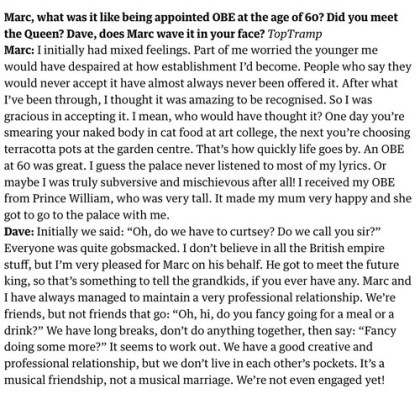
It’s funny with bands … you expect all the members to love each other. Have deep bonds that last a lifetime.
Of course part of that is cultivated by the record companies, but you still want them to be mates who hang out together … but often, they’re not.
It’s not that they don’t like each other – though that can happen too – it’s more their chemistry works in one environment and they’re good with that.
It was funny seeing it in print because it kind-of captured how I felt with Cynic.
While Andy, George and I talked every day … we weren’t close friends.
We didn’t socialize much together. In fact, we probably do it more now we’re not in a business together than we ever did then.
But it worked.
We liked each other.
We trusted each other.
We valued each other.
But it never really extended beyond the work environment.
And this probably helped us because unlike family – where the focus is not to cause upset – this situation allowed us to always tell each other the truth.
We would be considerate. We cared about each other. But we would never hold back.
And when I think of the best work experiences I’ve ever had, this has been the constant dynamic.
Blunt truth wrapped in visceral respect.
Where you felt you were better at your job when you were together, but had other enjoyable lives when you were apart.
And the joy of the working experience meant you kept coming back.
Not because you had to, but because you wanted to.
Or to paraphrase David from Soft Cell, a creative relationship rather than a creative marriage.
I didn’t realise how special that was.
It certainly doesn’t happen often.
And while you may ask why some of those relationships still end, the bigger question is why do so few ever begin?
For me, it’s all about trust and belief.
That you got together because of how you all see the world, not because you found yourselves in the same room or office.
And while you may share the same philosophy, you have different ways of embracing and executing it.
And that’s thrilling.
That’s the tension that drives both of you to be better.
That lets you say stupid stuff because it’s part of the trust you have of each other.
Part of the standards you hold each other to.
While I have some of that still, I miss some of the stuff I had.
And why I still feel a great privilege for having lived it .
But here’s the good news … because while many of those relationships are no more, the experiences, lessons and ambitions that were born from them remain and blossom.
So thank you to all of you who had – and have – that impact on me.
You know who you are.
And thanks to Marc and David for waking me up to it. Again.
Filed under: A Bit Of Inspiration, Attitude & Aptitude, Culture, Finance, Michael Jordan, Nike, Sport

A few weeks ago, I saw this on Linkedin.
Given NIKE paid MJ US$250+ million last year for the sale of his shoes – despite [properly] retiring in 2003 – it’s fair to say:
1. He got NIKE to pay.
2. Nike know how to monetise athletes.
3. Jordan is a true cultural icon of sport.
What do I mean by cultural icon?
To be honest, I’m not sure.
It’s more than just about success … because there’s plenty of athletes who have achieved that. It’s more than their continued standing … because there’s athletes who have achieved that as well. And it’s more than simply being popular with people who are not interested in their particular sport … because there’s examples of that too.
OK, so it could be those rare athletes who could feature in all 3 of those filters … but even then I don’t know if it’s that.
If I really think about it, it’s probably about how they changed the game.
Not just in terms of what they won, but how they won.
Where their style of play becomes the benchmark all others are judged by.
Their ruthless competitiveness.
Their commitment and drive.
The level of attention opposing teams give them.
The excitement they ignite when they are in the game.
The athletes and/or teams who you never write off … the ones who can change outcomes, defy records and evolve the game.
There’s not many of those.
At least not in terms of being able to do it over a long period of time.
But MJ is one.
And he’s still doing it even when he’s stopped playing competitive sport.
Which is why MJ’s greatest talent may not be playing basketball, but knowing his worth.
Filed under: A Bit Of Inspiration, Attitude & Aptitude, China, Colenso, Culture, Dad, Daddyhood, Emotion, Empathy, England, Family, Friendship, Happiness, Home, Jill, London, Loyalty, Mum, Mum & Dad, New Zealand, Nottingham, Nottingham Forest, Otis, Parents

I was born in 1970 in Nottingham.
For 25 years, I lived there, worked there, socialised there.
Sure, I also worked in London … but I always came home to NG2.
Every. Bloody. Night.
But in 1995, I left.
I went to Australia and started an adventure all over the place. And while I back to the UK after 24 years – I never went back to living in Nottingham.
And yet, despite having now spent more time away from Nottingham than living in it, it’s still what I regard as ‘home’.
Sure it’s where my formative years were spent.
Sure it’s where my parents ashes have been spread.
Sure it’s where my beloved Paul still lives.
Sure it’s where my football team resides.
Sure it’s where I spent the longest period of my life in.
But still …
What is also interesting is that when I go back, while I feel a sense of familiarity, I also feel disconnected. Of course, that’s to be expected when you’ve been away for so long … but it means when I think – or am in – Nottingham, I feel displaced and comforted at the same time.
It’s a weird feeling, caught between 2 emotional poles …
A stranger in where you believe you come from.
Of course, I go through similar feelings when I visit previous places I once lived – especially Shanghai, which is the place I probably felt the most connected to – but Nottingham is where I have roots [or where I used to have them] and so while I am far away, I am increasingly surrounding myself with stuff that reminds me of the place.
But I don’t want to go back.
It is my past rather than my future.
And that’s where it all gets complicated because I want Otis to have a place where he can build roots like I did with Nottingham, but I don’t know if that’s possible or where that is.
He’s 8 and lived in 4 countries already.
More than that, at some point we’ll be leaving here.
Don’t get me wrong, we love NZ.
We adore our home.
But we feel our life still has other places to go.
It won’t happen in the short term …
We are happy here, Otis absolutely adores it, we want him to be in a place longer than the 2 year periods he’s experienced so far in his life and I haven’t yet repaid the generosity the country has shown us … but it will eventually happen and so I wonder what Otis will regard as his ‘identity’.
If you ask him now, he’ll say, “China”.
I love that, but it’s also more because of where he was born rather than where he was raised.
So we shall see.
Of course we could just stay here and remove the issue … and while there’s a big part of us that would like to do that, we also would like to be closer to the people who matter most to us.
At some point.
This may all sound like a reason to never move country and if that’s how it comes across then that would be wrong.
It’s dead easy to think about what you will miss by moving away but you need to think about what you will gain. And in my case, apart from Paul and Shelly in Nottingham … every single thing in my life is because I took that leap.
Everything.
My wife.
My son.
My cat.
My home.
My career.
My life.
So while identity is increasingly important to me, I’m not going to devalue the utter privilege of the adventure we’ve had – and will hopefully keep having. Especially given nationalism is increasingly acting as a barrier towards the understanding and acceptance of others… rather than a way for people to identify, share and grow.

Occasionally you read a story that just blows you away.
It may be about human endeavor … or suffering … or achievement … but you’re deeply affected by it.
Maybe it’s because you can’t imagine how you would cope in the same situation or that you can never even imagine the situation … but it changes something in you.
I’ve recently read 2 stories that have had this affect on me.
They’re both very different … one is about finding themselves, the other survival … and yet there are commonalities as well.
Blind belief.
Dumb luck.
A desire to see things through.
Acceptance of who they are or the situation they’re in.
An ability to only deal with issues when they become issues.
One is the story of Tom Turcich, who at age 17, spent the next 7 years of his life walking around the World.
The reasons behind it are both deeply personal and emotional … but the story he then takes us on is truly inspirational.
I don’t mean that in a ‘Hollywood’ type of way, but in its everyday humbleness and normality.
And it’s exactly because of that, that he explains things that have a lot of insight and learning.
One thing that really struck me was at the end, when he was asked if his journey had made him more confident in himself.
“That’s a difficult question to answer” … he says.
“It’s a kind of Dunning-Kruger. You know, the psychological study where the dumbest person in the room is the most confident? The more you know, the less confident you are. I think I was pretty confident at the beginning, but I was an idiot. Once you know you don’t know everything, you lose some of the confidence and become less sure about things.”
I love this. Love it.
It’s so true … though, judging by the bravado of so many of our political leaders – not to mention people like Andrew Tate and his blinkered followers – it seems not everyone understands that.
Well, I say that, but I feel they make it a deliberate choice.
It’s as if they realise being open to information and experiences would undermine their whole viewpoint on life … and as their entire value is based on their own delusional confidence, they’d rather choose to remain blinkered than to evolve.

The other story is about Annette Herfkens – the only survivor in a plane crash.
Her story, like Tom, is incredible and yet she also expresses it without drama or superlatives.
Again, it’s not a conscious attempt to play down her story to appear more enlightened to those who follow her … it’s a reflection of who she is and how she overcame the most tragic and challenging of circumstances.
And like Tom, what she learned from her experience has many implications on how we could all benefit in how to live our lives.
I don’t mean that in terms of ‘valuing what you have’ [though that wouldn’t be bad] … but more in terms of being quick to accept situations, however bad.
That may sound counter-intuitive – and it certainly is different to many of the ‘projection’ ideals spouted in countless self-help books – but based on how it liberated Tom and Annette from the harshest of situations, it certainly has merit.
They’re relatively long … but they’re worth it.
From a personal point of view, they’re two of the most powerful things I’ve read.
Have a good weekend.