
Filed under: A Bit Of Inspiration, Advertising, Attitude & Aptitude, Audi, Authenticity, Brand, Communication Strategy, Corporate Evil, Culture, Honesty, Luxury, Management, Mediocrity, Metallica, Packaging, Premium, Resonance, Respect, Standards, Status, Strategy

A lot of luxury brands, invite a lot of mocking.
It might be what they make.
It might be the prices they charge.
It might be the way they look at the world.
But whatever your opinion, at least they commit.
Walk into a proper high-end luxury brand and you see high-end standards and experience.
Everywhere.
[The Netflix series ‘7 Day’s’ perfectly demonstrates this, as I wrote about here]
Innovation. Craft. Details. Service. Packaging. Training.
You might not like it.
You might not value it.
But you can’t say they’re not committed to it.
Now compare that to companies that like to position themselves as ‘premium’.
Sure, some live up to it … but my god, most don’t.
The only premium-ness is often only in their pricing and ego.
Big talking to the public, short-changing everywhere else around them.
Now I get you have to look after the pennies in business, but when you claim to be premium – it should mean you recognize the value of premium standards and service in those around you and with you. And if you don’t – or you don’t think the people you are dealing with offer that – then why the fuck are you dealing with them?

I’ve written about this before, but once-upon-a-time I was asked to work on a freelance project for a high-end German brand.
I submitted my estimate to which I was met with the following reply:
“Your fee is higher than other partners we use, please lower it”.
That was it. Not even an indication of the costs they were comparing me too.
Now while I value what I do, the costs weren’t excessive.
Infact they were a fraction of the cost of one of their lowest priced products.
But more than that, I’d agreed my fees with the CMO before I submitted them to procurement, so I thought., ‘fuck this’ and wrote the following response.
“Your products are higher priced than other brands I could choose, please lower it”.
I know … it was cheeky, but I just thought they were incredibly arrogant in their attitude, especially in the way they wanted to undermine my experience.
And guess what, almost immediately they replied with,
“We accept your rate and look forward to working with you” … which is the exact moment I saw through the hype.
Brands who value quality don’t benchmark costs against the lowest market rates.
I get it’s a negotiation tactic, but it also reveals their hypocrisy and insecurity.

It’s why my experience with Metallica was so shocking … despite the fact what they do and value all makes total sense but the way most business operates means it felt so bizarre.
Actually, Metallica are a great example of a brand that values who they are.
Everything they do is focused on respecting the quality of what they do.
For example, to make sure their vinyl is always of the highest quality – they bought the best vinyl printing press company in the world.
Same with their live shows …
To ensure their sound is of the highest quality, they had the highest-quality live speaker system in the world built.
Rather than approach investments in terms of ‘what can we get away with’, their attitude is to put highest quality first … which is why they buy stuff rather than lease it because not only does it ensure their creativity is given the highest possible quality [rather than the best they can get away with] it ensures they always have priority access to it. And when they don’t need to use it, they get people like me to work out how to make it pay for itself, which often ends up leasing it to other bands who don’t have the same needs/standards or values as them.
Metallica understand standards better than most brands.
But then they understand who they are better than most brands.
Which is why everything they do is focus up to the quality not down to the price.
That’s a proper premium brand … one who makes decisions that reflects who they are not who they are pretending to be.

Christ, I recently saw a rep from a coffee brand get into their gold Audi.
It stood out to me because it was a errrrrm, gold Audi.
And while some may look at it and say,
“If they drove a Prius, maybe their coffee prices were lower”
… not only are they unlikely to be people who buy their coffee, they are also unlikely to care about the difference of coffee.
That’s not a diss … I like Nescafe with Coffee Mate … but it also doesn’t mean that my taste is reflective of everyone else’s either.
Whether true or not, my impression of a brand giving their rep this choice of car was they had a different perspective on standards. Rather than give their reps the lowest priced car they could get away with, they found the most efficient car of the standards they live and operate in.
Of course many may slate or disagree with me for this view …
I also appreciate some may find their choice a reflection of their pretentiousness, which they find fucking annoying.
And in some way I agree with them.
However I feel a lot better about pretentious assholes when that’s who they actually are rather than those who do it to look like they’re premium when everything else highlights they’re anything but.
Commitment costs.
You might not want to pay it … you might not understand the reasoning for it … but at least you’re dealing with people who believe it rather than those who are exploiting you for it.
Filed under: A Bit Of Inspiration, Advertising, Agency Culture, Attitude & Aptitude, Confidence, Content, Context, Creative Brief, Creative Development, Creativity, Culture, Management, Marketing

A while back I was in conversation with a very successful football team manager.
In many ways, they’re the managers, manager.
When I asked how – or who – they used to look to for guidance, inspiration or technical advice, they immediately responded with:
“Learn from winners, not players”.
And when I asked why only winners … they replied:
“Because winners face greater challenges than players and still come out on top”.
Interestingly, later in the conversation, they indicated their definition of ‘winner’ was more than simply someone who has achieved success in a league or a tournament … but someone who has achieved success in multiple league or tournaments, because – to paraphrase an old Nike campaign I did – it’s easier to get to the top than to stay there.
Which made me think about my industry …
Because when I look at who we can turn to, to evolve the standards, abilities and skills of our people, I feels there’s more players than winners.
Of course, being ‘a winner’ is much harder to define in our industry …
+ Creativity is as subjective as fuck.
+ Awards have become as much about how you enter as what you enter.
+ Success is defined by more factors than simply scoring more goals than the opposition.
+ The environment we operate in – and who against – is always changing at rapid rates.
+ You can be respected for your opinion without ever having made work that is respected.
+ Blah blah blah blah.
What bothers me most is how much of the industry outsources its training to people who are good players, but often not great players. And by that, I mean people who never made great things, even if they have great opinions on things.
Some may question why it’s important to have actually made things …
Well it’s simple. Anything is easy when you don’t have to do it, so those who have, have better advice than those who don’t.
That doesn’t mean they don’t have things of value to teach, but to paraphrase the manager I interviewed – those who have made work of note, have better lessons to give than those who have simply an opinion on making good work.
That said, it’s not players fault they’re being paid by companies to train their staff. What is far scarier are the reasons why they’re being asked:
One. It’s cheaper for companies than investing in on-going, personalised training for staff.
Two. Few companies have their own philosophy towards work, so having broad training schemes work for their needs.
Three. You are only as good as the people you are exposed to, and many companies confuse billings or popularity with craft and quality.
I know our industry faces many challenges from clients who value different things. But fundamentally, this issue was caused by our industry selling the value of creativity and understanding society down the river. By focusing on ‘players rather than winners’ to drive our standards and knowledge … we’re not moving putting ourselves back in contention, we’re just delaying our downfall.
To leave this post with a final football punditry reference.
We need to get back to playing to win, not playing not to lose.
Filed under: A Bit Of Inspiration, Advertising, Attitude & Aptitude, Authenticity, Confidence, Creative Development, Creativity, Culture, Differentiation, Management, Marketing, Marketing Fail, Trust, Truth
I was going through some old folders when I found this lovely campaign for Staedtler Highlighters.

To give a highlighter a desirable role in society is a pretty big achievement.
OK, so it’s not as thought-provoking as that door handles ad I wrote about, but it’s pretty close.
But this post isn’t about celebrating luminous green … it’s about what it is promoting: Getting to the point.
Or as this post is titled, cutting the crap.
And my god is there a lot of crap to cut.
The great irony of the above ad is that what it uses to demonstrate its ability to get to the point is something you would see in many companies self-descriptions.
Over-inflated, self-important expressions of what they do and how they do it.
It’s everywhere.
From the umbrella stand that claims to be a protection and lifestyle solutions company to We Work who decided they were a tech company simply because they had an app that people used to book a fucking room.
Look I get we all want to feel validated in what we do.
I get it provides an ability to charge a premium.
But just because you say it doesn’t mean others will think it’s true.
In fact, it can have the total opposite effect … where the good things you do are clouded by the fairy dust being constantly released.
With tech enabling people to check claims like never before, it blows my mind how much delusional ego inflation continues to rise.
Of course, part of it is because companies feel they can continue to get away with it … and there’s an element of truth in that, except in many cases, it’s because no one gives a shit about who they are or what they say and so the relationship is shallower than a Hollywood romance.
10,000 years ago I wrote about something I called unplanning … and in many ways, it’s more relevant now than it’s ever been.
That doesn’t mean being brutally honest downplays your role or value, if anything it can elevate it … especially when surrounded by big talking idiocy. But it’s more than simply differentiating from a crowded competitive space, because as someone wise once said to me, “nothing makes mistakes like someone who can’t be honest with themselves”.
Filed under: A Bit Of Inspiration, Advertising, Agency Culture, Apple, Attitude & Aptitude, Brand, Brand Suicide, Communication Strategy, Creative Development, Creativity, Culture, Differentiation, Distinction, Technology, Wieden+Kennedy
Apple.
One of the best brands in the world.
From product to marketing … everything they do is considered, consistent and distinctive.
A brand voice forged over years, with a clear understanding of who they are.
But what’s interesting is what they used to be …

Or this …

Or worse of all, this …
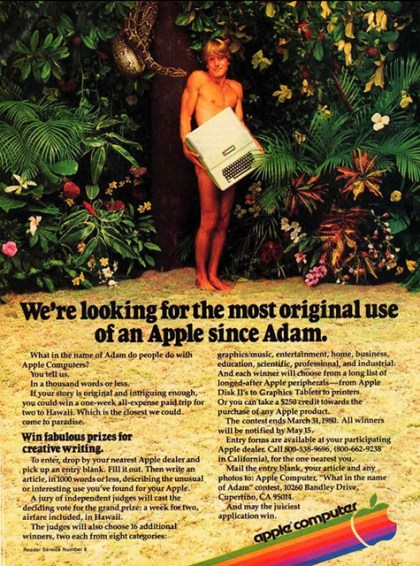
I know they’re from a time where long copy wasn’t viewed with the same distain as a global pandemic but look at them?
And what’s with their obsession with mythical figures?
It’s ugly, it’s cluttered, it’s got no clear point of view and it’s talking around the product not at it.
And then, there’s a point in their advertising evolution that you feel they took a clear step towards where they are today with work like this …

And this …

Still a lot of copy. Arguably more.
But it just feels more contemporary …
From being product benefit focused to the choice of font to the voice … which talks to adults like an adult rather than the disinterested, casual, general audience tone they had used before.
It’s so strikingly different that you feel this was the moment Apple understood who they were and who they were for.
It’s also an obviously deliberate act … because there’s no way you would get here from the – let’s be honest – horrible historical figure focused campaigns they’d run before.
Which leads to the point of this post.
A while back I got to hear the wonderful Nils of Uncommon talk.
One of the things he said that particularly resonated with me was brands who say they need to ‘work up’ to the creativity you think they need.
In essence, it’s just their polite way of saying ‘no’ to the work you want them to do.
But the funny thing is that in the main, there’s no valid reason for them to say that, other than them being fearful of change or commitment.
There’s a lot of that at the moment.
Work in an endless loop … seemingly because the people who have the right to sign off on something are scared that the moment they do, they will be judged.
So what happens is the entire industry are caught in arrested development.
And what do agencies do?
Well, in a bid to get anything made, they agree to anything – justifying it as “being a bit better than what they did before” – so we end up with bland and boring campaigns that, bizarrely, keep everyone happy as the agency got to make something and the client doesn’t have to worry of offending anybody.
Said another way, everybody loses with this strategy.
Brand.
Advertising.
Customers.
Industry.
Which is why Nils challenges brands on what they need to do the work they could do.
It’s a test of their truth and ambition.
And he’s right to do that …
Because brands don’t get to where they want through time, but deliberate acts and choices.
Even then it won’t happen overnight … but continually and consistently playing to where you want to be is far smarter than playing to where you hope to be taken.
Because to paraphrase Dan Wieden said … you don’t become the brand you can be by discovering the power of advertising … you do it when you discover the power of your own voice.
Filed under: A Bit Of Inspiration, Advertising, Agency Culture, Attitude & Aptitude, Brand, Brand Suicide, Business, Comment, Communication Strategy, Creative Development, Creativity, Culture, Effectiveness, Management, Marketing, Marketing Fail
A few weeks ago, I saw this …

… and I have to be honest, it’s had me thinking a lot.
Because while I acknowledge you can’t take things for granted, when you get lost in the weeds, you lose sight of what you’re working towards and how you do it.
And a lot of people are doing both of those things.
Nothing sums this up more to me than the issue of attribution.
The quest to minimise risk – or ‘optimise value’ – has resulted in brands forgetting that the easiest way to get attribution is to do something interesting.
But instead – reinforced by industry ‘guru’s – we have ended up with a continual production line of commercially responsible alternatives.
Be a one colour brand.
Place brand assets higher than a brand idea.
And – worse of all – have watermarks in your ads.

While colour and brand assets have a role – albeit not a primary role as so many people seem to suggest – if you feel the only way your brand will be remembered in your commercial is to place your logo all the way through it, then you either don’t know how people work or how advertising does.
Or said another way, you’re admitting your brand and your product are forgettable.
Seriously … why would you do that?
Why would you spend millions on something that positions you as uninteresting.
Worse, why would you spend millions on something that positions you as uninteresting and make sure people know it’s you by ramming your logo down their throat?
But somewhere, someone is measuring the ‘impact’ of this approach and finding a way to demonstrate its effectiveness to clients. Letting everyone feel pleased with themselves. Their choices. Their actions. Creating a precedent others will follow in the blind belief they’re being smarter … more optimised … more effective than all their competitors. All the time consciously and deliberately ignoring the critical fact that it’s undermining them rather than liberating them.
Which leads back to that tweet at the top of the page.
Because while knowing how things are going is important, nothing reveals how lost you are than measuring everything but valuing nothing.