
Filed under: Advertising, Apathy, Attitude & Aptitude, Authenticity, Brand, Crap Products In History, Creativity, Culture, Marketing, Marketing Fail, Tiffany
So recently I saw this from Tiffany …

It costs US$3500.
Now don’t get me wrong, I appreciate Tiffany are trying to shed the ‘Breakfast At Tiffany’s’ stereotype … and I’m all for brands exploring and experimenting … but this feels so wrong.
An attempt to be cool without understanding what is cool.
The equivalent of a Goldman Sachs CEO thinking they’re a DJ and because they’re rich, people just nod at them. Oh yes, we have that too don’t we. Ha.
The problem classic luxury brands have is its street culture driving the luxury category – especially in fashion – not the other way around and most definitely not in this sort of overt and contrived way.
Sure some classic luxury brands have managed to do this, but they’ve done it with more deliberate, committed and authentic acts and associations, not just some random drops in scale categories.

Will the Tiffany ball sell?
Of course and some will say that’s all that matters … but the real question is at what cost?
It all feels like Ducati a few years ago when they sold their name to everything. Including a USB drive.
Don’t get me wrong, I appreciate a fast USB transfer rate as much as the next sad bastard, but the only thing a Ducati USB said about you was you were a next level twat.
I remember interviewing Ducati owners to ask them their opinion and the people I talked to, hated it. As one rider said to me [and I’m paraphrasing as it was a long time ago] … while the brand marketing people probably thought this was a way for fans to express their loyalty, Ducati owners thought it was a way to cheapen the value of their investment.
Or said another way, winning over a new generation who only associate with the superficial while alienating those who appreciate the craft.
Now I get the Tiffany situation is slightly different – because they were getting seriously weighed down with their age – but we’re seeing this sort of thing everywhere at the moment.
Attempts at quick wins.
Superficial not substance.
Misunderstanding the difference between being needed and looking like the one in need.
Where brands – and based on something that happened this week, also people – think having what they call ‘an asset’ means they can do whatever they want with whoever they want.
It’s a new level of brand arrogance.
The era of Trump brand [mis]management.
Which means if can only be a matter of time before we see the Tiffany x Wish collab.
Oh … and before I forget, today is Sir Dr Brian May [CBE] birthday.
For a guitarist in one of the biggest selling rock bands of all time, he’s done alright hasn’t he.
Happy birthday Mr May, you’re a legend to me and countless others.

Filed under: Advertising, Attitude & Aptitude, Colenso, Comment, Communication Strategy, Creative Development, Creativity, Culture

So our office is being renovated which means for the last few months, we’ve been crammed into a couple of rooms while a building site envelops us.
It also means we’ve been severely impacted by space for meeting rooms which is why recently, when we had a pitch, we felt it was only appropriate to let the prospective client know that we knew that we’re in the most uncreative space on the planet.
Hence the sign above.
And you know what, we won.
OK, the work was bloody awesome … but at a time where so many clients seems to choose agencies for reasons beyond the actual work, it’s nice to know this client not only recognised the quality of the ideas put in front of them, but actually rewarded it, because there was no other bloody reason to choose us. Unless they were a building company.
Filed under: A Bit Of Inspiration, Advertising, Attitude & Aptitude, Audi, Authenticity, Brand, Communication Strategy, Corporate Evil, Culture, Honesty, Luxury, Management, Mediocrity, Metallica, Packaging, Premium, Resonance, Respect, Standards, Status, Strategy

A lot of luxury brands, invite a lot of mocking.
It might be what they make.
It might be the prices they charge.
It might be the way they look at the world.
But whatever your opinion, at least they commit.
Walk into a proper high-end luxury brand and you see high-end standards and experience.
Everywhere.
[The Netflix series ‘7 Day’s’ perfectly demonstrates this, as I wrote about here]
Innovation. Craft. Details. Service. Packaging. Training.
You might not like it.
You might not value it.
But you can’t say they’re not committed to it.
Now compare that to companies that like to position themselves as ‘premium’.
Sure, some live up to it … but my god, most don’t.
The only premium-ness is often only in their pricing and ego.
Big talking to the public, short-changing everywhere else around them.
Now I get you have to look after the pennies in business, but when you claim to be premium – it should mean you recognize the value of premium standards and service in those around you and with you. And if you don’t – or you don’t think the people you are dealing with offer that – then why the fuck are you dealing with them?

I’ve written about this before, but once-upon-a-time I was asked to work on a freelance project for a high-end German brand.
I submitted my estimate to which I was met with the following reply:
“Your fee is higher than other partners we use, please lower it”.
That was it. Not even an indication of the costs they were comparing me too.
Now while I value what I do, the costs weren’t excessive.
Infact they were a fraction of the cost of one of their lowest priced products.
But more than that, I’d agreed my fees with the CMO before I submitted them to procurement, so I thought., ‘fuck this’ and wrote the following response.
“Your products are higher priced than other brands I could choose, please lower it”.
I know … it was cheeky, but I just thought they were incredibly arrogant in their attitude, especially in the way they wanted to undermine my experience.
And guess what, almost immediately they replied with,
“We accept your rate and look forward to working with you” … which is the exact moment I saw through the hype.
Brands who value quality don’t benchmark costs against the lowest market rates.
I get it’s a negotiation tactic, but it also reveals their hypocrisy and insecurity.

It’s why my experience with Metallica was so shocking … despite the fact what they do and value all makes total sense but the way most business operates means it felt so bizarre.
Actually, Metallica are a great example of a brand that values who they are.
Everything they do is focused on respecting the quality of what they do.
For example, to make sure their vinyl is always of the highest quality – they bought the best vinyl printing press company in the world.
Same with their live shows …
To ensure their sound is of the highest quality, they had the highest-quality live speaker system in the world built.
Rather than approach investments in terms of ‘what can we get away with’, their attitude is to put highest quality first … which is why they buy stuff rather than lease it because not only does it ensure their creativity is given the highest possible quality [rather than the best they can get away with] it ensures they always have priority access to it. And when they don’t need to use it, they get people like me to work out how to make it pay for itself, which often ends up leasing it to other bands who don’t have the same needs/standards or values as them.
Metallica understand standards better than most brands.
But then they understand who they are better than most brands.
Which is why everything they do is focus up to the quality not down to the price.
That’s a proper premium brand … one who makes decisions that reflects who they are not who they are pretending to be.

Christ, I recently saw a rep from a coffee brand get into their gold Audi.
It stood out to me because it was a errrrrm, gold Audi.
And while some may look at it and say,
“If they drove a Prius, maybe their coffee prices were lower”
… not only are they unlikely to be people who buy their coffee, they are also unlikely to care about the difference of coffee.
That’s not a diss … I like Nescafe with Coffee Mate … but it also doesn’t mean that my taste is reflective of everyone else’s either.
Whether true or not, my impression of a brand giving their rep this choice of car was they had a different perspective on standards. Rather than give their reps the lowest priced car they could get away with, they found the most efficient car of the standards they live and operate in.
Of course many may slate or disagree with me for this view …
I also appreciate some may find their choice a reflection of their pretentiousness, which they find fucking annoying.
And in some way I agree with them.
However I feel a lot better about pretentious assholes when that’s who they actually are rather than those who do it to look like they’re premium when everything else highlights they’re anything but.
Commitment costs.
You might not want to pay it … you might not understand the reasoning for it … but at least you’re dealing with people who believe it rather than those who are exploiting you for it.
Filed under: Advertising, Agency Culture, Attitude & Aptitude, Brand, Business, Communication Strategy, Confidence, Craft, Creative Development, Creativity, Culture, Effectiveness, Egovertising, Marketing, Marketing Fail, Perspective, Planners, Planning, Strategy

Not too long ago, Campaign – in the UK – asked me for my point of view on Byron Sharp and the obsession with brand assets etc.
Specifically, they wanted to know if I felt he was hindering creativity as well as making it harder for small business to ever stand a chance of breaking through.
Now I have some issues with Mr Sharp’s character, but if I put that aside to answer the question, I said this:
First of all, I don’t think Mr Sharp wants to kill creativity.
From my perspective, he recognises its value far more than others in his position. If I’m going to talk about who is undermining the power of creativity, I’d say it can be aimed far more at the companies who outsource all their training needs to the same few individuals because it’s easier and cheaper for them to do.
God, that’s started off controversially hasn’t it?
The reality is what Mr Sharp says isn’t wrong, it’s just not the one-size-fits-all approach that so many seem to have interpreted it as.
And that highlights what the real problem is for me: conformity over possibility.
Or said another way, the modern equivalent of ‘no one got fired buying IBM’.
Look, I get it … marketing is expensive, complicated and influenced by a whole host of factors that you can’t control, so if someone say’s “this will stop you making stupid mistakes”, it’s pretty compelling.
But the reality is not making stupid mistakes doesn’t mean you are ensuring success. Worse, blindly following these rules creates a real risk you will commodify yourself … looking, talking and behaving just like everyone else. Let’s be honest, you don’t have to look too hard to see that already happening …
And that’s my problem with terms like ‘brand assets’ … they’re talked about as if you can buy them off the shelf.
Simply choose a single colour, add a logo and some category cues … then sit back and count your billions.
But people are confusing visual distinction with brand value.
Sure, being recognised in some way helps … but it only becomes an ‘asset’ if it has meaning built into it and to do that requires distinctive and deliberate acts, actions and behaviour over time.
Or said another way, you don’t ‘create’ a brand asset, things become a brand asset.
The industry is continually looking for shortcuts.
I get it … I really do … but the irony is the thing that can deliver so much of this, is the thing the industry continually tries to diminish or control.
Creativity.
At its best, creativity rewrites rules and changes the odds in your favour.
Creativity helped Liquid Death get men to want to drink water.
Creativity helped Gentle Monster become the fastest selling and growing eyewear brand across Asia.
Creativity helped Roblox go from niche player to the single most played game by kids and teens across America.
Creativity even helped Metallica use a 30 year old album to attract more fans resulting in them becoming the second most successful American band of all time.
They didn’t achieve this simply because of smart distribution of their brand assets. Nor did they achieve it by placing their logo as a watermark throughout their TV commercial [which has to be the laziest and most misguided attempt to achieve ‘attribution’]. They achieved it by allowing creativity the freedom to push forward in ways that – as a by-product – meant their voice created value in their numerous assets.
I get it’s not easy.
I get it requires real energy and openness.
But little can achieve what creativity can do when you commit to letting it loose.

My problem [and I appreciate this may just be me] is that many seem to have interpreted the words of Sharp [and others] in a way where they see creativity as simply the ‘wrapping paper’ to execute their rules and processes.
But creativity isn’t the wrapping, it’s the fucking present.
A gift that offers value to brands that goes far beyond the fulfilment of singular commercial objectives and goals.
There are countless examples of brands achieving incredible success and growth following different rules so much of the industry feel is the only way to progress.
That’s not meant as a diss to Mr Sharp, he is obviously very good – though I note he and his peers choose to not highlight that many misinterpret and misuse their guidance, which suggests there is an element of complicity and profiteering from the one-size-fits-all blandification that is happening all around us.
But even then, the real blame should be aimed at the industry for fetishising the learnings and viewpoints of the same few people, because however good they may be – and they are good – it means we’re literally choosing to narrow our own potential and future.
Don’t get me wrong, brand assets are definitely a thing. But they don’t make creativity valuable … creativity makes them an asset.
Filed under: Advertising, Agency Culture, Attitude & Aptitude, Colleagues, Context, Craft, Creative Development, Creativity, Culture, Cynic, Friendship, Music

I recently read an interview with the members of 80’s art-pop band, Soft Cell.
Sure, I liked their song ‘Tainted Love’ but that was about it.
I thought they were try-hard and much preferred my heavy metal bands.
But as I’ve got older, I’ve realized how blinkered I was … how judgmental … and this interview rammed it home.
I love so much about it.
Their attitude to music.

Marc’s phenomenal and ferocious attitude to the frankly, horrific homophobic rumours that I remember hearing way back in my college days.

And their approach to their working relationship.
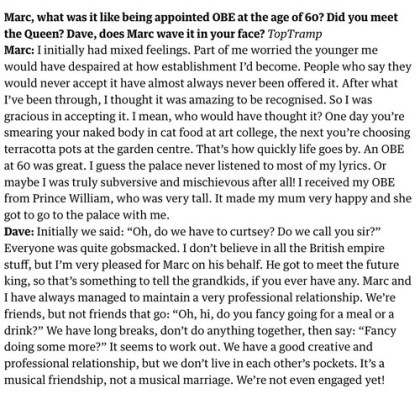
It’s funny with bands … you expect all the members to love each other. Have deep bonds that last a lifetime.
Of course part of that is cultivated by the record companies, but you still want them to be mates who hang out together … but often, they’re not.
It’s not that they don’t like each other – though that can happen too – it’s more their chemistry works in one environment and they’re good with that.
It was funny seeing it in print because it kind-of captured how I felt with Cynic.
While Andy, George and I talked every day … we weren’t close friends.
We didn’t socialize much together. In fact, we probably do it more now we’re not in a business together than we ever did then.
But it worked.
We liked each other.
We trusted each other.
We valued each other.
But it never really extended beyond the work environment.
And this probably helped us because unlike family – where the focus is not to cause upset – this situation allowed us to always tell each other the truth.
We would be considerate. We cared about each other. But we would never hold back.
And when I think of the best work experiences I’ve ever had, this has been the constant dynamic.
Blunt truth wrapped in visceral respect.
Where you felt you were better at your job when you were together, but had other enjoyable lives when you were apart.
And the joy of the working experience meant you kept coming back.
Not because you had to, but because you wanted to.
Or to paraphrase David from Soft Cell, a creative relationship rather than a creative marriage.
I didn’t realise how special that was.
It certainly doesn’t happen often.
And while you may ask why some of those relationships still end, the bigger question is why do so few ever begin?
For me, it’s all about trust and belief.
That you got together because of how you all see the world, not because you found yourselves in the same room or office.
And while you may share the same philosophy, you have different ways of embracing and executing it.
And that’s thrilling.
That’s the tension that drives both of you to be better.
That lets you say stupid stuff because it’s part of the trust you have of each other.
Part of the standards you hold each other to.
While I have some of that still, I miss some of the stuff I had.
And why I still feel a great privilege for having lived it .
But here’s the good news … because while many of those relationships are no more, the experiences, lessons and ambitions that were born from them remain and blossom.
So thank you to all of you who had – and have – that impact on me.
You know who you are.
And thanks to Marc and David for waking me up to it. Again.