
Filed under: 2026, A Bit Of Inspiration, Agency Culture, America, Brand Suicide, Comment, Communication Strategy, Complicity, Corporate Evil, Gambling, Planners, Reframing, Strategy

I’m a strategist so I can respect a good repositioning when I see one … however, the repositioning of gambling to ‘prediction markets’ is fucking evil.
Oh don’t get me wrong, I see the smartness in it …
I see how they’re attempting to both separate themselves from the negative associations of gambling while also making it easier for people to justify taking part by presenting it like its an investment scheme rather than a punt on hope.
I saw the billboard at the top of this post in NYC last week, and it doesn’t take a rocket scientist to see that the deliberate use of words like ‘trade’ are all part of their manipulation …
Attempting to look reputable and legitimate while they steal cash from right under your nose and potentially, your future.
I was going to say it blows my mind that this shit is allowed to be so blatantly misleading, but then I read Trump and his family are big investors in the major ‘prediction market’ players – which would go some way to explaining why the President is doing all he can to ensure they remain classified as ‘derivative traders’, because if they lose that right, not only would they have to adhere to rules that stops them implying they’re an investment firm, they’d have to go one step further and publicly acknowledge what they really are: financial parasites.
But whether Trump’s involvement is real or not almost doesn’t matter, because the bigger issue is not simply these companies are allowed to blatantly gaslight, exploit and rob the public … but we – as an industry and discipline – are helping them get away with it.
So to everyone involved in this evil shit, ‘fuck you’.
Maybe you should start ‘predicting’ how long you’ve got before you’re seen – and punished – for the lies and misery you’re so happy to flog for a few dollars more.
Filed under: 2026, A Bit Of Inspiration, Ambition, Apple, Aspiration, Attitude & Aptitude, Comment, Delusion, Empathy, Finance, Generosity, Money, Privilege, Reputation, Technology
On Tuesday I wrote about how we have our priorities messed up …
If you haven’t read it, you can see it here.
The underlying point being we seem to accept the shitty behaviour of the super rich, but are hyper-critical of the humble – even though we know the former are making choices to become even richer whereas the latter are simply trying to survive.
In the post, I highlighted a valuable lesson I learned when I was starting out in my career from my then client – and now mentor – the wonderful Lee Hill.
He told me:
“There’s nothing wrong making lots of money, it’s how you do it and what you do with it that counts”.
It would be easy to think that in this Trumpian, authoritarian World, the ability to be ‘decent and rich’ is a pipe dream.
But I remember many years ago, George interviewed a bunch of wealthy people for a project we were doing at Cynic and came back saying he had discovered a group he called ‘the reluctantly rich’.
Basically, these were people who had made a lot of money but never felt they deserved it.
Maybe they inherited it, maybe they were in the right place at the right time … maybe they were just lucky … but they didn’t connect to it so did all they could to be generous to others with it.
Some to that was because it helped offset their guilt a little bit.
Some was their way to let others experience what they were going through.
But most of it was simply because they wanted to help others who hadn’t been blessed with the good fortune they’d received.
Often this was done quietly and privately because the goal was never about recieving gratitude, they just wanted to do some good with it, helped by the fact they never felt connected to the cash, so giving it away was easy … even though they were perfectly aware of what it offered and could do.
Admittedly there weren’t masses of people who felt this way, but there were more than a few.
Still are.
I say this because recently I saw a video of Steve Wozniak – Woz – the co-founder of Apple.
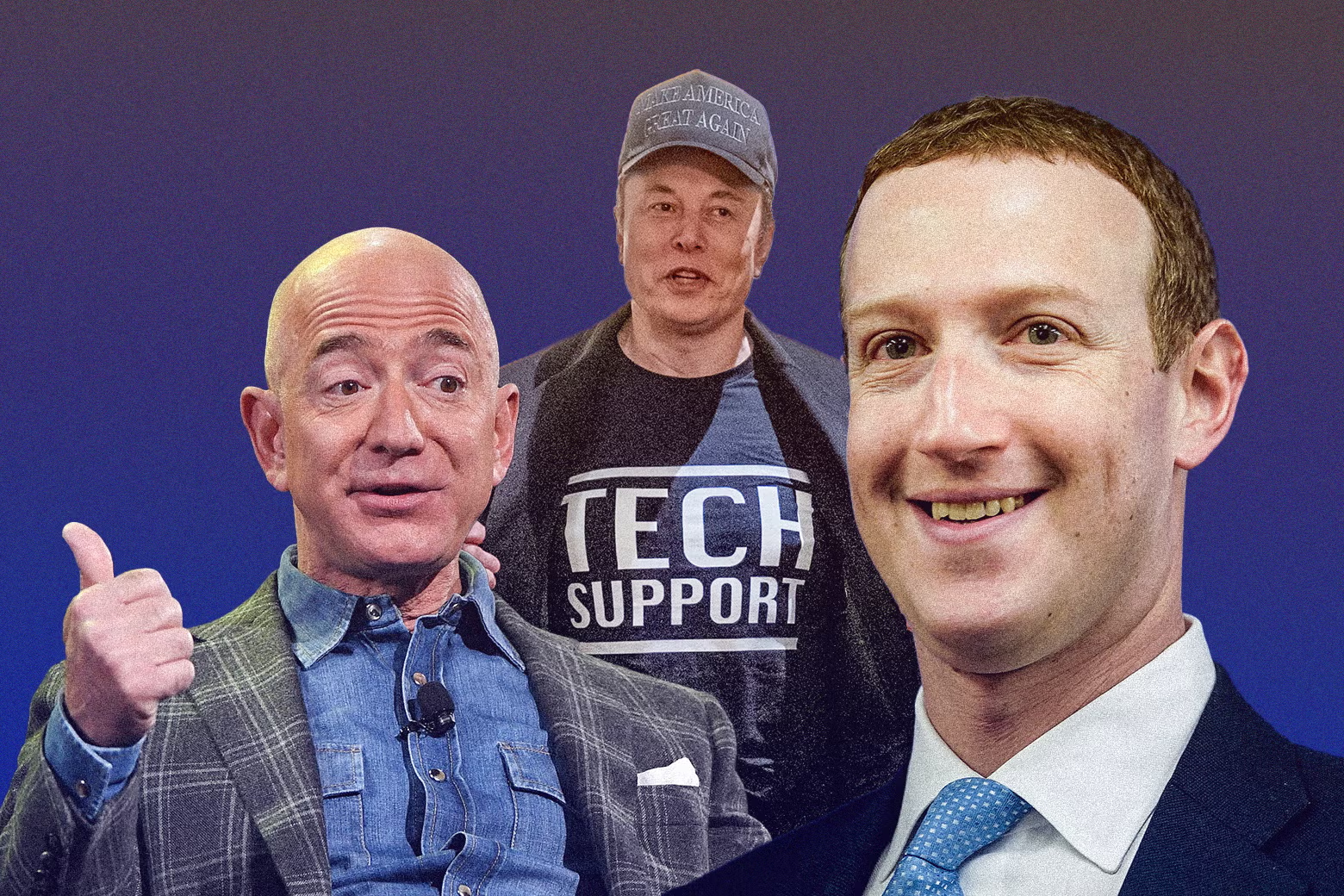
At a time where Musk, Bezos, Zuck and countless other ultra-wealthy tech and finance bros revel in their elitist, vulgar, arrogant lifestyles, he is a reminder of when the tech industry consisted of a few people trying stuff they hoped could help millions grow, express and explore their lives … which is a world away from where we are today, where the tech industry seems to be a few people designing products that enable them to control, contain and restrain millions for their own, fucked-up benefit.
So thank you Mr Woz, you’ve just proved you don’t have to be a prick to be rich.
It just feels that way.
Filed under: 2026, A Bit Of Inspiration, Attitude & Aptitude, Collaboration, Comment, Communication Strategy, Confidence, Context, Craft, Creativity, Culture, Effectiveness, Emotion, Empathy, Focus Groups, Interviews, Leadership, Planners, Planners Making A Complete Tit Of Themselves And Bless, Planning, Resonance, Respect
One of the things that has always bugged me about some strategists is their desire to be academically victorious in every conversation.
To not just be ‘right’, but to be the ‘rightest of right’.
And then expect wild applause for their proclamations and declarations of self-appointed brilliance.
Putting aside the problematic nature of this behaviour, the irony is it stands in the way of them being able to properly understand – and connect to – how others feel, think, believe or behave … because they’re too busy telling others what they ‘really mean or think’.
And here’s the kicker …
The reality is people often do know what they want, think or think … they just don’t know how to express it clearly.
Which is why the key is the ability to listen rather than to judge. Or explain.
And by listen, I mean listen ‘hard’ …
Not just what is said, but how it is expressed … verbally, visually, contextually.
And while I appreciate we’re in a time poor, distraction rich world … the benefit of doing this is that not only will you have a greater appreciation of how they see the world, they will often reveal opportunities that ‘intellectual logic’ may never see, let alone get to.

Maybe that’s why I love that Lucille Ball quote so much … because in a few words, she articulates the difference between clever and smart.
And where strategy is concerned, smart trumps clever.
That doesn’t mean you don’t care about facts, details, knowledge or academic accuracy, it just means you appreciate that being emotionally resonant with others can achieve more than being academically victorious.
Or as my Dad used to say:
“If you need to show how clever you are, you’re probably not”
I say all this because I saw a brief interview with the singer Billy Idol.
In it, he demonstrates the importance – and craft – of emotional resonance.
The act of understanding what others need to be able to give them the space and place to express.
Not manipulation.
Not exaggeration.
But emotional consideration.
Which is why if a true Rockstar – who has lived the equivalent of 100 lives – can do it, then us poxy strategists should be able to, too.
Watch it, you’ll be a better person for it.
Filed under: 2026, A Bit Of Inspiration, Attitude & Aptitude, Comment, Contribution, Craft, Creativity, Culture, Pride, Standards

Good enough.
Two words that trigger the fuck out of me.
Truly press every button I have.
Not because I’m some perfectionist who never gets things wrong.
Nor because I’m a myopic tyrant who only cares about what works for me.
But because I don’t have the time to waste on things – and people – who don’t share the same standards as me.
That sounds massively condescending, doesn’t it?
Believe it or not, I don’t mean it to be … but the fact is, time is precious to me. More precious than it has ever been. And – as I’ve written in the past – when you find yourself in this position, you realise you’re in a race.
That may sound over the top … exaggerated even … but I assure you it’s not.
For a start you know all the things you want to do won’t happen. Just won’t be possible.
Then to make matters worse … the more you do, the more you discover and that adds to the list of things you would love to explore and experiment with.
So you end up having to try and choose what matters – or intrigues or scares you – the most and when you have done that, you go into them like a freight train.
Hardcore.
Total commitment.
Focus on being as brilliant as you think it can be and you hope to be.
Or at least I do.
And that’s why when you find the people around you are in a different place in life … or have a different set of expectations or standards … that can be hard.
It’s not that they’re wrong, it’s just that they’re wrong for where you are at right now.
Because you have no time for casual.
You have no time for not being utterly focused.
And anything that shows a lack of consideration feels like a knife in your back.
I appreciate this may not be a popular perspective – especially on a Monday morning – but as a friend of mine’s father once said:
“If you haven’t got the time to do it right at the beginning, when will you?
The reality is standards are all that sets you apart in this industry …
That doesn’t mean everything you do has to be a hit … but it does mean everything you do has to feel you’ve pushed for it, cared for it and fought to make it as good as it can be.
Not simply outsourced to a system or framework.
Not simply doing what others have done quicker, cheaper or bigger.
Not simply following what’s popular or hyped.
But standards, efforts and taste.
Because the reality is anyone can be lucky occasionally, but real reputations are born from standards over time.
Where you are known and seen for continually making and pushing things to better and more interesting places, time and time again.
That’s what gets the calls from the clients and people who care as much about what they put out as why they are putting things out.
Of course it’s not easy, but it’s worth it … or at least worth more than churning stuff out you wish didn’t have your name attached to, even if others are OK with it.
Because when your time is running out – but your ambition, hunger and curiosity isn’t – the problem isn’t the fear of failure, the problem is giving your time to people who don’t value what you can do with it.
Filed under: 2026, A Bit Of Inspiration, Aspiration, Attitude & Aptitude, Comment, Corporate Evil, Creative Development, Creativity, Culture, Effectiveness, Efficiency, Emotion, Empathy, Experience, Leadership, Loyalty, Management, Passion, Stress
Over the years I’ve written a lot about companies viewing ‘emotional people’ as problems.
Viewing them as too passionate.
Too dramatic.
Too impatient.
But the reality is, emotion means you give a fuck and I’d rather have that than work with robots who efficiently execute what’s needed without ever wishing to add, elevate or challenge the status quo.
Of course, the irony is the companies who criticise employees for caring deeply about what they do, tend to also expect their people to be disproportionately passionate and loyal about the company – but guess what fuckers, you can’t have one without the other.
Now I appreciate there are different ways to express emotion …
And when it becomes about what YOU want versus what you want the work to be – they’re very different things.
But having people who care … who deeply want to do the right thing, the better thing and the new thing … is creatively and commercialy far more valuable – let alone interesting – than having an entire department of drones. And yet in these optimisation obsessed times, companies have decided the opposite is true.
Which leads to the point of this post.
Recently I saw this clip of Robert Glasper playing Radiohead’s ‘Everything In It’s Right Place’.
In it, you witness Robert crying as he plays the piece.
The emotional impact he feels because of the piece.
It’s not ego.
It’s not performative.
It’s pure, unfiltered emotion. For a piece of music he didn’t write but feels deeply connected to.
So connected, he gives his all in performing it. To honour what it means to him and what he hopes the audience will get from it.
In many ways, it’s one of the most selfless, geneous acts you could ever witness.
Something I am sure Radiohead would feel honoured by, rather than say:
“Robert … Robert … stop being so emotional about the music. It makes us feel uncomfortable and we don’t know how to deal with it”.
Because that’s the thing … the issue of emotion is not about the person feeling it, but the people who never can.
Who are so disconnected to what they do, the only thing they value is the checklist of what has been done.
Because for them, quality isn’t the goal, it’s productivity.
People who care about what they do and what the company does, is a gift.
It’s why we have to put an end to this false narrative of them being a problem … because they provide life to what so many senior leaders destroy.
Enjoy.