
Filed under: A Bit Of Inspiration, Attitude & Aptitude, Colenso, Comment, Creativity, Culture, New Zealand
A few months ago, the disgustingly talented Nils Leonard of Uncommon, posted this on his twitter …

Maybe it’s because I’m old, but it stopped me in my tracks.
Of course, the reality is death is coming for all of us the moment we are born, but when you hit my age – it has a more profound impact.
But what’s interesting is that as much as turning 50 brought up a bunch of issues I never knew I had – driven by the fact my dad was only 60 when he died – it’s also given me more energy to chase after the things I’m interested in.
To be honest, I’ve never needed help with going after the interesting, but when you hit my age you come to the realisation the things you find exciting and intriguing can’t be put on a list to check out later, you have to act now because you may run out of time to do them later.
Of course the shit about all this is that the more you go into something new, the more exciting and intriguing things you find – so the concept of ‘running out of time’ is an unnerving inevitability. But it’s also something else. Inspiring.
While I have always prided myself on doing interesting stuff with interesting people, the last 9 months have been some of the most inspiring times I’ve ever had.
From what I’ve helped create to who I’ve helped create it with to what I have learned … I’ve thrown myself into anything that sounded beautifully bonkers and the result is that I feel like I’ve had a 10 years of experiences crammed into less than a year.
And while the pandemic helped make that happen … as did being made redundant from R/GA … so did turning 50 years of age.
That feeling that death is coming so I’d better live more.
Focus on the interesting not the banal.
Creativity not the endless talk of how to do it.
It’s a big part of why we are in New Zealand. At Colenso.
While it would have been easy to stay in England after 25 years away – and I totally acknowledge will be back eventually – the idea of being in an interesting and stimulating environment we had never lived before was pretty hard to resist.
Not just because it was Colenso …
Not just because it was closer to Jill’s Mum …
But because we have always evaluated our life by what we’ve done, not what we have and this allows us to add a shit-ton more weird and interesting experience to our lives.
Which isn’t bad when you’ve turned 50.
So thank you death.
You may be an asshole, but you’re one hell of a motivator.
Filed under: A Bit Of Inspiration, Advertising, Agency Culture, Attitude & Aptitude, Brand, Brand Suicide, Comment, Confidence, Creativity, Culture, Differentiation, Distinction, Diversity, Innovation, Insight, Loyalty, Management, Marketing, Marketing Fail, Perspective, Planners, Point Of View, Resonance, Respect, Rick Rubin, RulesOfRubin
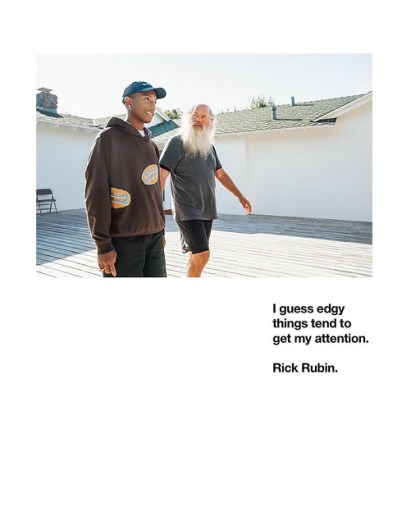
So this is the end of the week so this is the final Rules of Rubin.
To be honest, I’ve got at least another 3 weeks worth of posts I could do, but I want to write about some other stuff.
Yes, less valuable, less relevant, less interesting stuff.
Hey, this blog hasn’t got to where it is by writing stuff that is good. That’s why where this blog is, is at the bottom of everything.
But in all seriousness, maybe I’ll write more about the lessons from Rick later – I’ve certainly enjoyed it – but if you are interested, below is the list of quotes I’ve used and if you click here, you can read my write-ups on all of them.


However this last one is one of the most important.
One of the things I’ve never understood are brands consistently playing to the middle.
I get their thinking.
It’s a mass audience.
It’s a relatively safe audience.
It increases the odds of scalable success rather than risk.
But the thing is, playing to the middle is just the illusion of safety.
Apart from the fact lots and lots of brands are all playing there, all you’re actually doing is – at best – staying where you are, but more likely going backwards.
You might not notice it at first.
You may think everything is fine and dandy and slap yourself on the back for being so brilliant and successful.
But what starts off slow eventually turns in the blink of an eye as the brands or people who play and push to the edge take away all the safety you thought you had.
And what’s worse is because you’re high and dry and left far behind, your legacy and capabilities are impacted.
You’re tainted with being part of the past rather than the present, but even worse than that, your operational capabilities have been built around optimising rather than advancing so the best you can achieve is to play catch up.
This is a nightmare situation, based on one simple reality.
When you are playing catch up, your starting point is where everyone else is. But the problem is that by the time you get there, everyone is even further ahead and you’re back where you started.
A bit like Kyle in this episode of South Park
Of course it doesn’t have to be that way.
Some get that the only way to truly catch up is to leap frog current standards to set the next standard, but few companies have the courage to do that, let alone the money.
Oh they’ll suggest they can.
They’ll make all the right noises.
They’ll invest in some new technology, research or corporate ‘tagline’
They’ll even hire the odd new person from a new discipline with new ideas [though in many cases, they’ll then get moved on with the excuse ‘they weren’t the right cultural fit’] … but the reality is they’ll remain in this endless cycle of catch up.
I’ve seen it.
Hell, I’ve worked in some companies that have practiced it.
Because for all the desire to not get left behind, nothing feels as good as feeling in control.
Even if that’s just an illusion.
Because doing this means their position is protected.
It means they don’t have to look at their entire business model.
But more importantly, it means they don’t have to take a long hard look at their contribution for being in this situation.
So while I totally get why choosing to stand still may sound like the wisest option for so many, the problem with it is that it ignores one pretty vital consideration.
Culture never stops moving.
If you don’t want to get left behind, always play to the edge.
Filed under: A Bit Of Inspiration, Advertising, Attitude & Aptitude, Authenticity, Comment, Confidence, Creative Brief, Creative Development, Creativity, Culture, Design, Emotion, Empathy, Experience, Imagination, Innovation, Insight, Management, Marketing, Perspective, Point Of View, Relationships, Relevance, Resonance, Respect, Rick Rubin, RulesOfRubin

When I read that Rubin quote, it reinforced why I hate when companies devalue creativity.
Focused on working down to a price rather than up to a quality ..
An expense, rather than an investment.
Even though they then expect it to work it’s socks off for them.
And while it would be easy to throw all this blame at the organisations who hide behind their procurement departments, the reality is – as I mentioned in an earlier post – the ad industry are equally complicit in this downturn.
Look, I get it … we’re fighting for our lives.
But selling the value of creativity down the river in favour of process and hourly rates seems to be an act of self sabotage. An act that has ended up handing power to a group of people who ignore context and quality and just evaluate on the comparison of unit prices. Who then demand agencies to accept work based on a price/output ratio not on quality/value.
And what this means is talent – real talent – gets pushed out for being too expensive.
Or too demanding.
Or too stubborn.
Adland has always had an issue with ‘experience’, but this approach is also affecting the new and the different.
The people with different backgrounds, new ways of doing things, looking at the world in unique ways.
And all because the price/output ratio the agency agreed to, won’t allow for any exploring.
Any anything.
Instead, they need to execute exactly what is wanted, efficiently. precisely and repeatedly.
And what is wanted?
Well, whatever the producer has determined can be done in the time/budget allowed … using previous work as the blueprint even though [1] the context is different [2] they don’t know whether that previous work, worked and [3] reducing creative minds to simply executional monkeys is the quickest way to destroy confidence, character and creativity.
Because what everyone seems to be forgetting is what it takes to make great work.
It’s not just about putting a brief in front of someone and – voila – it’s done.
Creativity is born from years of experiences, adventures, wins and losses, stories and songs, failures and fuck-ups.
Where every step of the journey has played a role in crafting that thing that will make so many people feel, think and do so much.
Ignoring that … devaluing that … not catering for that … doesn’t just mean you’re working against your own best interests, it means you’ve have failed to realise what you’re really paying an agency for.
It’s not simply to make an ad, it’s so they can hire the people who have the most interesting ways of looking at the world because of the experiences, ideas and imagination from the life you never had.
Filed under: A Bit Of Inspiration, Advertising, Agency Culture, Attitude & Aptitude, Authenticity, Comment, Communication Strategy, Confidence, Creative Brief, Creative Development, Creativity, Culture, Emotion, Empathy, Management, Marketing, Marketing Fail, Point Of View, Relationships, Relevance, Resonance, Rick Rubin, RulesOfRubin

Great work. It’s a term used by so many but – let’s be honest – there’s not huge amounts of it about.
Of course there’s some … work that literally takes your breath away … but in the main, it’s all a bit beige and blah.
But what’s interesting is who people are blaming for this situation.
Often it’s the ad agencies who cop all the abuse.
Claims of being … out of touch, selfish and arrogant, more focused on what they want than their client needs.
But frankly, all this feels a bit too convenient because the people and organisations shouting the abuse the loudest happen to be the people and organisations who are directly competing for the same budgets.
Hmmmmn, I wonder if that undermines their credibility a little?
Throw in they’re often more focused on optimising than progressing and make work that either says whatever the client wants to say – regardless of how tone deaf that may be in culture – or just talk at people with buzzwords and data points that have no value, resonance or humanity towards the audience they are trying to engage … then you start to realise this is more a shitty strategy, than a future of marketing play.
Don’t get me wrong, I think agencies have to take a significant amount of the blame for the situation they find themselves in …
Too many have sold creativity down the river.
Charge for the process they undertake rather than work.
Seek to beliked by clients rather than respected.
Focus on creating generalised answers not unique problems.
Underpay, undervalue and under-appeal to the best of the best – existing or new.
… but even then, it’s only some of the blame, not all.
And the reason for this is great work is a team sport.
Everyone plays a part.
Not everyone – to use a football analogy – will be the striker, but they’re all necessary to score the goal.
But too often, we’re in situations where it’s not played that way.
Where too many wanting the authority but none of the responsibility.
Taking the credit but rejecting the blame.
Handing out dour instruction but expecting amazing results. Even though they don’t even know what amazing is, because either they’re context is small or they simply think everything they do is great so it doesn’t matter what they say.
Hence they’re the ones who criticise the agency for not delivering.
They’re the one’s questioning their commitment and passion.
They’re the ones running to data and management consultants to subject society to communication that in cultural landfill, not cultural stimulus.
And that’s why Rick’s quote is so good.
Because it acknowledges the inclusive responsibility to making something great.
From literally how you deliver the brief – let alone the actual brief – to how you support, encourage and give feedback to the people you want to do the best work of their life to help you have the best time of your life.
Because the reality is, if you’re not excited about doing something great, why the fuck do you think anyone else will be?
Filed under: A Bit Of Inspiration, Advertising, Attitude & Aptitude, Authenticity, Brand, Brand Suicide, Comment, Confidence, Creative Development, Creativity, Culture, Honesty, Management, Relationships, Sport
There’s a well-known phrase that says. ‘it’s easier to get to the top than to stay there’.
I couldn’t agree with it more.
That’s not to say getting to the top is easy, but staying there requires a very different mentality.
However, while it should mean you’re always pushing forward … looking for ways to push and provoke possibilities … understanding where culture is heading rather than where you wish it was … defining the future rather than just following it … a lot of companies do it in a very different way.
Abusing their scale.
Buying market share.
Pricing competitors out.
Focused on size not change.
But what makes this ‘optimise the position’ approach even more fascinating is that a lot of these organisations who are like this, were not like that in the beginning.
In fact, they were the polar opposite.
Founded on changing something in their industry they felt was wrong.
They wanted to create change by offering a real alternative.
Something that drove them and defined them.
Where over time, they became distinctive and definitive.
And then … the more comfortable they became, the less they could see what they were turning into.
Silencing the alternate voices that used to fuel their drive.
Replacing the misfits with the people who look just like them.
Seeing a point of view as alienating rather than a beacon for those they once served.
Looking at cost rather than value.
Optimisation over innovation.
But this isn’t just in terms of operational behaviour.
It also affects the people within the operation.
Playing politics more than performance.
Protecting their position rather than growing those around them.
Following the process rather than focusing on what they want to do … create … change.
It’s a question I love to bring up with clients.
Especially when we’re talking about brand and positioning work.
The good ones are open to the uncomfortableness of the conversation.
I’m not saying they like it.
I once asked it to the founder of a rather well-known, global sports brand and he DEFINITELY didn’t like it … but based on the hard, honest, passionate and open debate it stirred – let alone the shifts it later encouraged – it was definitely worth it.
As for those organisations who are too far gone?
Well, they tend to shut down that conversation very, very quickly.
Then try to position you as bad for daring to ask it.
That everything is perfect with them and you should respect them and embrace them.
Of course, asking that question is the ultimate sign of respect.
You’re putting yourself on the line because you do like them. You do want them to do well.
You have recognised something may be misbalanced and you want to help them get that back.
Which may explain why the vast majority of companies I’ve asked this question have been open to it.
That doesn’t mean it has always led to different actions or behaviours, but it has been something they’re willing to debate. And while some may consider this approach ‘career suicide’, the great irony is it has had a huge and positive impact on the majority of my client relationships … because they know I’ll always give them the truth and I know they will always give it the time.
So while I still believe it is harder to stay at the top than to get there … if it means you’ve turned into the beast you were created to slay, then ‘the top’ is really rock bottom.