
Filed under: A Bit Of Inspiration, Advertising, Attitude & Aptitude, Communication Strategy, Creative Brief, Creative Development, Creativity, Culture
One thing I love is working with creatives who – during a review – looks at the nuance of the idea, not just the excitement of it.
I don’t mean getting lost in the details … I mean understanding what the actual idea is behind the thought and seeing how it all works together.
Of course, knowing when to do this is important.
Too early and it kills the creative journey of exploration.
Too late and it just fucks and undermines everyone involved.
But done properly doesn’t just mean you gain clarity on what the actual idea is … but it highlights the nuances make the idea work so it can be pushed and elevated in ways that allow it to be consistent without ever being boring.
To be honest, it shocks me how little this stuff is talked about …
For all the talk of ‘brand’, it’s amazing how many people equate that to simply repeating a tagline a colour or a set of ‘brand assets’ without realizing the work they’re producing is slowly but surely moving further and further away from the premise of what the creative idea was built on or what the brand stands for.
What really brought this home was a post by the brilliant Trevor Beattie.
For those who don’t know who Trevor is, please go learn your creative history.
For those who do, you’ll appreciate why this is so good.

How good is that?
I particularly love how concise and articulate Trevor is in identifying the heart of the Specsavers idea.
“The comedic potential of not seeing clearly enough”
Clear. Definitive. Focused.
Opening creative possibilities without falling into creative ambiguities.
And then there’s the fact it’s delivered with such brevity.
No rambling. No ambiguity. A demonstration of someone who can see past the flash and see the core. Affording them the ability to give proper feedback … feedback that changes how people see the work and how they can improve it.
Simple. Valuable. Powerful.
Which – based on a lot of the work I see out there in the world – seems to be a dying art … lost to a sea of concepts without consideration or pithy headlines over random images. Or – as Trevor’s feedback also highlights – people interpreting ideas without ever really understanding them or giving them proper consideration so they end up dumbing it down and taking it to somewhere else. And while Trevor politely suggests that in the case of Specsavers, its a strategic pivot [laughing at stupid people] it’s probably more likely laziness, convenience and a lack of craft.
When we’re good our industry is a total fucking force … an infectious, impossible-to-ignore, emotion pleasure machine … but when we’re bad, we’re cheap wallpaper.
But while we have to take a lot of the blame, it’s not entirely our fault.
A lot of clients need to take responsibility for their contribution to this situation.
A situation that undermines their potential with all their mandates and demands.
Demanding simplistic and tactical than distinctive and definitive and caring more about what is said rather than what their audience will embrace and connect to.
If we think craft is dying in our industry, so is the understanding of what it means.
Too many dismiss it as time consuming or expensive.
An outdated concept from a time where advertising was a broadcast only medium.
But those people are wrong.
Because craft isn’t limited to execution, but in the nuance.
Filed under: A Bit Of Inspiration, Advertising, Agency Culture, Attitude & Aptitude, Comment, Complicity, Confidence, Context, Creative Development, Creativity, Culture, Differentiation, Distinction, Effectiveness, Innovation, Insight, Linkedin, Marketing, Marketing Fail, Mediocrity, Planners, Planners Making A Complete Tit Of Themselves And Bless, Planning, Relevance, Standards, Strategy, Trust, Wieden+Kennedy

There is a lot of talk about a new term in marketing, called ‘UBR’.
UBR stands for Universal Buying Reason and there’s a lot of people seemingly wetting their pants over it. In essence, UBR is when a brand owns a position within a category that arguably, anyone within that category could have had, but they were first or the most consistent or invested in making it their or were simply, the biggest spenders behind it.
If you’re thinking this is not exactly new, you’d be right … but many people seem to be more obsessed with being associated with new terminologies or methodologies than actually making stuff that pushes brands and business to new places.
That’s why UBR feels like the next terminology trope in a long line of terminology tropes …
Brand Assets.
Brand Eco-Systems.
Global Human Truths.
Overly simplicitic labels that promote conformity under the guise of effectiveness or efficiency.
[And yes, I know Dan Wieden used to talk about Global Human Truths … and as I told him, he was wrong. Because while all Mum’s may love their kids, a Mum in Wuhan shows it in very different ways than a Mum in Washington, and to ignore that nuance is to ignore truth for convenience and complicity. And as anyone worth their salt will tell you, often it’s the nuance that is the difference between doing things for people or about them]
Of course, like all trope trends, there’s some value in what is being said about UBR – after all, its hardly a new concept given countless brands and categories have used this approach for literally decades, from alcohol to jewellery.
But what some of the people pushing UBR are seemingly forgetting – or not understanding – is that even at the most functional level of category marketing, it requires depth and consideration to fully release its potential … and frankly the lack of discussion about that highlights the industries obsession with providing clients with easy answers/solutions rather than encouraging/pushing/provoking them to appreciate the rewards [and shareholder benefit, let alone expectation] of putting in the hard work to identify how they can consistently build their value, role and position.

What scares me most is that some of the people ‘fluffing UBR’ – but thankfully not all – are in jobs where they’re paid to help clients with their business … and yet they talk in incredibly generalistic and simplistic terms about something that has context and complexity.
Where the hell is their objectivity?
Where is the understanding?
Where is the nuance?
It all feels like a desperate play to be seen as an industry thought leader, where the goal is to highjack whatever seems to be getting industry traction and then aligning themselves to it.
What’s worse is we’ve seen how this approach works as more and more people value and aspire speed and status over substance and experience … and I don’t really care that makes me sound old, because it actually has nothing to do with age, and everything to do with valuing what our industry can do when we do it with craft, understanding and ambition.
What sums it all up [for me] is how one of the brands the UBR advocates bang on about is Tesco’s.
I get why, because on face value, Tesco’s is a supermarket like every other supermarket.
But …
All it takes is a quick look at Tesco’s history – from their foundation in 1919 through to the many acts and actions they’ve embraced and led over 100 years, from the ‘computers for schools’ program to challenging EU law to give their customers access to products at the same price as their European cousins and a million things in-between – and they’d see the ‘Every Little Helps’ position is not something ‘anyone’ could say, but something far more specific to them specifically … something they’ve continually reinforced and invested in through retail, customer and cultural innovation as opposed to just the repetition of a category trope.
It’s yet another example of people needing to know their history before they can claim they’re creators of it.
Or – said another way – why clients and the industry at large, need to get back to valuing those who have DONE and DO shit, rather than just talk it … regardless how popular or well-meaning they may be.
[OK, ‘talking shit’ is harsh, but it sounded good in that sentence, so forgive me]
Don’t get me wrong, I’m all for pushing knowledge and possibilities, I’m just not for people putting lipstick on a dead sheep and calling it Ms World.
And don’t get me started on how many of these people are ultimately downplaying someone else’s creative excellence to make it all about them.
Wow, that’s like a rant from 2010. Felt good. Thanks industry trope for waking me up.
Filed under: A Bit Of Inspiration, Advertising, Agency Culture, Attitude & Aptitude, Colenso, Colleagues, Comment, Communication Strategy, Creative Development, Creativity, Culture, Cynic, Empathy, Honesty, Marketing, Media, Perspective, Planning, Point Of View, Provocative, Relevance, Resonance, Wieden+Kennedy
This blog has been going for a loooooooong time.
Which means, it’s had its fair share of April Fool posts.
Some have been very good [even though I say it myself] with different industry people picking it up and commenting on it thinking it’s real.
And some being utterly, utterly shite.
But this year I decided not to do one.
Not because I couldn’t be bothered.
Nor because I couldn’t think of what to do.
Not because it was an Easter holiday on April 1.
But because after a while, it just becomes a bit boring.
I say this because a lot of brands don’t seem to get that. Instead, they keep doing the same thing over and over again without realising the audience have moved on.
That might be because of ego. That might be because of a lack of self-awareness. That might be because they don’t even know who the fuck their audience is … but whatever the reason, they keep doing what they do regardless.
And one of those things they keep repeating is ‘hijacking culture’.
By that I mean either during or after a topical event … they hire a van, slap a billboard on the back, put some headline on it that refers to whatever event they are ‘leveraging’ and then drive back and forth so a photographer can snap it in situ and then send it to the press or put it on the socials.
Hey, sometimes it’s really good.
But often, it just feels pretty sad.
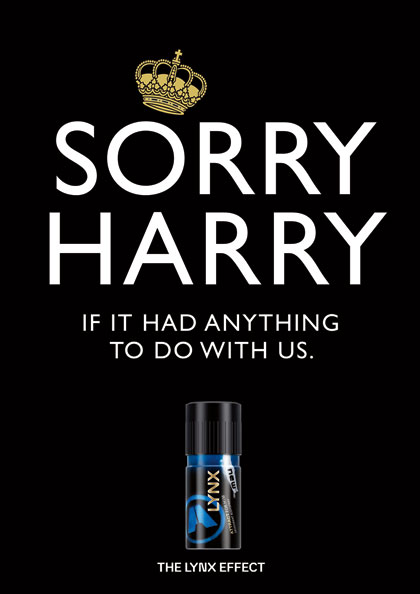
Especially when lots of companies are all trying to do exactly the same thing for the same event at the same time.

Look I get it … it’s a way to get boost attention.
It’s also a way to show your client – or their bosses – you’re ‘on the ball’.
Can’t criticise that … except in many cases, it also seems to have a subliminal admission that they need to borrow from others to make people care about them.
Which is less good.
Yes, I know I’m being a bit of a pedantic asshole here, but here’s the thing … when people expect brands to do this stuff, then you have to accept that you’re no longer ‘hijacking’ anything, you’re simply conforming.
Of course there are ways to do it well.
Wieden were the masters and – arguably – the originators of it.
Which was basically to do stuff that ‘added to the cultural conversation, not just stole from it.
They did it with NIKE for literally decades.
Olympics.
Superbowls.
World Cups.
Winning.
Failing.
Achievements.
Retirements.
Fines.
Spectaculars.
But achieving it wasn’t simply down to great talent, great clients or being quick at doing stuff like this, it was down to 3 things.
Creatives co-run/run the account, not simply make the ads.
They understand the culture around the category, not just the category.
They think in terms of owning the brand voice, not just launching campaigns.
What the combination means is everyone feels there role and purpose is more than just making advertising, but finding how … where … when and who the brand can/should a voice and point of view. It’s more than just being pro-active, it’s a confidence in your preparation.
You know what the brand will say.
You know how the brand will say it.
You know what the culture of the audience want and need.
You’re moving things forward because you’re always moving things forward. Seeing your role as far more than simply fulfilling ‘campaign requirements’ and ‘unexpected opportunities’ but directly and continually driving, shaping and influencing the behaviour and energy of the vision and role of the brand in culture.
Many people will say they do that, few do.
Instead they just churn out stunts or puns that often end up being more for the ego of the people involved than the benefit of the audience it is supposedly for.
Which is the heart of what, in my opinion, separates brands/agencies who get it and those who pretend they do.
Because the wannabes and imposters talk about how they will make the masses love their brand, whereas the real deal know it’s about the brand showing and expressing who they love and who they are for.
Filed under: A Bit Of Inspiration, Advertising, Attitude & Aptitude, Brand, Brand Suicide, Comment, Creativity, Effectiveness, Lego, Marketing Fail, Media
Today is a special day for me.
A special day because of a birthday and an anniversary.
Not mine, but people who are important to me …
I had written a long post to them that went on a tangent to talk about investing in your own relevance.
That however young you are today, you’ll become an old fuck one day.
But I couldn’t wrap it up so I have left it for another day … instead, I am writing a post about the importance of your relationships.
Have a look at this …

At first glance, what do you see?
A Lego ad campaign?
Yeah … me too.
But then, when you look again, there’s that weird-as-fuck headline.
“Super Sweet And Fake Tasting”
What the absolute fuck? Has Lego gone rogue and decided to make social commentary on their own product?
Well obviously they haven’t … it’s simply an alcohol ad that has been stuck on the end of those 3 posters that – because of the colours of the poster frames – looks like it’s all part of the same campaign.
Now on one hand it’s funny. But I wouldn’t be laughing if I was the Lego client.
Putting aside their choice of headline colour – with the B&W image – makes it look like a Sainsbury’s ad [albeit Sainsbury’s aren’t in NZ], I’d be VERY disappointed the media team and/or the billboard company did not see the problematic nature of this linkage.

I mean, it’s pretty obvious.
Lego … kids, wholesome, creative. Alcohol … errrrm, less so.
Look, I get we all make mistakes, but what this says to me is that no one asked – or cared to ask – the right questions.
The client.
The media agency.
The billboard company.
Fuck, the only one who gets off here is the creative company, because they’d be as pissed off as the client.
Of course I’m not really surprised this has happened because in the quest for the lowest price possible, there seems to be more focus on having a programatic, optimised and systemised system and process than actually giving a fuck about your brands contexts, craft and associations.
It blows my mind how few clients care about ‘placement’.
They’ll argue till they’re blue in the face over the size of their logo, but rarely go into depth about the placement and contexts of where they appear.
And yet many clients think media agencies are professional and creative are the children.
Now of course there’s some amazing media agencies out there … agencies who think in terms of communication rather than media.
But the market has become so fixated on price, they’re forgetting – or not valuing – one vital element about brand building.
It’s not just about who you are, it’s about the company that you keep.
_____________________________________________________________________
PS: If anyone from Lego reads this, this post is because I love you. And you know this because I told you that when you invited me to talk at your global conference thing. Plus you’ve been very good and kind to me – and Otis – over the years. But the fact is, despite this being an isolated incident, you deserve better than this. You should demand better than this. So hold people to standards, not just price points and please don’t ask for any of the freebies you’ve sent me to be returned. Please!!!
PS2: It’s Easter holiday tomorrow and Monday so there will be no blog posts till next Tuesday. In the meantime, I’ll be looking longingly at the Hot Cross Buns and Easter Eggs I won’t be eating and wishing April Fools was on a Tuesday, rather than a Monday. Have fun.
Filed under: A Bit Of Inspiration, Advertising, Attitude & Aptitude, Authenticity, Comment, Creativity, Culture, Insight
A few years ago, the APG asked me to do a presentation about how to get to interesting work and I summed it up by saying, ‘live an interesting life’.
While I appreciate that is a relatively superficial answer, there’s truth in it.
Put simply, what you find interesting is directly related to the experiences you have and the people you meet. The more experiences – and people – you have, the more interesting the possibilities.
But when I look around, it can feel like a cultural echo chamber.
Everyone reading the same things. Following the same people. Commenting on the same issues.
Sometimes I wonder if people even look at life outside of work. Hell, there were people over the festive season who used social media to only talk about ‘ad issues’.
WHAT THE FUCK?
Look, I get strategy means everything can have some sort of professional value … but there’s a big difference between looking at life with ‘professional blinkers’ and just doing shit for the sheer curiosity and interest of it.
It’s why I think there’s huge value in the messy stuff.
The weird … the strange … the ‘makes no sense’ …
That’s where you find the new and the different.
That’s where you gain understanding rather than answers.
That’s where you learn about people not ‘consumers’.
Of course it’s rare these days.
Now everyone is looking for short-cuts.
From online surveys to AI driven chat bots.
Optimise … maximise … squeeze every inch of efficiency out of what you’re doing.
And while some of that has value, it’s no where near as good as running with reality.
It’s why Wieden – despite being all about the work – has always been so good at strategy.
Because they celebrate those who are more than just professionally curious, but culturally.
The people who have a hunger and desire to get ‘in it’.
To get messy and lost in the opinions, behaviours, actions, viewpoints and nuance of the communities and subcultures they’re exploring and working with. Which is why they value being among them as much as reading every possible book about them.
A commitment to authenticity over advertising.
A commitment to adding to culture not just stealing from it.
A commitment to finding the interesting rather than repeating the tropes.
A commitment to fucking around and finding out rather than playing where you’ve always been.
Sure it takes more work. Sure it takes more time. Sure it probably adds more initial cost.
But putting aside the fact this helps get to better work – that plays to where the culture/subculture is heading rather than where it currently is, or worse, was – there’s the simple fact of doing things right. Because, as my Dad once said to me, if you’re not interested in doing that, then what’s the fucking point of doing it at all?