
Filed under: Advertising, Agency Culture, Attitude & Aptitude, Colleagues, Context, Craft, Creative Development, Creativity, Culture, Cynic, Friendship, Music

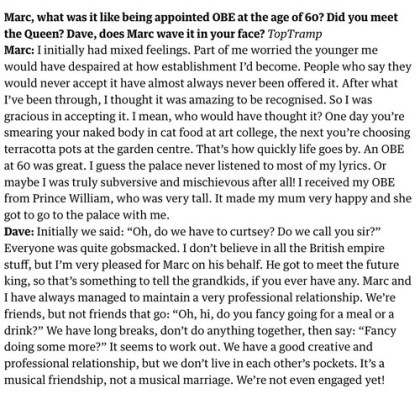
I recently read an interview with the members of 80’s art-pop band, Soft Cell.
Sure, I liked their song ‘Tainted Love’ but that was about it.
I thought they were try-hard and much preferred my heavy metal bands.
But as I’ve got older, I’ve realized how blinkered I was … how judgmental … and this interview rammed it home.
I love so much about it.
Their attitude to music.

Marc’s phenomenal and ferocious attitude to the frankly, horrific homophobic rumours that I remember hearing way back in my college days.

And their approach to their working relationship.
It’s funny with bands … you expect all the members to love each other. Have deep bonds that last a lifetime.
Of course part of that is cultivated by the record companies, but you still want them to be mates who hang out together … but often, they’re not.
It’s not that they don’t like each other – though that can happen too – it’s more their chemistry works in one environment and they’re good with that.
It was funny seeing it in print because it kind-of captured how I felt with Cynic.
While Andy, George and I talked every day … we weren’t close friends.
We didn’t socialize much together. In fact, we probably do it more now we’re not in a business together than we ever did then.
But it worked.
We liked each other.
We trusted each other.
We valued each other.
But it never really extended beyond the work environment.
And this probably helped us because unlike family – where the focus is not to cause upset – this situation allowed us to always tell each other the truth.
We would be considerate. We cared about each other. But we would never hold back.
And when I think of the best work experiences I’ve ever had, this has been the constant dynamic.
Blunt truth wrapped in visceral respect.
Where you felt you were better at your job when you were together, but had other enjoyable lives when you were apart.
And the joy of the working experience meant you kept coming back.
Not because you had to, but because you wanted to.
Or to paraphrase David from Soft Cell, a creative relationship rather than a creative marriage.
I didn’t realise how special that was.
It certainly doesn’t happen often.
And while you may ask why some of those relationships still end, the bigger question is why do so few ever begin?
For me, it’s all about trust and belief.
That you got together because of how you all see the world, not because you found yourselves in the same room or office.
And while you may share the same philosophy, you have different ways of embracing and executing it.
And that’s thrilling.
That’s the tension that drives both of you to be better.
That lets you say stupid stuff because it’s part of the trust you have of each other.
Part of the standards you hold each other to.
While I have some of that still, I miss some of the stuff I had.
And why I still feel a great privilege for having lived it .
But here’s the good news … because while many of those relationships are no more, the experiences, lessons and ambitions that were born from them remain and blossom.
So thank you to all of you who had – and have – that impact on me.
You know who you are.
And thanks to Marc and David for waking me up to it. Again.
Filed under: A Bit Of Inspiration, Advertising, Craft, Creative Brief, Creative Development, Creativity

One of my pet hates is when people think the best way to brief creativity is to say what they want to see, not the problem they need to be solved.
Whether it was where I worked … or who I worked with … I didn’t encounter this much at the beginning of my career. But as marketing lost its clout – and so standards increasingly fell – I’ve seen it happen a hell of a lot more.
I wish I could say I deal with this sort of situation well, but let’s say there is ‘room for improvement’.
Oh I can hear Andy as I type this.
“If they don’t know how to do their job, you can do your job anyway you choose” … but fights don’t solve anything other than a temporary moment of relief.
I know … you’re wondering who am I?
Don’t worry, I did say I have room for improvement because frankly, I still suck at dealing with this sort of thing, even if I’m way better than I used to be.
One of the worst situations I ever encountered was in Malaysia when a client complained about the way an actors hand looked in a print ad.
I should point out the ad wasn’t about hands, didn’t focus on hands and the hand in question was perfectly normal … but for some insane reason, he wanted it reshot – at our cost – suggesting it would ruin everything.
I genuinely thought they were joking when they first said it, so laughed.
And then he looked at me like I’d just smashed his mother in the face and asked ‘what the hell was I laughing at?’
I’d love to say I responded in a calm, professional manner … however, well, you can guess.
That said, I also put a proposition to him that said if there was commentary about the hand when the campaign launched, we would not only pay for a re-shoot, but we would refund 25% of our costs to him. However if nothing was said, then he had to pay us an additional 50% of our costs.
He lost interest in his argument after that and – surprise surprise – there was absolutely no commentary about the freak hand that wasn’t freaky whatsoever.
I say this because I recently read about the 1994 movie, Street Fighter, featuring Jean-Claude Van Damme and errrrrm, Kylie Minogue.
The film was rubbish [though it’s now seen as a camp classic, like the Queen soundtracked ‘Flash Gordon’ that preceded it] and the making of it was a rollercoaster but writer/director Steven de Souza makes a comment that is not just insightful, but highlights how creativity not only solves problem … but can do it in the most bombastic or gentle of ways.
It’s a lesson we could all do with remembering.
Especially those who dictate what outcomes, not identify their problems.

Filed under: A Bit Of Inspiration, Advertising, Agency Culture, Attitude & Aptitude, Confidence, Content, Context, Creative Brief, Creative Development, Creativity, Culture, Management, Marketing

A while back I was in conversation with a very successful football team manager.
In many ways, they’re the managers, manager.
When I asked how – or who – they used to look to for guidance, inspiration or technical advice, they immediately responded with:
“Learn from winners, not players”.
And when I asked why only winners … they replied:
“Because winners face greater challenges than players and still come out on top”.
Interestingly, later in the conversation, they indicated their definition of ‘winner’ was more than simply someone who has achieved success in a league or a tournament … but someone who has achieved success in multiple league or tournaments, because – to paraphrase an old Nike campaign I did – it’s easier to get to the top than to stay there.
Which made me think about my industry …
Because when I look at who we can turn to, to evolve the standards, abilities and skills of our people, I feels there’s more players than winners.
Of course, being ‘a winner’ is much harder to define in our industry …
+ Creativity is as subjective as fuck.
+ Awards have become as much about how you enter as what you enter.
+ Success is defined by more factors than simply scoring more goals than the opposition.
+ The environment we operate in – and who against – is always changing at rapid rates.
+ You can be respected for your opinion without ever having made work that is respected.
+ Blah blah blah blah.
What bothers me most is how much of the industry outsources its training to people who are good players, but often not great players. And by that, I mean people who never made great things, even if they have great opinions on things.
Some may question why it’s important to have actually made things …
Well it’s simple. Anything is easy when you don’t have to do it, so those who have, have better advice than those who don’t.
That doesn’t mean they don’t have things of value to teach, but to paraphrase the manager I interviewed – those who have made work of note, have better lessons to give than those who have simply an opinion on making good work.
That said, it’s not players fault they’re being paid by companies to train their staff. What is far scarier are the reasons why they’re being asked:
One. It’s cheaper for companies than investing in on-going, personalised training for staff.
Two. Few companies have their own philosophy towards work, so having broad training schemes work for their needs.
Three. You are only as good as the people you are exposed to, and many companies confuse billings or popularity with craft and quality.
I know our industry faces many challenges from clients who value different things. But fundamentally, this issue was caused by our industry selling the value of creativity and understanding society down the river. By focusing on ‘players rather than winners’ to drive our standards and knowledge … we’re not moving putting ourselves back in contention, we’re just delaying our downfall.
To leave this post with a final football punditry reference.
We need to get back to playing to win, not playing not to lose.
Filed under: A Bit Of Inspiration, Advertising, Attitude & Aptitude, Authenticity, Confidence, Creative Development, Creativity, Culture, Differentiation, Management, Marketing, Marketing Fail, Trust, Truth
I was going through some old folders when I found this lovely campaign for Staedtler Highlighters.

To give a highlighter a desirable role in society is a pretty big achievement.
OK, so it’s not as thought-provoking as that door handles ad I wrote about, but it’s pretty close.
But this post isn’t about celebrating luminous green … it’s about what it is promoting: Getting to the point.
Or as this post is titled, cutting the crap.
And my god is there a lot of crap to cut.
The great irony of the above ad is that what it uses to demonstrate its ability to get to the point is something you would see in many companies self-descriptions.
Over-inflated, self-important expressions of what they do and how they do it.
It’s everywhere.
From the umbrella stand that claims to be a protection and lifestyle solutions company to We Work who decided they were a tech company simply because they had an app that people used to book a fucking room.
Look I get we all want to feel validated in what we do.
I get it provides an ability to charge a premium.
But just because you say it doesn’t mean others will think it’s true.
In fact, it can have the total opposite effect … where the good things you do are clouded by the fairy dust being constantly released.
With tech enabling people to check claims like never before, it blows my mind how much delusional ego inflation continues to rise.
Of course, part of it is because companies feel they can continue to get away with it … and there’s an element of truth in that, except in many cases, it’s because no one gives a shit about who they are or what they say and so the relationship is shallower than a Hollywood romance.
10,000 years ago I wrote about something I called unplanning … and in many ways, it’s more relevant now than it’s ever been.
That doesn’t mean being brutally honest downplays your role or value, if anything it can elevate it … especially when surrounded by big talking idiocy. But it’s more than simply differentiating from a crowded competitive space, because as someone wise once said to me, “nothing makes mistakes like someone who can’t be honest with themselves”.
Filed under: A Bit Of Inspiration, Advertising, Agency Culture, Apple, Attitude & Aptitude, Brand, Brand Suicide, Communication Strategy, Creative Development, Creativity, Culture, Differentiation, Distinction, Technology, Wieden+Kennedy
Apple.
One of the best brands in the world.
From product to marketing … everything they do is considered, consistent and distinctive.
A brand voice forged over years, with a clear understanding of who they are.
But what’s interesting is what they used to be …

Or this …

Or worse of all, this …
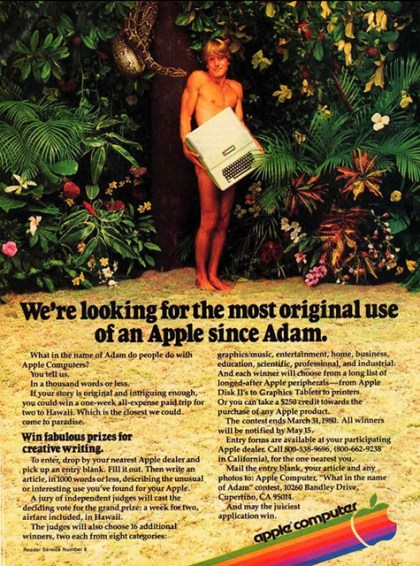
I know they’re from a time where long copy wasn’t viewed with the same distain as a global pandemic but look at them?
And what’s with their obsession with mythical figures?
It’s ugly, it’s cluttered, it’s got no clear point of view and it’s talking around the product not at it.
And then, there’s a point in their advertising evolution that you feel they took a clear step towards where they are today with work like this …

And this …

Still a lot of copy. Arguably more.
But it just feels more contemporary …
From being product benefit focused to the choice of font to the voice … which talks to adults like an adult rather than the disinterested, casual, general audience tone they had used before.
It’s so strikingly different that you feel this was the moment Apple understood who they were and who they were for.
It’s also an obviously deliberate act … because there’s no way you would get here from the – let’s be honest – horrible historical figure focused campaigns they’d run before.
Which leads to the point of this post.
A while back I got to hear the wonderful Nils of Uncommon talk.
One of the things he said that particularly resonated with me was brands who say they need to ‘work up’ to the creativity you think they need.
In essence, it’s just their polite way of saying ‘no’ to the work you want them to do.
But the funny thing is that in the main, there’s no valid reason for them to say that, other than them being fearful of change or commitment.
There’s a lot of that at the moment.
Work in an endless loop … seemingly because the people who have the right to sign off on something are scared that the moment they do, they will be judged.
So what happens is the entire industry are caught in arrested development.
And what do agencies do?
Well, in a bid to get anything made, they agree to anything – justifying it as “being a bit better than what they did before” – so we end up with bland and boring campaigns that, bizarrely, keep everyone happy as the agency got to make something and the client doesn’t have to worry of offending anybody.
Said another way, everybody loses with this strategy.
Brand.
Advertising.
Customers.
Industry.
Which is why Nils challenges brands on what they need to do the work they could do.
It’s a test of their truth and ambition.
And he’s right to do that …
Because brands don’t get to where they want through time, but deliberate acts and choices.
Even then it won’t happen overnight … but continually and consistently playing to where you want to be is far smarter than playing to where you hope to be taken.
Because to paraphrase Dan Wieden said … you don’t become the brand you can be by discovering the power of advertising … you do it when you discover the power of your own voice.