
Filed under: A Bit Of Inspiration, Advertising, Attitude & Aptitude, Authenticity, Confidence, Creative Development, Creativity, Culture, Differentiation, Management, Marketing, Marketing Fail, Trust, Truth
I was going through some old folders when I found this lovely campaign for Staedtler Highlighters.

To give a highlighter a desirable role in society is a pretty big achievement.
OK, so it’s not as thought-provoking as that door handles ad I wrote about, but it’s pretty close.
But this post isn’t about celebrating luminous green … it’s about what it is promoting: Getting to the point.
Or as this post is titled, cutting the crap.
And my god is there a lot of crap to cut.
The great irony of the above ad is that what it uses to demonstrate its ability to get to the point is something you would see in many companies self-descriptions.
Over-inflated, self-important expressions of what they do and how they do it.
It’s everywhere.
From the umbrella stand that claims to be a protection and lifestyle solutions company to We Work who decided they were a tech company simply because they had an app that people used to book a fucking room.
Look I get we all want to feel validated in what we do.
I get it provides an ability to charge a premium.
But just because you say it doesn’t mean others will think it’s true.
In fact, it can have the total opposite effect … where the good things you do are clouded by the fairy dust being constantly released.
With tech enabling people to check claims like never before, it blows my mind how much delusional ego inflation continues to rise.
Of course, part of it is because companies feel they can continue to get away with it … and there’s an element of truth in that, except in many cases, it’s because no one gives a shit about who they are or what they say and so the relationship is shallower than a Hollywood romance.
10,000 years ago I wrote about something I called unplanning … and in many ways, it’s more relevant now than it’s ever been.
That doesn’t mean being brutally honest downplays your role or value, if anything it can elevate it … especially when surrounded by big talking idiocy. But it’s more than simply differentiating from a crowded competitive space, because as someone wise once said to me, “nothing makes mistakes like someone who can’t be honest with themselves”.
Filed under: A Bit Of Inspiration, Advertising, Agency Culture, Apple, Attitude & Aptitude, Brand, Brand Suicide, Communication Strategy, Creative Development, Creativity, Culture, Differentiation, Distinction, Technology, Wieden+Kennedy
Apple.
One of the best brands in the world.
From product to marketing … everything they do is considered, consistent and distinctive.
A brand voice forged over years, with a clear understanding of who they are.
But what’s interesting is what they used to be …

Or this …

Or worse of all, this …
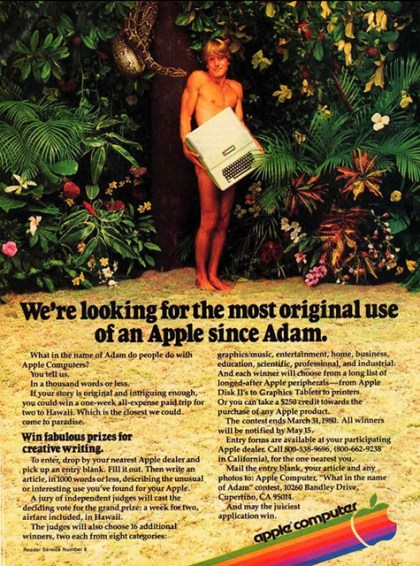
I know they’re from a time where long copy wasn’t viewed with the same distain as a global pandemic but look at them?
And what’s with their obsession with mythical figures?
It’s ugly, it’s cluttered, it’s got no clear point of view and it’s talking around the product not at it.
And then, there’s a point in their advertising evolution that you feel they took a clear step towards where they are today with work like this …

And this …

Still a lot of copy. Arguably more.
But it just feels more contemporary …
From being product benefit focused to the choice of font to the voice … which talks to adults like an adult rather than the disinterested, casual, general audience tone they had used before.
It’s so strikingly different that you feel this was the moment Apple understood who they were and who they were for.
It’s also an obviously deliberate act … because there’s no way you would get here from the – let’s be honest – horrible historical figure focused campaigns they’d run before.
Which leads to the point of this post.
A while back I got to hear the wonderful Nils of Uncommon talk.
One of the things he said that particularly resonated with me was brands who say they need to ‘work up’ to the creativity you think they need.
In essence, it’s just their polite way of saying ‘no’ to the work you want them to do.
But the funny thing is that in the main, there’s no valid reason for them to say that, other than them being fearful of change or commitment.
There’s a lot of that at the moment.
Work in an endless loop … seemingly because the people who have the right to sign off on something are scared that the moment they do, they will be judged.
So what happens is the entire industry are caught in arrested development.
And what do agencies do?
Well, in a bid to get anything made, they agree to anything – justifying it as “being a bit better than what they did before” – so we end up with bland and boring campaigns that, bizarrely, keep everyone happy as the agency got to make something and the client doesn’t have to worry of offending anybody.
Said another way, everybody loses with this strategy.
Brand.
Advertising.
Customers.
Industry.
Which is why Nils challenges brands on what they need to do the work they could do.
It’s a test of their truth and ambition.
And he’s right to do that …
Because brands don’t get to where they want through time, but deliberate acts and choices.
Even then it won’t happen overnight … but continually and consistently playing to where you want to be is far smarter than playing to where you hope to be taken.
Because to paraphrase Dan Wieden said … you don’t become the brand you can be by discovering the power of advertising … you do it when you discover the power of your own voice.
Filed under: A Bit Of Inspiration, Advertising, Agency Culture, Attitude & Aptitude, Brand, Brand Suicide, Business, Comment, Communication Strategy, Creative Development, Creativity, Culture, Effectiveness, Management, Marketing, Marketing Fail
A few weeks ago, I saw this …

… and I have to be honest, it’s had me thinking a lot.
Because while I acknowledge you can’t take things for granted, when you get lost in the weeds, you lose sight of what you’re working towards and how you do it.
And a lot of people are doing both of those things.
Nothing sums this up more to me than the issue of attribution.
The quest to minimise risk – or ‘optimise value’ – has resulted in brands forgetting that the easiest way to get attribution is to do something interesting.
But instead – reinforced by industry ‘guru’s – we have ended up with a continual production line of commercially responsible alternatives.
Be a one colour brand.
Place brand assets higher than a brand idea.
And – worse of all – have watermarks in your ads.

While colour and brand assets have a role – albeit not a primary role as so many people seem to suggest – if you feel the only way your brand will be remembered in your commercial is to place your logo all the way through it, then you either don’t know how people work or how advertising does.
Or said another way, you’re admitting your brand and your product are forgettable.
Seriously … why would you do that?
Why would you spend millions on something that positions you as uninteresting.
Worse, why would you spend millions on something that positions you as uninteresting and make sure people know it’s you by ramming your logo down their throat?
But somewhere, someone is measuring the ‘impact’ of this approach and finding a way to demonstrate its effectiveness to clients. Letting everyone feel pleased with themselves. Their choices. Their actions. Creating a precedent others will follow in the blind belief they’re being smarter … more optimised … more effective than all their competitors. All the time consciously and deliberately ignoring the critical fact that it’s undermining them rather than liberating them.
Which leads back to that tweet at the top of the page.
Because while knowing how things are going is important, nothing reveals how lost you are than measuring everything but valuing nothing.
Filed under: A Bit Of Inspiration, Advertising, Agency Culture, Attitude & Aptitude, Authenticity, Awards, China, Creativity, Culture, Equality

This is an open letter to Little Black Book, The Drum, Campaign Brief, Campaign, Adweek, Cannes, Warc … basically every industry publication or award show around the world.
Please …
Pretty please …
… can you stop awarding English speaking agencies – especially those only with offices in English speaking nations, only producing work in English – titles like ‘Best APAC agency’.
I get they may have won more awards than any other agency in the region.
I get they may have topped more categories than any other agency in the region.
I get they may have been recognised more than any other agency in the region.
BUT at best, they’re the best ENGLISH SPEAKING agency in APAC.
That clarification is important …
Because apart from it being factually correct, it stops devaluing and demeaning the companies, agencies and people who don’t speak English as their native language.
Which in terms of the APAC region, is the vast majority.
Years ago, an agency who had been named APAC Agency of the Year, put something out that said something like:
“If you’re a company in Japan who are ambitious, then the APAC Agency of the Year would love to help you fulfil your goals”.
Now I get recognition is important.
I also get being named APAC Agency of the Year is utterly epic.
But … but …
Hell, it wasn’t even written in Japanese … which suggests they didn’t think it mattered if you don’t speak the language, don’t know the culture, don’t have an office in that country, don’t have any Japanese employees, don’t work in Japanese … you can teach them a thing or two about great work.
I mean, can you get more Colonialist than that???
Hell, even if they meant it in terms of expanding outside of Japan – rather than inside the country – it’s still pretty arrogant.
That said, I used to see this shit all the time when I was in China.
I still remember an exec from a UK-only based agency telling a room full of Chinese business leaders “we can help them be successful”, despite that being the very first time they had been in China … or the social media ‘guru’ who told people at Unilever China why Twitter was so powerful, not realising Twitter was banned in China.
It would be hilarious if it wasn’t tragic.
I should point out Colenso has been crowned ‘best APAC agency’ in its time … and while that before I was here, I still find it wrong and would openly say it was.
Sure, they didn’t suggest they were going to colonise the whole region with their approach to creativity, but they also didn’t say they weren’t … which still suggests some sort of superiority, intentional or not.
Look, I get the titles are a byproduct of how the awards are calculated … and I get it also reflects who enters and how many times … but given the vast majority of the judges are English natives – with Western frames-of-reference – it immediately benefits those who come from similar backgrounds.
This is not a new issue for me.
I said it when I got Chaz from BBH to do a co/presentation with me/Wieden in 2012 … I said in back in 2013, when I was invited to speak at Mumbrella about Asian creativity and I said it every time I was spoke at an Asian awards where the lead language was – bizarrely – English.
Asian creativity has a terrible reputation.
I know there’s issues of scam advertising, but that’s not unique to Asia. Remember Peggy?
The reality is the Asian region has used creativity in innovative ways for thousands of years.
For fucks sake, this is where paper, printing, money, gunpowder, wheelbarrows, coffins, chopsticks, toilet paper, holistic health and TikTok originated.
Sure, the creativity produced today may not always follow Western market approaches … and their contexts of life may be very different to other countries … but that doesn’t mean it’s any less worthy, valuable, creative or interesting.
We can all learn from others.
There is so much to gain from hearing how other countries approach things.
Being the best English speaking agency in APAC is still a wonderful achievement.
But there’s enough ego in this industry without us adding to it by handing out titles that have more in common with colonialism than creativity.
Over to you industry award and magazines …
Filed under: A Bit Of Inspiration, Advertising, Agency Culture, Attitude & Aptitude, Communication Strategy, Corporate Evil, Crap Marketing Ideas From History!, Creative Brief, Creative Development, Creativity, Culture, Marketing, Marketing Fail, Perspective, Planners, Planners Making A Complete Tit Of Themselves And Bless, Planning, Point Of View
Somewhere along the line, the strategy discipline went from judging what we did by what it achieved, to what process was followed.
I get it, process matters – but as I pointed out a while back, the vast majority of strategic models out there say and do the same thing, just with additional layers of complexity and/or ego huff-puffery.
But as much as purposefully making things sound like it’s rocket science is tragic, it’s the one’s that are patronisingly simplistic that are almost even more offensive.
Recently I saw one that left one of the worst tastes in my mouth.
It’s called, ‘the beef burger’ strategy.
Here it is …

Terrible eh.
I mean, proper horrific.
But that’s only the aperitif, because each one of those shapes is ‘an ingredient’ and the creator of this has written out a recipe of how it ‘all goes together’.
I should point out, I have purposefully removed the name of the person who developed this.
I don’t know them.
I don’t know the background to them.
I don’t know if they’ve come to their senses and disowned this.
Plus I accept their reason to do it was to try to help and that is worthy.
However …

Look at that.
Look at it.
And what’s worse, I can imagine LOADS of people liked it.
Probably said “it makes sense of the complex in ways that are ‘digestible'”.
Well it does if you don’t know what the fuck you’re talking about. The overly simplistic definition that lets people immediately think they’re experts when they’re literally going to miss the point of each and every ‘layer’.
And what’s worse is there’s a lot of this stuff out there. Portraying accessible expertise when it’s really just Emperor’s New Clothes.
Strategy is in danger of forgetting what it’s supposed to do, which is see the future.
A future of commercially valuable opportunities.
Stuff that’s not been made yet, but can be.
And yet these days, it’s treated like some superficial, ineffective glue.
A superficial, ineffective glue used to lightly hold some creative bullshit ‘wrapper’ on whatever blinkered thinking a company has convinced themselves is Einstein standard of brilliance.
And everyone loses because of it. Everyone.
Especially strategy.
Because instead of helping companies take giant leaps, it’s just shuffling it’s feet and it’s stuff like the ‘beef burger strategy process’ that is bringing it down.
Playing to the lowest common denominator rather than the highest.
Letting certain organisation claim they’re developing their teams skills when they’re really destroying their potential.
Allowing ‘guru’s’ who have built their own brand more than they’ve ever built anyone else’s, churn out Morph-strength, strategy landfill.
Strategy is more than a bunch of bland and ambiguous terminology.
More than a condiment in a sea of condiments.
Strategy is imagination.
A way of looking forwards to see opportunity, possibility and value.
It’s not some shitty, unsatisfying burger made by instructions, regardless of context or hunger … and anyone who thinks that or eats that, deserves all the indigestion they’ll get.
Crikey, that’s some post isn’t it … and I’m not even in a bad mood.