
Filed under: Brilliant Marketing Ideas In History, China, Culture, ECommerce, Internet
So yesterday I talked about Singles Day.
Well, in the last 24 hours, more than US$13 billion dollars was spent, with almost US$4 billion in the first hour alone and US$1 billion in the first EIGHT MINUTES!!!
Let’s say those numbers again.
US$1 billion in 8 minutes.
US$4 billion in 60 minutes.
US$13 billion in 24 hours.
Look, I know China doesn’t officially celebrate Christmas [though more and more retailers are pushing it, in a bid to make even more money] but that is a bloody enormous amount.
Anyway, I recently came across a buyer guide by Chinese company Alibaba.
Alibaba – founded by the irrepressible Jack Ma – is a phenomenon.
From very humble beginnings as an online retailer, he managed to overcome a skeptical government … set up one of the most amazing delivery infrastructures ever seen anywhere in the World … educate 1.4 billion people about the ease and convenience of online shopping … kick out eBay [which is an interesting story in itself which you can read here] help entrepreneurs throughout China sell to China and the World … make his company bigger than Amazon and eBay combined and end up as one of the richest – and most powerful – men in the World.
Not bad for a business set up in 1999.
Anyway, back to the tutorial.
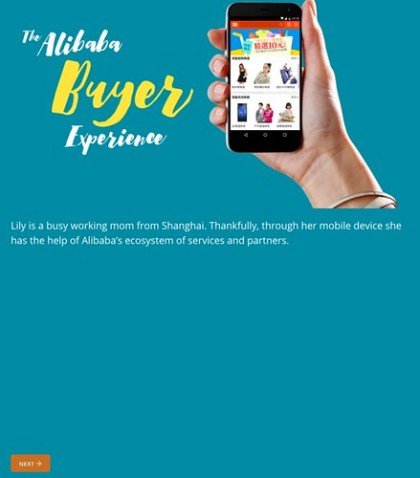
Over 10 pages, Mr Ma’s company explains how they have an app/business that will make life easier and more enjoyable for you.
Unsurprisingly, it focuses almost exclusively around spending money.
I say unsurprisingly because that’s what Jack Ma’s businesses focus on … mainly because he knows that’s what Chinese society focuses on.
It’s a match made in heaven.
Buying products … buying food … buying holidays … buying materials … buying entertainment … buying with others … if you have the desire to spend, one of Mr Ma’s companies will find something that you will like to buy.
Then he has a bunch of apps/businesses that allows you to pay for what you’ve bought, track what you’ve bought and then tell others what you’ve bought to help kick start their spending mania too.
And if he doesn’t get you with any of that, he’s started a film business so one way or another, you’ll be trading with him.
Mind you, if his movies are anything like the storyline he has created in this ‘buyer guide’, Hollywood doesn’t have too much to worry about quite yet. That said, a friend saw a rough draft of the new Bridget Jones Diary script, and from what he told me, there isn’t that much difference between the two.


As much as the West likes to heap praise on people like Jeff Bezos, Jack Ma is in a different league.
Whether it’s the level of success he has achieved, the inventiveness of the businesses he creates, the way he helps millions of people find their own success or the overall adoration he gets from the general public [because on top of everything else, he’s a huge philanthropist] … Alibaba is proof that China is far more innovative than most give it credit for.
It also explains why most advertising in this market is focused on what it can sell today rather than build for tomorrow, which is why there is an attitude in this country of ‘good enough is good enough’, because the belief is if you hesitate, you lose.
But it will change. It has to. The only issue for debate is when and my guess is Jack Ma will know before the rest of us.
This is why this country is such an amazing place to be.
And mental. Most definitely mental.
Filed under: Brilliant Marketing Ideas In History, Chinese Culture, Devious Strategy, Social Media

Today it’s ‘singles day’ in China.
If you haven’t lived here or don’t run a big multinational corporation, you probably haven’t heard of it.
But if you have – or do – I’m pretty certain it’s a day you find very important.
Singles day was originally created by some university students to celebrate ‘being single’.
In a culture that believes and promotes the importance of family, being single was – and still is – something that tends to provoke more questions than support.
It’s even harder if you’re a female.
If you’re not married by 30, you’re labelled ‘left behind’ … a horrible label implying you will be left on the shelf until eternity.
Apart from the fact it’s hurtful and simply not true, the fact that the culture believes you can only be happy if you are with someone before the age of 30 is pretty mad.
But then there’s a lot of madness in this country.
Some is beautiful, some not so much.
Which goes back to singles day.
The university students behind it, didn’t want to feel like they were an embarrassment of society, so they created this day to embrace and celebrate their situation. To be honest, for China – especially in the 90’s – that was a pretty ballsy move.
They chose the 11th of November because it features all the ones … 11.11 … and for years, it was a day embraced by many university students, especially in Nanjing, where it is alleged to have started.
Then in 2009, business got involved.
Seeing an opportunity to exploit the ‘singles day celebration’, they started offering special online deals to entice people to spend.
Now China doesn’t need an excuse to shop and before you knew it, singles day morphed from a day of celebrating singledom with your single mates into the single largest online shopping day in the World.
How large?
Well, last year it generated US$9.3 billion.
Yes, 9.3 billion. In US dollars in 24 hours.
If you think that is impressive, they did US$2 billion in the first hour.
FIRST HOUR!!!
For all the talk in the West of Black Friday and Cyber Monday, nothing compares to the craziness of China’s Singles Day and given the sales in 2009 was only US$8 million [not billion] and only 27 retailers offered discounts, you can see the level of growth that has happened in the space of 6 years and why every CEO of every retail organisation in the World is desperate to get in on the action.
The thing is that the discounts aren’t just on big stuff … it’s on the little things too.
House cleaning goods. Make-up. Batteries.
In fact, far more little things get bought than big.
Not just because there’s more on offer, but because Singles Day has become something where people feel they have to buy something just so they can feel they were part of the madness.
You know when FOMO extends to buying three AA batteries, just so you can say you ‘bagged a bargain’ to your mates, the World – or should I say, China – has gone mad.
But then, as I said, China does mental better than anywhere else in the World.
And that’s why it’s so bloody special.

Over the years, I’ve talked – hypocritically, given my gadget addiction – about societies obsession with technology.
How something that was created to serve us now rules us.
How we are all junkies to the power of the screen …
How we turn to it whenever we find ourselves with a minute of freedom … whenever we feel we are not being stimulated enough in the ‘real World’ … when we want to quieten our kids …
When I was younger, I used to see office workers standing outside their offices, huddled around ashtrays, smoking on their cigarettes. Now, they are huddled around their smartphone … getting their fix through twitter, snapchat or tinder.
There’s a bunch of reasons for why this might be the case.
And no, I’m not talking about cigarettes being a filthy, dangerous habit – even though they are.
I’m talking about issues like social dissatisfaction … unemployment … the need to belong … loss of hope … the cult of celebrity.
Of course technology is also a wonderful thing – it has changed lives and industry in countless positive ways – I’m simply saying we are reaching a point where maybe we are losing sight of the brilliant things we are inadvertently giving up.
What’s frightened me is how Otis – from 5 months old – was captivated by the iPhone/iPad.
For someone who is a tech groupie, I had told Jill that I would rather we keep this stuff away from him – and we did – only for him to see them in the corners of the rooms … blinking at him, tempting him over with pictures and sounds.
The iPhone helped him crawl.
Sadly I’m not joking. He saw it on the end of our bed one day and willed himself to get to it.
The sound of accomplishment he made when he finally got his hands on it will always stay with me … both for good and bad reasons.
The other thing that has blown me away is how quickly he worked out his finger could make things move to his command on the screen.
How did he know this?
We had to develop that skill but for my son, it was natural.
You have to give Apple respect for creating a navigation system that a literal baby can use.
Fortunately he is more interested in the cover of the iPad than the iPad itself – and that’s important to me. Not just because it has been proven that overuse of smart devices actually stunts a child’s development, but because I don’t want him to spend his life with his head pointed down towards a screen, but up towards the wonders of life.
I say all this because I saw a photograph collection where the photographer had taken photos of families using smartphones and then airbrushed them out. By doing this, he highlights our obsession and over-reliance on a device that, for many, is creating a barrier to the World rather than a gateway to it. [See the photo at the top of this post]
Have a look. It’s brilliant and scary all at the same time and it might – just might – make you put whatever device you’re reading this on, down for a while.
[And let’s face it, if my writing hasn’t done that for you already, you have problems]
More info on the background to the project can be seen here.
Filed under: Brilliant Marketing Ideas In History, China, Corporate Evil, Sport, Unexpected Relevance
So when I was at the hospital a few weeks ago for Otis, I saw this …

Yep, it’s a brochure for the spinal specialists at a Shanghai hospital … a brochure that says your golf swing could be radically improved by their medical intervention.
Now on one level, I find this genius.
I really do.
Whereas most people put up with a bad back, they’ve recognised a group of people who won’t. Or at least could be easily convinced not too.
Not because they care about the state of their spine or their overall health … but because they are competitive. And given playing golf in China means you have to have a ton of cash, the hospital know they’re targeting a group of people who are likely to have the money to pay for it.
In some ways, that’s brilliant ‘audience’ targeting. On the other, it’s pretty sad.
Not just because we have a hospital looking to profit from the vain, but that these people value their sporting prowess more than their overall wellbeing.
That said, I still grudgingly respect what these guys have done – especially when I’ve seen so many client briefs over the years, that say they want to target anyone as opposed to being meaningful to someone.
Which all serves as a valuable reminder that the best brands mean everything to someone not something to everyone.
In other words, they focus on the culture of the category, not purely focused on appealing to the potential users of the category.
Filed under: Attitude & Aptitude, Brand Suicide, Comment, Perspective, Planning, Standards
One of the things that blows me away about ad agencies is how many people they many have in them.
Of course, part of this is that every 5-10 years, we invent a new discipline to incorporate.
Planners.
Digital Strategists.
Communication Planners.
Can you see the theme?
Yeah, they’re all bloody planners.
We sit there pontificating about how we add to the work – elevating conversations or connecting to audiences – but what if we ultimately exist just to help our agency bosses pull back some of the fee they’ve lost by selling the value of creativity down the river?
OK, so I don’t think planners are useless [even though I would say that, wouldn’t I] but the fact is, when I look at the amount of people inside an agency, I wonder if the quantity is driven more by the managements focus on creating process [which creates money] or this is what it takes to play in the modern communication World.
I may be cynical, but I think it’s the former.
When we started cynic, we did an incredible amount with just 4 people.
Sure, we farmed a lot out.
Sure, we were reliant on collaborating with other specialists.
But the amount of work we did as a foursome, was easily on par with the output of agencies with 10 times that number of staff.
And in terms of quality – both in terms of idea and execution – we were miles ahead of so many of the agencies, which was reflected in the projects we ended up being given to work on … from helping design airport lounges for Virgin to helping NASA position themselves to get more cash from Congress to building mopeds with Piaggio that were designed around a countries needs rather than just a riders.
But here’s the thing … as we got bigger, we got slower.
We found ourselves allowing processes to impact our creation.
We looked at ‘how to get things out the door’ rather than what will make the biggest difference.
Sure, some of those processes were necessary, sure some were valuable … but some – in fact, a lot of them – were processes that ultimately achieved nothing. Created because we felt that’s what we had to do rather than what was the right thing to do.
I’m ashamed to say it took us a long time to realise the horrible path we were going down, but we ultimately corrected it and while that resulted in us making less money – there’s definitely cash to be made in process – it made us happier and got us back on track developing ideas that made a lasting difference.
I mention all this because I recently read a quote that sort-of sums up the issue cynic went through and the issue facing adland now …
____________________________________________________________________________
“Being a technology company means that a single programmer’s work can boost the company’s profit for years. In a media company, one person’s work gets noticed perhaps for a day, and then vanishes in the stream of fresh news”
____________________________________________________________________________
Interesting eh?
But my point isn’t about tech vs media – though that’s an interesting point in itself – I’m talking about what the quote is really about … empowerment vs process.
When cynic was firing on all cylinders, it was when we empowered our talented people to make decisions and take action.
They would always surprise us and we would develop ideas that were infectious and intriguing in ways we never expected.
Where it went wrong was when we started conversations with ‘the process’ rather than the ambition.
But ironically, process seems to be where a lot of agencies like to play.
Probably because they know – as we discovered – process pays.
Process keeps people in jobs.
Process boosts share price.
Process keeps the wheels turning.
If the truth about planners is they exist for no other reason than to help agencies make more money from clients, then maybe the truth about the modern ad industry is that it exists to simply do the things the clients don’t really want to do.
Or delay the decisions they don’t really want to make.
Now compare that to how the tech industry operate.
They are hungry.
Ambitious.
They believe in their potential and capability.
They empower their people because they know freedom creates opportunity.
Sure, there’s wastage … dead ends … loss of cash …
But their focus on talent, speed and empowerment means they discover it quickly, learn from it, adapt and move on … because their ambition is to find the thing that can create something huge because they know huge means money.
And guess what, the corporate world believe in this too.
They don’t see it as a loss, they see it as an investment.
Adland used to behave like this.
Adland used to think like this.
Clients used to view us like this.
Maybe it’s time we got back to it?