
Filed under: Comment

Some say opinions are like arseholes.
Everyone has them, except some are prettier than others.
That definition could also be directed at advertising.
Everyone has an opinion.
An opinion on what’s wrong with it … what’s right with it … how it could be made better … how it could have been made … you name it, advertising attracts it and debates it.
What’s worse is that as much as the opinions flow like rivers once the things been made, that’s nothing compared to the opinions that are thrown into the mix when you’re trying to actually develop something.
The easy way would be to go with consensus.
Go with what the majority want and make your life easier.
But the problem with the majority is that their decisions are often tainted by all sorts of personal agenda or fear which means success can be impacted before it has even had a chance to prosper.
With this in mind, the ability to distinguish fact from fiction – and do it in a way that clients will understand and accept – is incredibly important and the funny thing is, it’s incredibly easy … at least in theory.
There’s an old adage that perception is reality but it isn’t reality is reality … which is why one of the greatest bits of advice I have ever been given to keep good things happening – rather than let consensus conquer all – is appreciate the difference between subjective and objective.
Now I’m sure you guys already know this, but for me, it’s still unbelievably important – especially when we’re discussing strategies/ideas/creative concepts with clients.
The sad reality these days is that clients are empowered to say ‘no’ rather than yes.
With that in mind, there seems to be this subliminal belief that a brand managers goal is to minimise risk rather than maximise potential.
Don’t get me wrong, no one wants to do something stupidly risky – well, unless strategically it makes sense – but when your starting point is ‘not rock the boat’ rather than ‘drive cultural change’, you can often end up in a situation where you’re bombarded with reasons why NOT to do something rather than things that can push the potential to even greater heights.
So what do you do?
Enter subjective and objective.
Too many times comments are thrown back at you that aren’t exactly true.
I’m not saying people are purposefully lying, but quite often the things they regard as ‘fact’ actually end up being far more subjective than objective.
It could be because they are using old research to form their view or basing it on feedback that comes from an unrelated topic or confusing the context of the situation or ignoring the broader issues that affected their example or simply talking about an ad that worked/failed at a very different time – which is why the key is to never go into a meeting thinking you can handle everything with your smarts, you have to go in prepared … where you know far more about their business than just their marketing and have the information to back it up.
Of course the key to challenging clients opinion is knowing how to do it – something that I admit, I need to improve on – but if you can do it and do it in a way they understand is to drive better work not just satisfy your ego, you might just find you end up making work that pushes culture not just adds to the overall category noise.
Filed under: Comment
I am an early adopter.
Obviously I’m not talking about music or fashion, but technology.
I. LOVE. TECH.
Actually, I should be more precise, I love gadgets.
Robot dogs, rabbits, cats and birds.
Cameras, games systems, phones and televisions.
Computers, lights, guitars and cars.
If it’s got some sort of cool gadget in it, I will either buy it or at least pay to try it.
In short, I am sad.
This addiction [and it is an addiction] has seen me spend untold amounts of cash on upgrades and silliness [robot ball anyone?] but one thing I’ve never done is spend my cash on something that tried to make me change my behaviour without addressing my concerns, especially if it concerns accessing my bank account.
What the fuck am I talking about?
This …
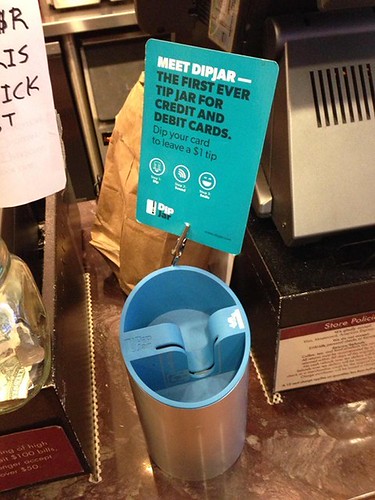
I know companies want us to live in a cashless society …
I know we use internet banking without a second thought …
I know we think nothing of handing our credit card details to shops via the internet or phone …
I know I’ve personally been ripped off by credit card fraud from Tunbridge Wells to Timbuktu …
… but I’ll be fucked if I’m going to use a separate machine to ‘tip’ someone via my debit/credit card.
Why?
Well, it’s not because I’m a tight bastard [though I absolutely LOATHE how some restaurants automatically add a tip to your bill, meaning you have to specifically ask to have it taken off if you don’t agree with it – which I am more than happy to do, let me tell you] it’s because it makes no sense. No sense at all.
If this machine is by a cash register, then I assume you will have purchased something … and if you’ve purchased something, then I’m pretty sure you’d give any tip you want to give directly to the person taking your money.
I very much doubt you’d pay the teller and then shove your card into another machine to hand over a tip – not just because it takes more time, but because you can choose how much you want to pay at the bill is presented to you.
And god-forbid this machine becomes the new ‘charity collection jar’.
I know it might make sense in terms of getting people to hand over cash – given more and more are living via cards, than coins – but sadly, I think this would end up with them obtaining even less money than they do already.
Why?
Because handing over some coins doesn’t have the same emotional concerns or consequences as handing over your card … especially when coins don’t give access to your entire bank account.
The problem with this sort of tech is that it might make sense in ‘theory’ but life doesn’t work like that.
Humans are suspicious, cautious, hypocritical beings – regardless of age – and to get people to embrace a completely new way of behaving needs time, trust, education or incentive and this device, as far as I know, has none of those … which goes to show that while technologists are incredibly smart, some are not very clever.
Filed under: Comment

And if anyone needs another reminder of the value of value – especially those agency heads who regard process as more important than creativity and those clients who think of everything as a cost, rather than as an investment – read this.
Filed under: Comment

Was it something I said?
Was it something I did?
Is it because I’m from Nottingham, like Queen and wear Birkenstocks or has it got more to do with you being nice to hipsters whereas I tend to slag them off?
In some ways I admire your good taste, I really do … but despite all my faults [and I am happy to admit to at least 432 of them] I’m really a quite nice person. Honest.
Even Northern said so and he hates Nottingham, Queen and Birkenstocks.
SO WHY PROFERO, WHY WON’T YOU LET US BE TOGETHER?
Filed under: Comment
For all the talk of openness, adland is actually pretty conservative.
We like putting people into boxes or saying ‘this is how things have to work’ … and while there are some valid reasons for that, from remuneration to the maintenance of standards, the reality is we haven’t really developed our approach to the same extent of other industries.
A lot of that is because despite all the tools, processes and [alleged] propriety tools, adland is still a people-driven business and result of the work – both creatively and effectively – is influenced far more by the people involved in the creative development than the process being adopted.
Now there’s good and bad in that.
Good, because if you have amazing, open-minded people that share beliefs – if not approaches – you stand a good chance that you will be able to keep creating awesome.
Bad, because if you have people who are closed minded and say ‘this is the way that you do things’, you end up creating category parity.
Sadly, there seems more in the bad group than the good.
This is not a case of me dissing people who have a wealth of experience – far from it, we need those people – however if their approach never evolves, never accepts people and society change, never appreciates that if you create work like everyone else it’s actually not doing much for the business, then they’re holding our industry back rather than pushing it forward … something, in my mind, we desperately need to do.
I was very lucky that I started at an agency that liked individual thought.
That doesn’t mean they were like liberal parents and met everything you said/did with applause – it means they were keen to discuss, debate, explore and – when they felt there was some validity to what you were suggesting/saying/contemplating, even if you couldn’t actually prove it – experiment.
For them, they knew that to keep moving things forward meant always inviting alternative opinions into the mix, not just keep the same group of established people in their self-contained bubble, regardless how experienced, smart and successful they were.
In essence they liked – and encouraged – weird to always be in the air, whether that was my suggestion we ask car thieves about what they think makes a car radio desirable [for stealing] to exploring what we could learn from forensic profilers in terms of understanding culture.
No, seriously.
To be honest, I gravitated towards this because quite frankly, this was how I was brought up by my parents.
They made me value knowledge and experience as well as breath of opinion.
I was told ‘freaks are interesting’ … ‘opinions are liberating’ … ‘experimentation is intelligence’.
Of course, I never realised this was different until I ended up working – for a very limited time – at an agency that was the antithesis of that.
Where I was told “that isn’t how we do things here” … “that’s ridiculous” … “you’re being naive” … and while they may well of had a point, it was destructive both professionally and emotionally.
Fortunately I got my own back when 15 years later, I was invited to speak at a conference and was able to say that everything I was talked about was based on what I had believed for over a decade … things that I had been previously criticised and ridiculed for suggesting.
Please don’t think I’m saying I was ahead of my time – far from it – all I’m saying is that some of the things that I now view as insanely important only came about because I was lucky enough to have some people encourage I explore the possibilities rather than have them dismiss it before it had a chance to be explored … which is why I hold those individuals in the highest acclaim possible and why I honestly believe anything I achieve in my career is down to them.
So what am I trying to say?
I suppose that if you’ve ever been told your beliefs and approaches aren’t right, don’t accept it. Sure, you might need to adapt it … sure you might need to evolve it … sure you might even need to change fundamental parts of it, but your weird can be your superpower and you should never forget it.